How to use this calculator
Translate a two-color reflected interferometric phase difference into a principal surface-height estimate with its larger ambiguity interval.
- Enter First vacuum wavelength (nm), Second vacuum wavelength (nm), Wrapped differential phase (radians). Match the units shown beside each field and review the result together with the assumptions below.
- Read the worked example below to check the expected input format and result.
- Compare another scenario by changing one input at a time. Use Reset to return to the starting values.
Two wavelength interferometry synthetic height interval explained
A numerical walkthrough
First vacuum wavelength (nm) = 632.8; Second vacuum wavelength (nm) = 635; Wrapped differential phase (radians) = 1.
- Principal reflective height: 14.534753 µm
- Synthetic wavelength: 182.649091 µm
- Full reflective ambiguity interval: 91.324545 µm
632.8 and 635 nm produce a synthetic wavelength near 182.65 µm, so reflected height repeats over about 91.32 µm.
The model behind the numbers
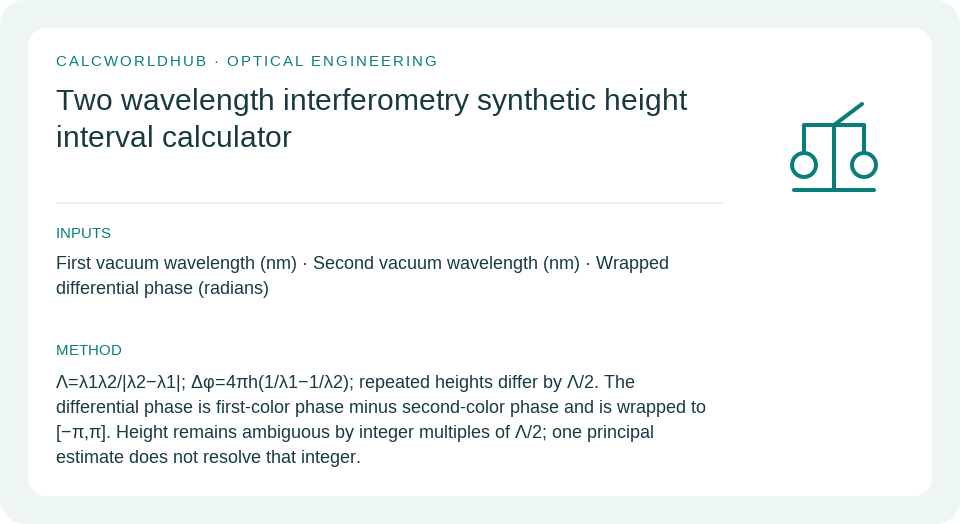
Λ=λ1λ2/|λ2−λ1|; Δφ=4πh(1/λ1−1/λ2); repeated heights differ by Λ/2.
The differential phase is first-color phase minus second-color phase and is wrapped to [−π,π]. Height remains ambiguous by integer multiples of Λ/2; one principal estimate does not resolve that integer.
What to enter
wave1— First vacuum wavelength (nm)- First coherent probe vacuum wavelength.
wave2— Second vacuum wavelength (nm)- Distinct second probe wavelength.
phase— Wrapped differential phase (radians)- Phase at wavelength one minus phase at wavelength two, wrapped into the signed principal interval.
Interpreting the result
Normal incidence, equal geometric path and negligible medium dispersion between colors. Close wavelengths amplify phase noise strongly and still require ambiguity handling.
Reading the outputs
All lengths are µm. The signed principal height lies within half the displayed full ambiguity interval.
Frequently asked questions
Does the synthetic wavelength remove all ambiguity?
No. It increases the repeating interval; an unknown integer interval still remains.
What happens when I exchange the wavelengths?
The differential-phase sign must also reverse to preserve the same height.
Why are very close colors noise sensitive?
Their small inverse-wavelength difference divides the measured phase error by a small number.
How do I use the Two wavelength interferometry synthetic height interval calculator?
Enter First vacuum wavelength (nm), Second vacuum wavelength (nm), Wrapped differential phase (radians). Match the units shown beside each field and review the result together with the assumptions below.
What is a worked example of Two wavelength interferometry synthetic height interval?
First vacuum wavelength (nm) = 632.8; Second vacuum wavelength (nm) = 635; Wrapped differential phase (radians) = 1. Principal reflective height: 14.534753 µm Synthetic wavelength: 182.649091 µm Full reflective ambiguity interval: 91.324545 µm 632.8 and 635 nm produce a synthetic wavelength near 182.65 µm, so reflected height repeats over about 91.32 µm.
Background or definition reference: MIT mirrors interferometers and thin films.
Read our calculation methodology.
The paper defines the synthesized equivalent wavelength and applies it to step-height measurement. Source: Creath, Step height measurement using two-wavelength phase-shifting interferometry.