How to use this calculator
Estimate pure ethanol and U.S. standard drinks from a beverage’s volume and labeled alcohol percentage.
- Enter Beverage volume (mL), Alcohol by volume (ABV, %). Match the units shown beside each field and review the result together with the assumptions below.
- Read the worked example below to check the expected input format and result.
- Compare another scenario by changing one input at a time. Use Reset to return to the starting values.
How this calculation works
A serving size alone does not determine how much alcohol a beverage contains: both liquid volume and alcohol by volume (ABV) matter. This tool estimates ethanol mass from those two measurements and expresses the result in U.S. standard-drink equivalents, which helps compare differently sized or differently concentrated pours.
Inputs and units
volumeMl— Beverage volume (mL)- Enter the liquid volume of one pour or combined beverages at the same ABV.
abv— Alcohol by volume (ABV, %)- Enter the label percentage, for example 5 for a 5% ABV beverage.
Formula
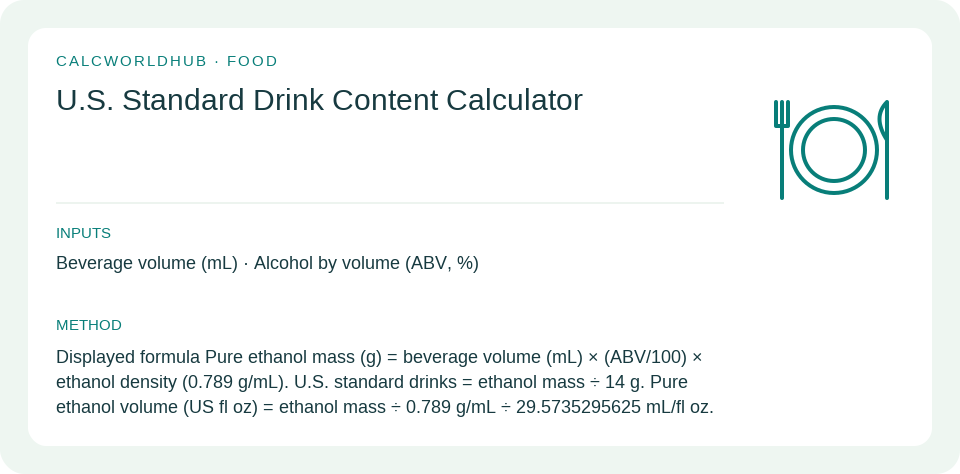
Pure ethanol mass (g) = beverage volume (mL) × (ABV/100) × ethanol density (0.789 g/mL). U.S. standard drinks = ethanol mass ÷ 14 g. Pure ethanol volume (US fl oz) = ethanol mass ÷ 0.789 g/mL ÷ 29.5735295625 mL/fl oz.
Method
Enter the beverage’s total liquid volume in milliliters and its ABV as a percent, such as 5 for 5%. The ethanol-mass estimate uses a density approximation of 0.789 g/mL, then divides by the U.S. 14 g standard-drink definition. The fluid-ounce output converts that ethanol mass back to volume using the same density, then uses the NIST U.S. fluid-ounce conversion.
Worked example
A 355 mL beverage at 5% ABV contains 355 × 0.05 × 0.789 = 14.00475 g of ethanol, or 14.00475 ÷ 14 = 1.00034 U.S. standard drinks. Its ethanol volume is 14.00475 ÷ 0.789 = 17.75 mL, and 17.75 ÷ 29.5735295625 = 0.600 US fl oz.
Assumptions and limits
This reports alcohol content, not a safe amount to drink, impairment level, or health recommendation. The U.S. standard-drink definition differs from other countries. ABV and volume labels may be rounded, and mixed-strength drinks should be calculated by ingredient or measured as a whole if their total ABV is known.
Frequently asked questions
What definition of a standard drink does this use?
The U.S. definition used here is 14 g of pure ethanol. Other countries use different standard-drink definitions.
Why can a large can count as more than one drink?
A container can hold more liquid than a reference serving, and a higher ABV adds more ethanol per milliliter.
Does this estimate tell me whether a drink is safe?
No. It only estimates ethanol content. It does not predict impairment or establish a safe drinking amount.
Can I calculate a cocktail with different spirits?
Use the combined volume and overall ABV only if you know the finished drink’s ABV; otherwise calculate each ingredient separately and add the ethanol amounts.
How do I use the U.S. Standard Drink Content Calculator?
Enter Beverage volume (mL), Alcohol by volume (ABV, %). Match the units shown beside each field and review the result together with the assumptions below.
Reference: NIAAA definition of a U.S. standard drink as 14 grams of pure ethanol. The volume conversion uses NIST’s U.S. fluid-ounce-to-milliliter factor. See our calculation methodology.