Undamped spring-mass natural frequency calculator
Relate linear stiffness and effective moving mass for an ideal single-degree-of-freedom oscillator. Use the mass participating in the mode, which may not equal the whole structure mass.
How to use this calculator
Estimate the natural frequency, angular frequency, and period of a lumped undamped spring-mass oscillator.
- Enter Linear stiffness (N/m), Effective mass (kg). Match the units shown beside each field and review the result together with the assumptions below.
- Read the worked example below to check the expected input format and result.
- Compare another scenario by changing one input at a time. Use Reset to return to the starting values.
Undamped spring-mass natural frequency calculator
Relate linear stiffness and effective moving mass for an ideal single-degree-of-freedom oscillator. Use the mass participating in the mode, which may not equal the whole structure mass.
What it measures
The natural frequency is the oscillation rate predicted after a small displacement and release when stiffness and mass are constant and damping is neglected.
Inputs and units
- Linear stiffness (N/m): Total linear restoring stiffness for the modeled mode, in N/m.
- Effective mass (kg): Effective mass participating in that mode, in kg; it need not be total assembly mass.
Formula and method
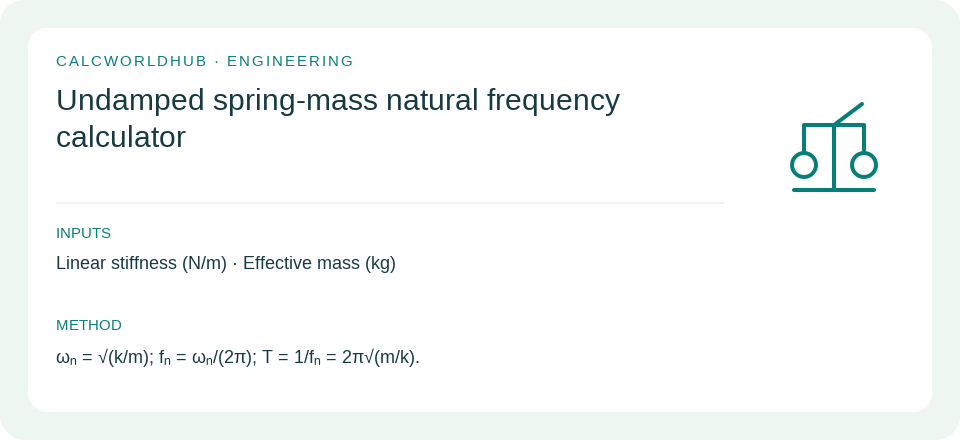
ωₙ = √(k/m); fₙ = ωₙ/(2π); T = 1/fₙ = 2π√(m/k).
Worked example
For k = 18,000 N/m and m = 45 kg, ωₙ = 20 rad/s, fₙ = 3.1831 Hz, and T = 0.3142 s.
Interpreting the result
Increasing stiffness raises frequency; increasing effective mass lowers it. The period is the time for one ideal cycle.
Assumptions and limits
The model assumes linear stiffness, a lumped mass, small oscillations, and no damping. Distributed structures have mode shapes and modal masses; measured damped frequencies can differ.
Sources and method
- Lists ω=√(k/m), f=(1/2π)√(k/m), and T=2π√(m/k) for an ideal mass-spring oscillator. OpenStax University Physics Volume 1: Key equations for simple harmonic motion
Frequently asked questions
Should I use the full machine mass?
Use the effective mass that moves in the modeled mode; a distributed structure may require modal analysis.
Does damping affect this result?
Damping is omitted; the displayed value is the undamped natural frequency.
How do I use the Undamped spring-mass natural frequency calculator?
Enter Linear stiffness (N/m), Effective mass (kg). Match the units shown beside each field and review the result together with the assumptions below.
What is a worked example of Undamped spring-mass natural frequency?
For k = 18,000 N/m and m = 45 kg, ωₙ = 20 rad/s, fₙ = 3.1831 Hz, and T = 0.3142 s.
What does the Undamped spring-mass natural frequency calculator calculate?
Estimate the natural frequency, angular frequency, and period of a lumped undamped spring-mass oscillator.
See the calculation methodology.