How to use this calculator
Convert a cleaned metal coupon’s measured mass loss into an estimated uniform penetration rate.
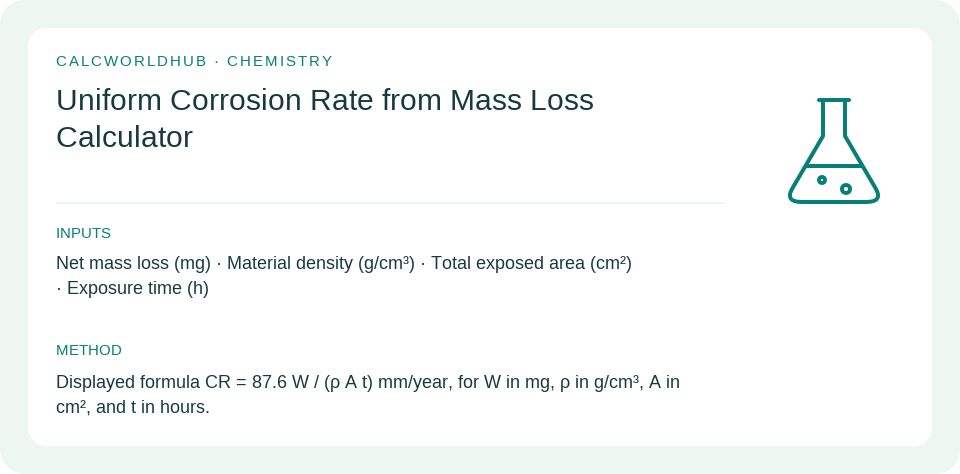
- Enter Net mass loss (mg), Material density (g/cm³), Total exposed area (cm²), Exposure time (h). Match the units shown beside each field and review the result together with the assumptions below.
- Read the worked example below to check the expected input format and result.
- Compare another scenario by changing one input at a time. Use Reset to return to the starting values.
How this calculation works
The gravimetric corrosion method normalizes cleaned specimen mass loss by exposed area, material density, and immersion time. With mass in milligrams, area in square centimetres, density in grams per cubic centimetre, and time in hours, the conversion constant 87.6 gives millimetres per year.
Inputs and units
massLossMg— Net mass loss (mg)- Coupon mass decrease after cleaning and correction for the cleaning procedure.
densityGcm3— Material density (g/cm³)- Density of the tested metal or alloy.
exposedAreaCm2— Total exposed area (cm²)- All specimen faces exposed to the test solution.
exposureHours— Exposure time (h)- Elapsed immersion time represented by the measured mass loss.
Formula
CR = 87.6 W / (ρ A t) mm/year, for W in mg, ρ in g/cm³, A in cm², and t in hours.
Method
Enter net mass loss after the specified cleaning procedure, material density, total exposed coupon area, and exposure time. The calculator reports uniform penetration in mm/year and mils per year.
Worked example
A 50 mg loss from a 7.85 g/cm³ coupon with 20 cm² exposed area after 720 h corresponds to 0.03875 mm/year, about 1.5255 mils/year.
Assumptions and limits
This is an average mass-loss penetration rate. It does not describe local pitting depth, crevice attack, erosion-corrosion, or future service life. Use the full wetted area and an applicable corrosion-test cleaning and weighing protocol; cleaning-related metal loss can bias the result.
Frequently asked questions
What is the 87.6 constant?
It converts milligrams, grams per cubic centimetre, square centimetres, and hours into millimetres per year.
Does this predict pitting?
No. It is an average uniform penetration estimate; local attack can be much deeper.
How should coupon mass loss be measured?
Follow a consistent specimen preparation, cleaning, blank correction, and weighing procedure from the applicable test method.
How do I use the Uniform Corrosion Rate from Mass Loss Calculator?
Enter Net mass loss (mg), Material density (g/cm³), Total exposed area (cm²), Exposure time (h). Match the units shown beside each field and review the result together with the assumptions below.
What is a worked example of Uniform Corrosion Rate from Mass Loss?
A 50 mg loss from a 7.85 g/cm³ coupon with 20 cm² exposed area after 720 h corresponds to 0.03875 mm/year, about 1.5255 mils/year.
Reference: Peer-reviewed mass-loss corrosion study using ASTM G31 methodology. See our calculation methodology.