How to use this calculator
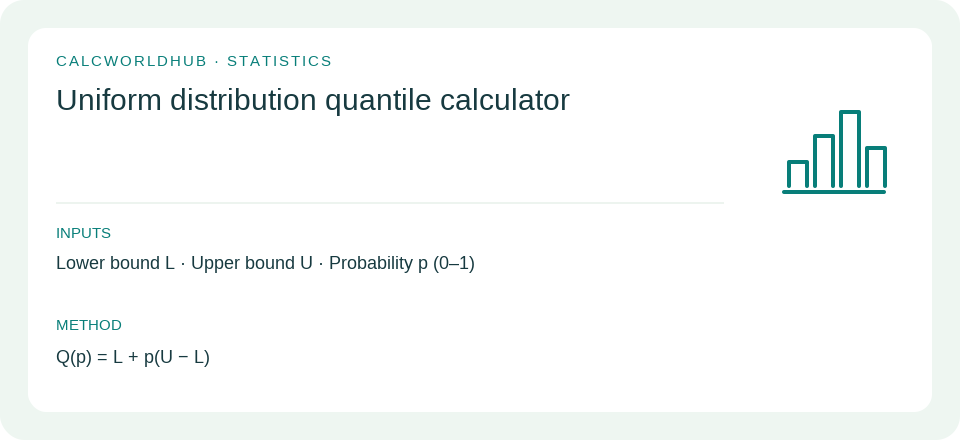
Calculate a percentile for a continuous uniform distribution between lower and upper bounds.
- Enter Lower bound L, Upper bound U, Probability p (0–1). Match the units shown beside each field and review the result together with the assumptions below.
- Read the worked example below to check the expected input format and result.
- Compare another scenario by changing one input at a time. Use Reset to return to the starting values.
How Uniform distribution quantile calculator works
Calculate a percentile for a continuous uniform distribution between lower and upper bounds.
Inputs and units
- Lower bound L: Enter the finite lower endpoint L.
- Upper bound U: Enter a finite upper endpoint U greater than L.
- Probability p (0–1): Enter the cumulative probability p from 0 through 1, inclusive.
Formula and method
Q(p) = L + p(U − L)
Worked example
For L = 0, U = 10, and p = 0.5, Q = 0 + 0.5(10−0) = 5.
Interpreting the result
The result is the point with probability p to its left under the uniform model. Because density is constant, percentiles divide the interval in the same proportion.
Assumptions and limits
This assumes every value within [L,U] is equally likely and values outside it are impossible. It is a continuous model, so an endpoint percentile is a model boundary rather than a point mass.
Frequently asked questions
Why is the median halfway between the bounds?
A continuous uniform distribution has constant density, so p = 0.5 gives the midpoint.
Can p be exactly 0 or 1?
Yes. Those valid endpoints return L and U, respectively.
How do I use the Uniform distribution quantile calculator?
Enter Lower bound L, Upper bound U, Probability p (0–1). Match the units shown beside each field and review the result together with the assumptions below.
What is a worked example of Uniform distribution quantile?
For L = 0, U = 10, and p = 0.5, Q = 0 + 0.5(10−0) = 5.
What does the Uniform distribution quantile calculator calculate?
Calculate a percentile for a continuous uniform distribution between lower and upper bounds.