Unit converter
Convert a value between compatible length, weight, US customary volume, or temperature units.
inputs.
Calculator
How to use this calculator
Convert length, weight, US customary volume, and temperature values between compatible units.
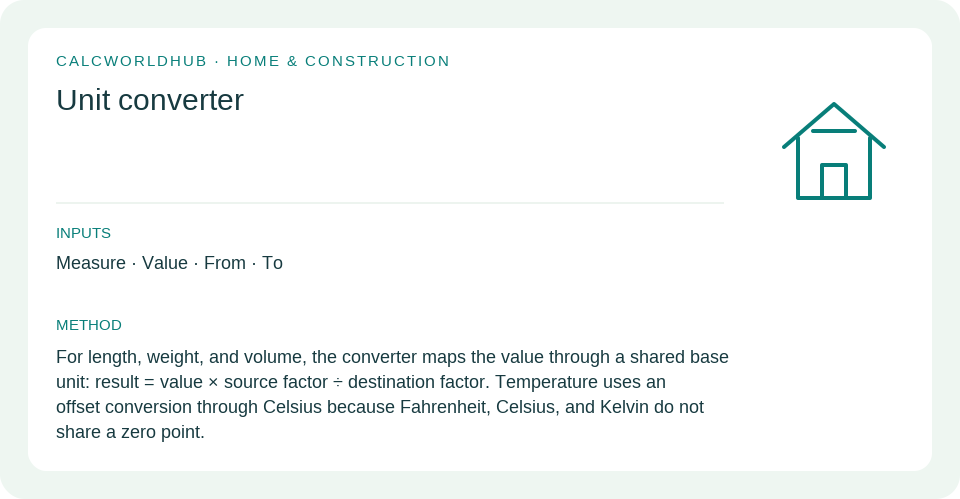
- Enter Measure, Value, From, To. Match the units shown beside each field and review the result together with the assumptions below.
- Read the worked example below to check the expected input format and result.
- Compare another scenario by changing one input at a time. Use Reset to return to the starting values.
Convert a measurement into a matching unit
Choose a measurement type, enter a value, and select its source and destination units. The tool converts length, weight, US customary volume, or temperature without changing the underlying quantity.
Inputs and units
- Measure: Select length, weight, volume, or temperature before choosing the units.
- Value: The numeric amount in the source unit.
- From: The unit the entered value currently uses.
- To: The unit for the converted result; the available choices follow the selected measure.
Formula and method
For length, weight, and volume, the converter maps the value through a shared base unit: result = value × source factor ÷ destination factor. Temperature uses an offset conversion through Celsius because Fahrenheit, Celsius, and Kelvin do not share a zero point.
Worked example
For 10 feet to meters, first convert to inches: 10 × 12 = 120 in. Since 1 m = 39.3700787 in, 120 ÷ 39.3700787 = 3.048 m. The converter displays 10 Feet = 3.048 Meters.
Interpreting the result
The result expresses the same measurement in the destination unit. Check that both choices describe the same physical quantity; a length value cannot be converted into a temperature.
Assumptions and limits
Volume choices use US customary units. Weight choices are mass units, not pound-force. Use consistent unit definitions when a project or instrument specifies a particular standard.
Method references
Frequently asked questions
Why is temperature converted differently?
A temperature scale has both a unit size and a zero offset. Fahrenheit-to-Celsius conversion subtracts 32 before multiplying by 5/9; a simple ratio is not enough.
How do I use the Unit converter?
Enter Measure, Value, From, To. Match the units shown beside each field and review the result together with the assumptions below.
What is a worked example of Unit converter?
For 10 feet to meters, first convert to inches: 10 × 12 = 120 in. Since 1 m = 39.3700787 in, 120 ÷ 39.3700787 = 3.048 m. The converter displays 10 Feet = 3.048 Meters.
What does the Unit converter calculate?
Convert length, weight, US customary volume, and temperature values between compatible units.
What assumptions apply to Unit converter?
Volume choices use US customary units. Weight choices are mass units, not pound-force. Use consistent unit definitions when a project or instrument specifies a particular standard.
Good calculators show their work.
CalcWorldHub is built around clear inputs and visible assumptions. Results are estimates for planning; check official sources or your provider’s terms when exact figures matter.