How to use this calculator
Compare two package prices using normalized cost per gram, milliliter, or item, even when package units differ.
- Enter Item A package price ($), Item A package amount, Item A amount unit, Item B package price ($), then complete the remaining labeled fields. Match the units shown beside each field and review the result together with the assumptions below.
- Read the worked example below to check the expected input format and result.
- Compare another scenario by changing one input at a time. Use Reset to return to the starting values.
How this calculation works
Shelf prices can hide the better value when package sizes or printed units differ. Enter both prices and quantities; the calculator normalizes compatible mass, volume, or item-count units before comparing cost per base unit.
Inputs and units
priceA— Item A package price ($)- Shelf price for the first item; enter the same currency for both.
amountA— Item A package amount- Quantity printed on the first package.
unitA— Item A amount unit- Select the package unit.
priceB— Item B package price ($)- Shelf price for the second item.
amountB— Item B package amount- Quantity printed on the second package.
unitB— Item B amount unit- Select the package unit.
Formula
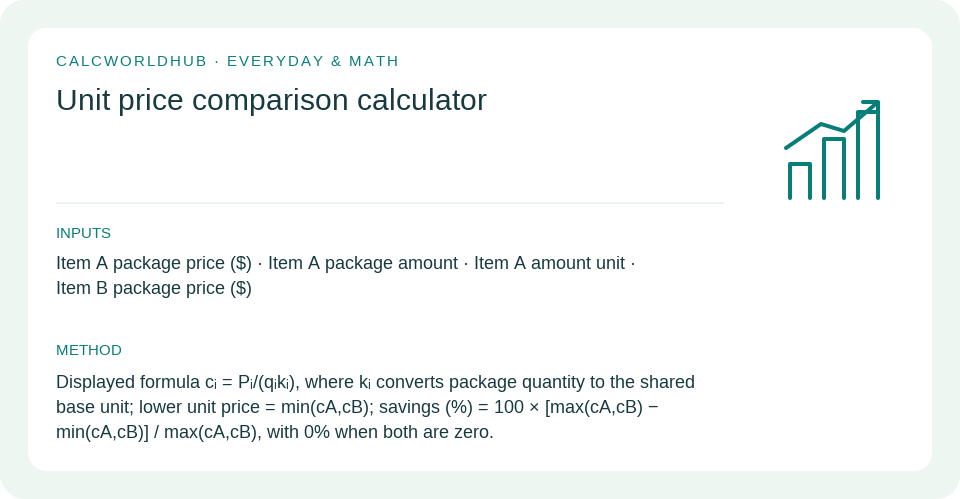
cᵢ = Pᵢ/(qᵢkᵢ), where kᵢ converts package quantity to the shared base unit; lower unit price = min(cA,cB); savings (%) = 100 × [max(cA,cB) − min(cA,cB)] / max(cA,cB), with 0% when both are zero.
Method
Mass converts to grams, volume to milliliters, and item counts remain eaches. The smaller normalized unit cost is the lower-price option. Savings are measured relative to the higher unit cost; a zero-versus-zero tie is reported as 0% savings.
Worked example
A $4.50 package of 12 oz costs about $0.01323 per gram. A $7.00 package of 250 g costs $0.02800 per gram, so Item A is the lower unit-price option.
Assumptions and limits
This compares price per compatible quantity, not product quality, usable yield, or total value. Mass cannot be compared with volume without product density. Coupons, taxes, spoilage, and package disposal are excluded.
Frequently asked questions
Can I compare grams with ounces?
Yes. Both are mass units, so the calculator converts each package amount to grams before comparing.
Can I compare liters with kilograms?
No. That would require the product’s density; mass and volume are not directly interchangeable.
Does this include discounts?
Enter the final package price you expect to pay, including any discount you can actually use.
How do I use the Unit price comparison calculator?
Enter Item A package price ($), Item A package amount, Item A amount unit, Item B package price ($), then complete the remaining labeled fields. Match the units shown beside each field and review the result together with the assumptions below.
What is a worked example of Unit price comparison?
A $4.50 package of 12 oz costs about $0.01323 per gram. A $7.00 package of 250 g costs $0.02800 per gram, so Item A is the lower unit-price option.
Reference: Penn State Extension guidance on comparing cost per unit. See our calculation methodology.