How to use this calculator
Estimate new users generated per existing user from invitations sent and invite conversion.
- Enter Invitations per user, Invite conversion (%). Match the units shown beside each field and review the result together with the assumptions below.
- Read the worked example below to check the expected input format and result.
- Compare another scenario by changing one input at a time. Use Reset to return to the starting values.
How this calculation works
A simple viral coefficient summarizes one referral loop: invitations sent per active user multiplied by the fraction of invitees who become new users. It is a compact estimate based on the entered average inputs.
Inputs and units
invitesPerUser— Invitations per user- Average number of invitations sent by one existing user during the selected period.
conversionPercent— Invite conversion (%)- Percentage of invitations that result in a new user.
Formula
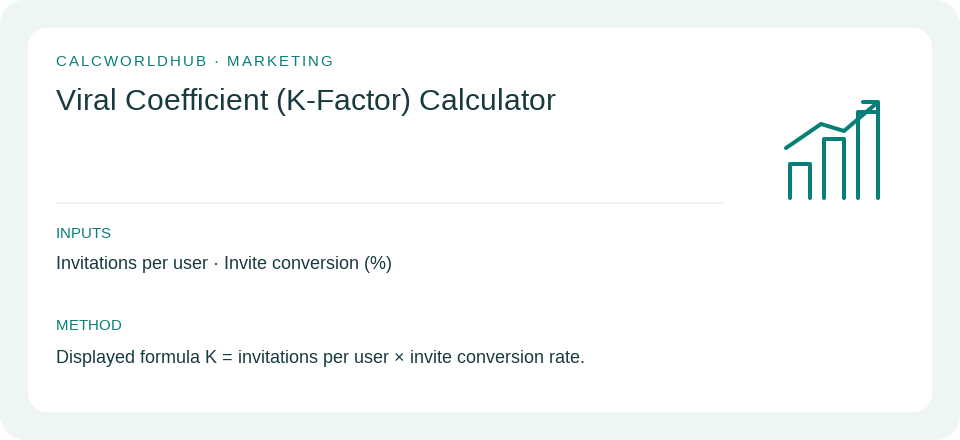
K = invitations per user × invite conversion rate.
Method
Enter invitations sent per user over the chosen period and the percentage of those invitations that convert into new users. The product estimates referred new users per existing user for that loop.
Worked example
If each user sends 5 invitations and 20% convert, the viral coefficient is 1.00 referred new user per existing user for that loop.
Assumptions and limits
K is a simplified cohort metric and does not include timing, repeated invitations, retention, acquisition costs, channel overlap, or organic growth. A value near or above 1 does not by itself prove sustained growth; measurement windows and denominator definitions matter.
Frequently asked questions
What does K = 1 mean?
Under the entered simple-loop assumptions, each existing user generates one referred new user on average during the chosen period.
Does K measure total growth?
No. It summarizes referral acquisition and excludes retention, paid acquisition, timing, and other growth sources.
What should count as a conversion?
Use a consistent event such as a verified signup or activated account, and define the same attribution window for invitations and conversions.
How do I use the Viral Coefficient (K-Factor) Calculator?
Enter Invitations per user, Invite conversion (%). Match the units shown beside each field and review the result together with the assumptions below.
What is a worked example of Viral Coefficient (K-Factor)?
If each user sends 5 invitations and 20% convert, the viral coefficient is 1.00 referred new user per existing user for that loop.
Reference: Andrew Chen analysis of invitations per user and invite conversion in a viral loop. See our calculation methodology.