Voltage divider calculator
Find the ideal output voltage across the lower resistor in a two-resistor series divider.
Calculator
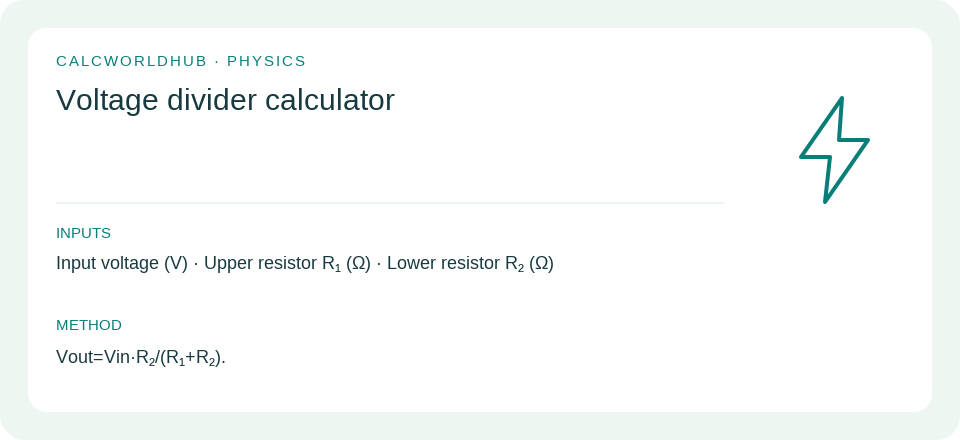
How to use this calculator
Find the ideal output voltage across the lower resistor in a two-resistor series divider.
- Enter Input voltage (V), Upper resistor R₁ (Ω), Lower resistor R₂ (Ω). Match the units shown beside each field and review the result together with the assumptions below.
- Read the worked example below to check the expected input format and result.
- Compare another scenario by changing one input at a time. Use Reset to return to the starting values.
Voltage divider calculator
Find the ideal output voltage across the lower resistor in a two-resistor series divider.
What it measures
The source voltage divides in proportion to resistance. The output is measured across R₂, the lower resistor connected to the reference node.
Inputs and units
- Input voltage (V): Input/source voltage in volts; its sign sets the output polarity.
- Upper resistor R₁ (Ω): Upper series resistance between source and output node; positive.
- Lower resistor R₂ (Ω): Lower resistance from output node to reference; positive.
Formula and method
Vout=Vin·R₂/(R₁+R₂).
Worked example
With 12 V, R₁=10 kΩ, and R₂=5 kΩ, Vout=12×5/(10+5)=4 V.
Interpreting the result
The divider ratio is 1/3 in this example. A load connected at the output can draw current and change the actual voltage.
Assumptions and limits
Assumes an ideal source and negligible output loading. Check resistor power ratings and source limits in a real circuit.
Frequently asked questions
Where is Vout measured?
Across the lower resistor R₂, relative to the reference node.
Will the same ratio hold under load?
Only approximately; a load in parallel with R₂ changes the effective lower resistance.
How do I use the Voltage divider calculator?
Enter Input voltage (V), Upper resistor R₁ (Ω), Lower resistor R₂ (Ω). Match the units shown beside each field and review the result together with the assumptions below.
What is a worked example of Voltage divider?
With 12 V, R₁=10 kΩ, and R₂=5 kΩ, Vout=12×5/(10+5)=4 V.
What does the Voltage divider calculator calculate?
Find the ideal output voltage across the lower resistor in a two-resistor series divider.
See the calculation methodology.
Good calculators show their work.
CalcWorldHub is built around clear inputs and visible assumptions. Results are estimates for planning; check official sources or your provider’s terms when exact figures matter.