Waste avoided mass calculator
Compare a positive baseline mass with the new mass for the same waste stream and reporting period.
Calculator
How to use this calculator
Compare a positive baseline mass with the new mass for the same waste stream and reporting period.
- Enter Baseline waste (kg), New waste (kg). Match the units shown beside each field and review the result together with the assumptions below.
- Read the worked example below to check the expected input format and result.
- Compare another scenario by changing one input at a time. Use Reset to return to the starting values.
Waste avoided mass calculator
Compare a positive baseline mass with the new mass for the same waste stream and reporting period.
What it measures
The signed difference shows whether mass decreased or increased; the percentage uses the baseline as its denominator.
Inputs and units
- Baseline waste (kg): Baseline mass for the defined stream and period; it must be positive.
- New waste (kg): New-period mass on the same measurement basis; a value above baseline correctly produces a negative change.
Formula and method
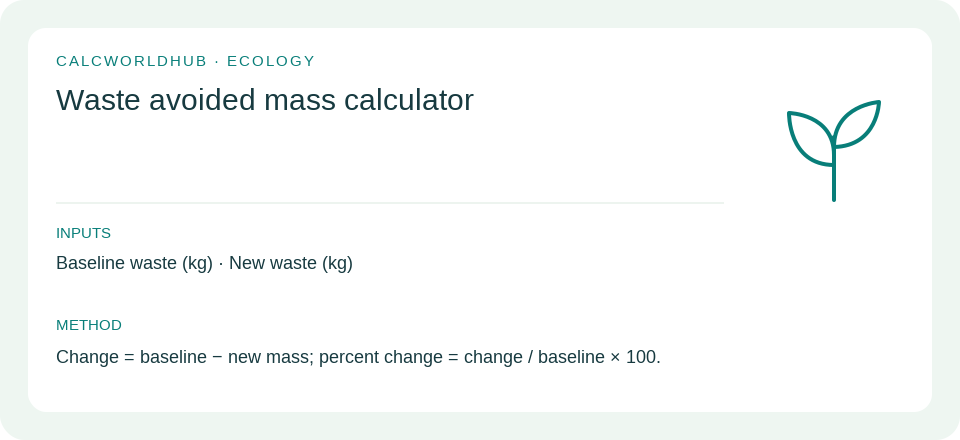
Change = baseline − new mass; percent change = change / baseline × 100.
Worked example
500 kg − 350 kg = 150 kg lower; 150 / 500 × 100 = 30%.
Interpreting the result
A positive change means less material was generated; a negative change means the new mass is higher than baseline.
Assumptions and limits
Compare the same material boundary, units, and time window. The result alone does not establish the cause or environmental impact of the change.
Frequently asked questions
Can the result be negative?
Yes. It means measured waste increased from baseline.
Does this prove the project caused the change?
No. It is a before-and-after comparison, not causal attribution.
How do I use the Waste avoided mass calculator?
Enter Baseline waste (kg), New waste (kg). Match the units shown beside each field and review the result together with the assumptions below.
What is a worked example of Waste avoided mass?
500 kg − 350 kg = 150 kg lower; 150 / 500 × 100 = 30%.
What does the Waste avoided mass calculator calculate?
Compare a positive baseline mass with the new mass for the same waste stream and reporting period.
See the calculation methodology.
Good calculators show their work.
CalcWorldHub is built around clear inputs and visible assumptions. Results are estimates for planning; check official sources or your provider’s terms when exact figures matter.