Weak acid pH calculator
Estimate pH from a monoprotic weak acid’s Ka and starting concentration without assuming ionization is negligible. Enter your values below to see the result and method.
inputs.
Related calculators
How to use this calculator
Estimate pH from a monoprotic weak acid’s Ka and starting concentration without assuming ionization is negligible.
- Enter Acid dissociation constant Ka, Initial acid concentration (mol/L). Match the units shown beside each field and review the result together with the assumptions below.
- Read the worked example below to check the expected input format and result.
- Compare another scenario by changing one input at a time. Use Reset to return to the starting values.
Set the chemical conditions and units
Estimate pH from a monoprotic weak acid’s Ka and starting concentration without assuming ionization is negligible.
Inputs and units
- Acid dissociation constant Ka:Equilibrium dissociation constant for the monoprotic acid in the concentration convention used by the model.
- Initial acid concentration (mol/L):Starting analytical concentration before dissociation, in mol/L.
Equation and worked example
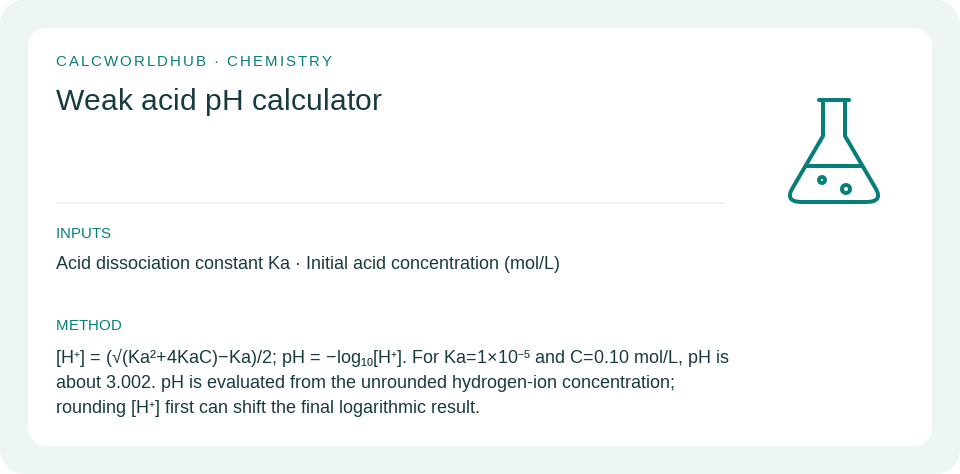
[H⁺] = (√(Ka²+4KaC)−Ka)/2; pH = −log₁₀[H⁺].
For Ka=1×10⁻⁵ and C=0.10 mol/L, pH is about 3.002.
pH is evaluated from the unrounded hydrogen-ion concentration; rounding [H⁺] first can shift the final logarithmic result.
Using the result
The pH follows from the modeled equilibrium [H⁺]. Activity effects and water autoionization are neglected, so concentrated or unusual solutions may need a fuller equilibrium model.
Assumptions and limitations
Uses the quadratic equilibrium solution for a monoprotic weak acid; neglects activity coefficients and water autoionization.
Source and method
The equilibrium treatment solves the weak-acid concentration change rather than assuming it is negligible. OpenStax Chemistry 2e — Relative Strengths of Acids and Bases.
Frequently asked questions
Why does this pH method solve a quadratic?
It solves the weak-acid equilibrium without assuming the ionized amount is negligible relative to the starting concentration; that approximation can be inaccurate when ionization is appreciable.
Which solution conditions does this pH estimate assume?
It models one monoprotic weak acid in an ideal dilute solution and neglects activity-coefficient effects and water autoionization.
When should I use the equilibrium concentration result instead?
Use the concentration tool when you need [H⁺] for a later calculation. This page reports pH = −log₁₀[H⁺] from the same quadratic equilibrium model.
How do I use the Weak acid pH calculator?
Enter Acid dissociation constant Ka, Initial acid concentration (mol/L). Match the units shown beside each field and review the result together with the assumptions below.
What is a worked example of Weak acid pH?
[H⁺] = (√(Ka²+4KaC)−Ka)/2; pH = −log₁₀[H⁺]. For Ka=1×10⁻⁵ and C=0.10 mol/L, pH is about 3.002. pH is evaluated from the unrounded hydrogen-ion concentration; rounding [H⁺] first can shift the final logarithmic result.
Read the calculation methodology and privacy policy.