How to use this calculator
Estimate Weibull survival probability at a chosen time from the scale and shape parameters, with the complementary failure probability shown.
- Enter Time t, Scale η, Shape β. Match the units shown beside each field and review the result together with the assumptions below.
- Read the worked example below to check the expected input format and result.
- Compare another scenario by changing one input at a time. Use Reset to return to the starting values.
Translate a Weibull lifetime model into survival probability
This page evaluates the Weibull survival function at one chosen time. The scale η sets the characteristic time; the shape β determines how the modeled failure hazard changes over time.
Inputs and units
- Time t: The elapsed lifetime being evaluated, in the same time unit as η; zero is a valid starting point.
- Scale η: A positive characteristic-life parameter in the chosen time unit.
- Shape β: A positive shape parameter; values below, equal to, or above 1 imply decreasing, constant, or increasing hazard in this model.
Formula and method
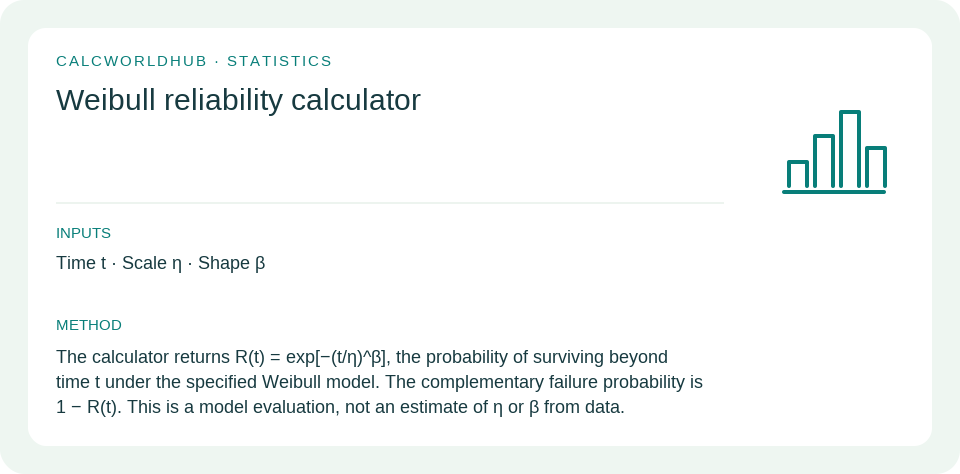
The calculator returns R(t) = exp[−(t/η)^β], the probability of surviving beyond time t under the specified Weibull model. The complementary failure probability is 1 − R(t). This is a model evaluation, not an estimate of η or β from data.
Worked example
With t = 10 hours, η = 10 hours, and β = 2, the ratio t/η is 1, so R(10) = exp(−1) = 0.3678794412. The complementary modeled failure probability by 10 hours is 1 − 0.3678794412 = 0.6321205588.
Interpreting the result
Under these parameters, about 36.8% of the modeled population survives past 10 hours. The number does not establish that a real product follows a Weibull distribution; fit and validate the model using appropriate lifetime data before using it for reliability decisions.
Assumptions and limits
Time units must match. β and η should come from a justified model fit or engineering specification. This calculator does not account for competing failure modes, repairs, changing operating conditions, or parameter uncertainty.
Method references
Frequently asked questions
What does the Weibull shape parameter change?
For the standard two-parameter Weibull lifetime model, β < 1 corresponds to a decreasing hazard, β = 1 to a constant hazard, and β > 1 to an increasing hazard over time.
How do I use the Weibull reliability calculator?
Enter Time t, Scale η, Shape β. Match the units shown beside each field and review the result together with the assumptions below.
What is a worked example of Weibull reliability?
With t = 10 hours, η = 10 hours, and β = 2, the ratio t/η is 1, so R(10) = exp(−1) = 0.3678794412. The complementary modeled failure probability by 10 hours is 1 − 0.3678794412 = 0.6321205588.
What does the Weibull reliability calculator calculate?
Estimate Weibull survival probability at a chosen time from the scale and shape parameters, with the complementary failure probability shown.
What assumptions apply to Weibull reliability?
Time units must match. β and η should come from a justified model fit or engineering specification. This calculator does not account for competing failure modes, repairs, changing operating conditions, or parameter uncertainty.