Weighted average cost of capital calculator
Combine equity and debt costs using their shares of total market-value capital. This simplified estimate is useful only when the chosen rate matches the risk and currency of the cash flows being discounted.
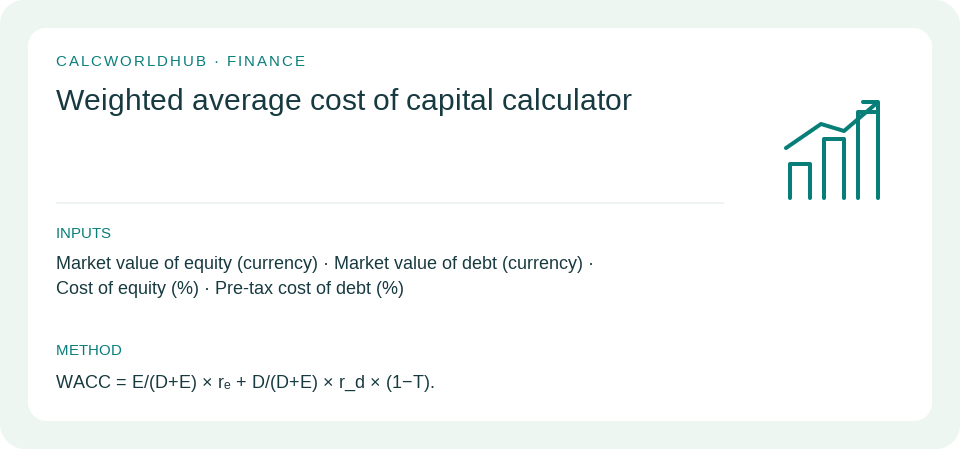
How to use this calculator
Estimate WACC from market-value equity and debt, required returns, and an entered corporate tax rate.
- Enter Market value of equity (currency), Market value of debt (currency), Cost of equity (%), Pre-tax cost of debt (%), then complete the remaining labeled fields. Match the units shown beside each field and review the result together with the assumptions below.
- Read the worked example below to check the expected input format and result.
- Compare another scenario by changing one input at a time. Use Reset to return to the starting values.
Weighted average cost of capital calculator
Combine equity and debt costs using their shares of total market-value capital. This simplified estimate is useful only when the chosen rate matches the risk and currency of the cash flows being discounted.
What it measures
WACC is a weighted financing cost: equity receives its market-value weight, while debt cost is adjusted for the entered tax shield.
Inputs and units
- Market value of equity (currency): Market value of equity in the same currency basis as debt.
- Market value of debt (currency): Market value of interest-bearing debt included in the capital mix.
- Cost of equity (%): Required return on equity as a percent.
- Pre-tax cost of debt (%): Pre-tax cost of debt as a percent.
- Corporate tax rate (%): Tax rate used for the debt tax shield, as a percent.
Formula and method
WACC = E/(D+E) × rₑ + D/(D+E) × r_d × (1−T).
Worked example
With E = $8m, D = $2m, rₑ = 11%, r_d = 6%, and T = 25%, WACC = 0.8×11% + 0.2×6%×0.75 = 9.70%.
Interpreting the result
The result is a percentage rate. A larger equity weight shifts the result toward cost of equity; the tax adjustment reduces the debt component in this model.
Assumptions and limits
This two-source model omits preferred equity, fees, changing leverage, tax-loss limits, and risk differences. WACC is not automatically the right rate for every project; align cash-flow risk, currency, and nominal/real basis.
Sources and method
- Shows WACC weighted by market values of debt and equity and applies the after-tax debt cost. CFA Institute: Free cash flow valuation
Frequently asked questions
Why use market values rather than book values?
The formula weights capital using the current market-value mix, rather than historical accounting balances.
Does WACC suit every investment?
No. Use a rate consistent with the investment’s risk, currency, and cash-flow basis.
How is debt tax-adjusted?
The model multiplies the pre-tax debt rate by one minus the entered tax rate.
How do I use the Weighted average cost of capital calculator?
Enter Market value of equity (currency), Market value of debt (currency), Cost of equity (%), Pre-tax cost of debt (%), then complete the remaining labeled fields. Match the units shown beside each field and review the result together with the assumptions below.
What is a worked example of Weighted average cost of capital?
With E = $8m, D = $2m, rₑ = 11%, r_d = 6%, and T = 25%, WACC = 0.8×11% + 0.2×6%×0.75 = 9.70%.
See the calculation methodology.