How to use this calculator
Estimate sample spread after capping observations at interpolated lower and upper tail cutoffs.
- Enter Observations, comma-separated, Tail fraction each side (0–0.25). Match the units shown beside each field and review the result together with the assumptions below.
- Read the worked example below to check the expected input format and result.
- Compare another scenario by changing one input at a time. Use Reset to return to the starting values.
How Winsorized standard deviation calculator works
Estimate sample spread after capping observations at interpolated lower and upper tail cutoffs.
Inputs and units
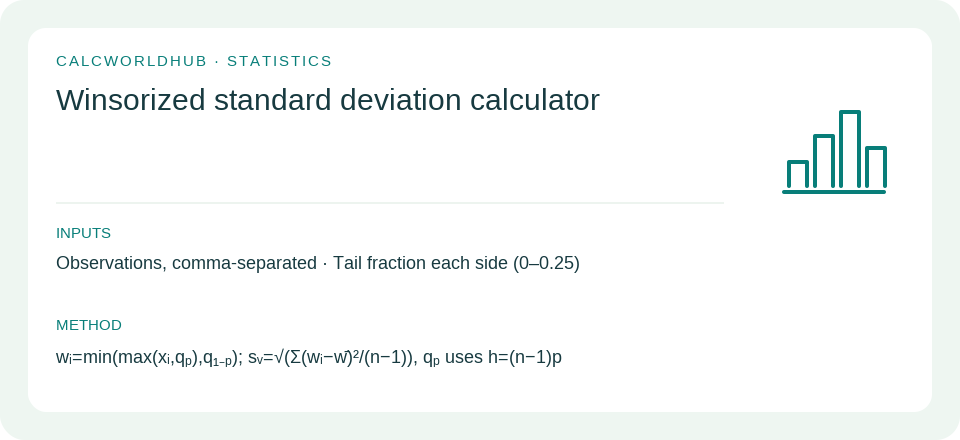
- Observations, comma-separated: Comma-separated observed values to sort before winsorizing.
- Tail fraction each side (0–0.25): Tail fraction p applied independently to each side, from 0 to 0.25; 0 leaves values unchanged.
Formula and method
wᵢ=min(max(xᵢ,qₚ),q₁₋ₚ); sᵥ=√(Σ(wᵢ−w̄)²/(n−1)), qₚ uses h=(n−1)p
Worked example
For 4,7,7,10,12 at p=0.10, linear cutoffs are 5.2 and 11.2; capping gives 5.2,7,7,10,11.2 and sample SD≈2.45194.
Interpreting the result
The result is the sample standard deviation after tail values are replaced by the corresponding cutoff. It is less affected by extreme observations, but it describes altered data.
Assumptions and limits
At least two observations are required and p must be from 0 to 0.25 per tail. This implementation uses linearly interpolated inclusive quantiles with h=(n−1)p and the sample n−1 denominator; other quantile conventions can differ.
Frequently asked questions
Does winsorizing remove observations?
No. It replaces tail values with cutoff values, keeping the sample size unchanged.
Why specify the quantile convention?
Different interpolation rules can produce different cutoffs, especially in small samples.
How do I use the Winsorized standard deviation calculator?
Enter Observations, comma-separated, Tail fraction each side (0–0.25). Match the units shown beside each field and review the result together with the assumptions below.
What is a worked example of Winsorized standard deviation?
For 4,7,7,10,12 at p=0.10, linear cutoffs are 5.2 and 11.2; capping gives 5.2,7,7,10,11.2 and sample SD≈2.45194.
What does the Winsorized standard deviation calculator calculate?
Estimate sample spread after capping observations at interpolated lower and upper tail cutoffs.