
Distinguish apparent and absolute magnitude
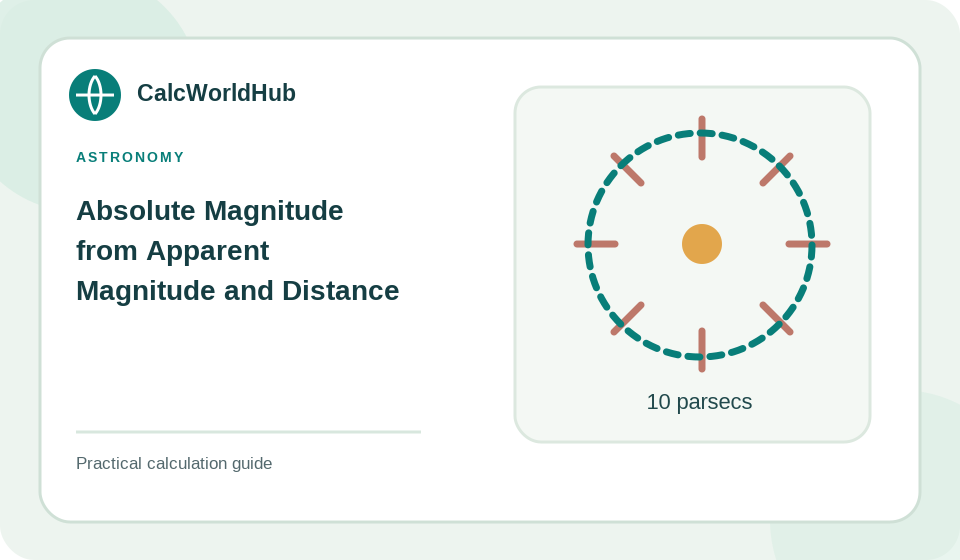
Apparent magnitude describes how bright an object looks from Earth; absolute magnitude is a standardized intrinsic-brightness comparison at 10 parsecs. Magnitude is logarithmic and runs in the inverse direction: a smaller number represents a brighter object. The calculator does not convert flux measurements to magnitude or estimate a distance from parallax; it uses values you already have.
Enter distance in parsecs
The distance field is in parsecs, and the apparent-magnitude input is a numeric magnitude. The distance modulus is meaningful for a positive distance. If a catalog gives light-years, convert before entering: one parsec is about 3.26156 light-years. Make sure the apparent magnitude and distance refer to the same object and observation context rather than mixing a catalog value with a different source.
Apply the distance modulus
The calculator uses M = m − 5 log₁₀(d/10), where m is apparent magnitude and d is distance in parsecs. At 10 pc, the logarithmic term is zero, so M equals m. At greater distances, the observed object must be intrinsically brighter to look equally bright; at closer distances, the standardized absolute magnitude is numerically larger. NASA defines the standard distance for absolute magnitude as 10 parsecs.
Account for interstellar extinction
Dust and gas between an object and the observer can absorb or scatter light, making apparent magnitude fainter. If extinction is significant, correct the observed apparent magnitude using an appropriate band-specific estimate before applying the distance modulus. The calculator explicitly assumes negligible extinction and does not include color, wavelength, bolometric correction, or uncertainty in the distance.
Read the logarithmic result
A one-magnitude difference is not a one-unit linear change in brightness. Under the standard magnitude relation, a difference of five magnitudes corresponds to a factor of 100 in flux at the same band. Because the formula uses a logarithm of distance, doubling distance changes the modulus by 5 log₁₀2, about 1.505 magnitudes. Keep the convention and photometric band consistent when comparing results.
Use absolute magnitude as a normalized comparison
The result helps compare objects after adjusting for distance, but it is not a complete physical description. Measurement band, extinction, variability, unresolved companions, and distance uncertainty can change interpretation. Keep source catalog, band, date, distance estimate, and extinction assumption with the computed value. For research-grade work, use the catalog’s uncertainty model and the appropriate extinction-corrected photometry rather than relying on a single rounded input.
Worked examples
Both examples use apparent magnitude m and distance d in parsecs. The output is absolute magnitude under the negligible-extinction assumption.
Normalize an object at 40 parsecs
Inputs: Apparent magnitude m = 8; distance d = 40 pc.
Calculation: M = 8 − 5 log₁₀(40/10) = 8 − 5 log₁₀4 ≈ 8 − 3.0103 = 4.9897.
The distance-modulus result is about 4.9897. If the measured apparent magnitude includes material extinction, the intrinsic absolute magnitude would require a correction not made by this calculator.
Use the 100-parsec reference case
Inputs: Apparent magnitude m = 12.5; distance d = 100 pc.
Calculation: M = 12.5 − 5 log₁₀(100/10) = 12.5 − 5×1 = 7.5.
The standardized absolute magnitude is 7.5. At 100 pc the distance modulus is exactly 5, so this check also makes the sign and reference distance easy to inspect.

Track uncertainty in the inputs
A distance error changes the distance modulus logarithmically. For small relative errors, a 10% distance uncertainty corresponds to roughly 0.21 magnitude in the distance term, before accounting for photometric error or extinction. Keep uncertainty separate from the rounded answer and follow the catalog’s documented distance posterior when precision matters. The calculator accepts one distance value and does not propagate a range.