Absolute magnitude from apparent magnitude and distance calculator
Calculate absolute magnitude from apparent magnitude and distance in parsecs. Enter your values below to see the result and method.
inputs.
Related calculators
These tools cover nearby questions while keeping this page focused on its own calculation.
How to use this calculator
Calculate absolute magnitude from apparent magnitude and distance in parsecs.
- Use the units printed beside each field. These values are Apparent magnitude m, Distance (parsecs). Apparent magnitude m: The object's measured brightness on the magnitude scale in the stated photometric band. Distance (parsecs): Distance from the observer to the object, expressed in parsecs; this equation requires a positive distance.
- Read the worked example below to check the expected input format and result.
- Compare another scenario by changing one input at a time. Use Reset to return to the starting values.
Choose the observed quantity and convention
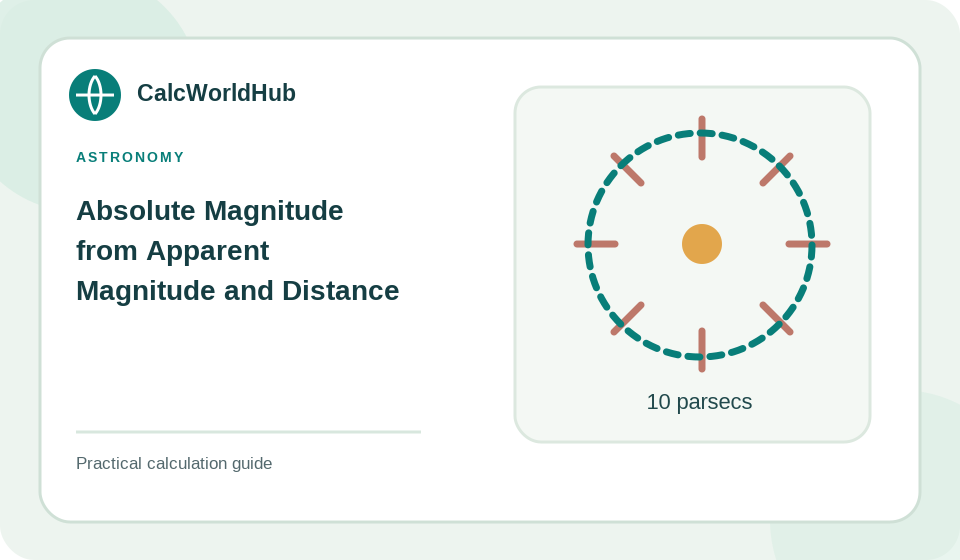
Absolute magnitude is the apparent magnitude an object would have at 10 parsecs, assuming negligible extinction. Enter apparent magnitude and distance in parsecs to apply the distance modulus.
Inputs and units
Use the units printed beside each field. These values are Apparent magnitude m, Distance (parsecs).
- Apparent magnitude m: The object's measured brightness on the magnitude scale in the stated photometric band.
- Distance (parsecs): Distance from the observer to the object, expressed in parsecs; this equation requires a positive distance.
Observation equation and example
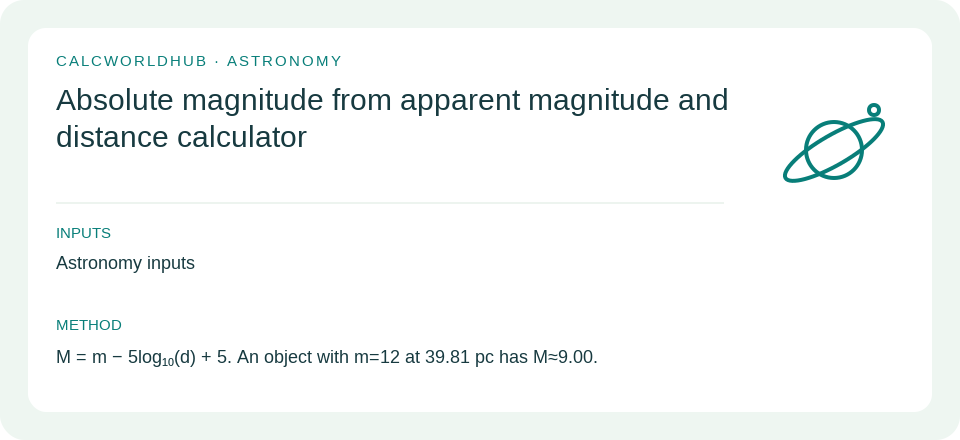
M = m − 5log₁₀(d) + 5.
An object with m=12 at 39.81 pc has M≈9.00.
Interpret the absolute magnitude
At 10 pc the distance-modulus correction is zero. Beyond 10 pc, a dust-free object's absolute magnitude is numerically lower than its apparent magnitude; correct for interstellar extinction when it is material.
Assumptions and limitations
Assumes negligible extinction; correct apparent magnitude for dust absorption before applying the distance modulus when needed.
Frequently asked questions
Which values are needed for the absolute magnitude from apparent magnitude and distance?
Enter Apparent magnitude m, Distance (parsecs). Check that distances and periods use the units shown beside the inputs.
Does this absolute magnitude from apparent magnitude and distance include real-world effects?
Assumes negligible extinction; correct apparent magnitude for dust absorption before applying the distance modulus when needed.
When should I use apparent magnitude instead of absolute magnitude?
Use the apparent-magnitude calculator when absolute magnitude and distance are known and apparent brightness is the desired output.
How do I use the Absolute magnitude from apparent magnitude and distance calculator?
Use the units printed beside each field. These values are Apparent magnitude m, Distance (parsecs). Apparent magnitude m: The object's measured brightness on the magnitude scale in the stated photometric band. Distance (parsecs): Distance from the observer to the object, expressed in parsecs; this equation requires a positive distance.
What is a worked example of Absolute magnitude from apparent magnitude and distance?
M = m − 5log₁₀(d) + 5. An object with m=12 at 39.81 pc has M≈9.00.
Read the calculation methodology and privacy policy.