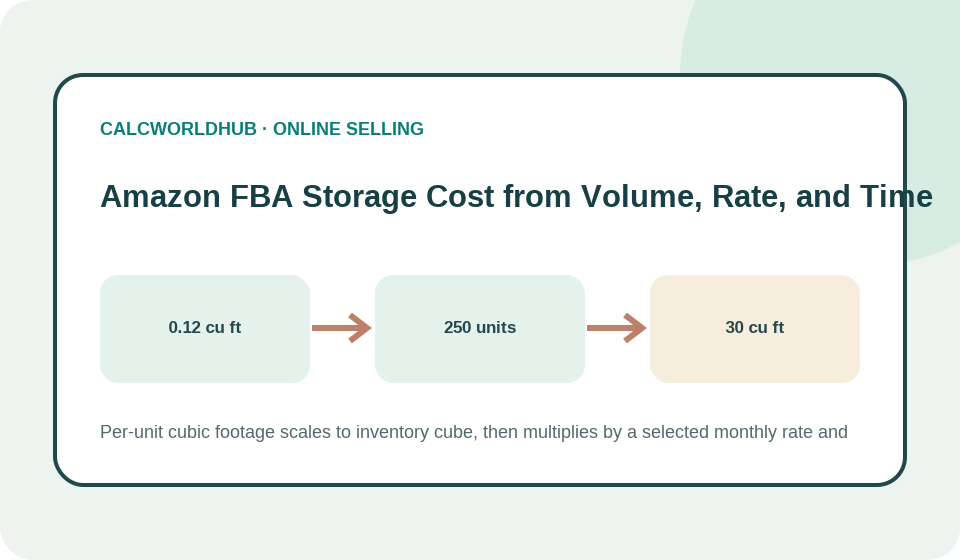

Build an inventory cube from the stored units
The calculator takes unit volume in cubic feet, average units stored, a rate per cubic foot per month, and months. Its simplified estimate is unit volume × units × rate × months. Multiply volume by units first to get the inventory cube; the final multiplication turns that volume and time into a currency estimate.
Use packaged dimensions when they are the basis for the volume figure. A small per-unit error scales with every stored unit, so confirm the same packaging state and unit across the item list. If your data is in cubic metres, convert it to cubic feet before entering it; the tool does not convert units automatically.
Treat the rate as a scenario input
Amazon’s published storage rules vary by product size tier, month or season, inventory age, eligibility, and other fee components. The calculator asks for one rate, so it cannot choose the correct fee table or evaluate an account’s surcharge status. Enter a rate only after checking the current Seller Central schedule that applies to your marketplace and product.
The months field scales the same rate evenly across the entered duration. It does not model a seasonal rate change, daily inventory swings, aged-inventory tiers, removal, or a changing unit count. If any of those apply, split the plan into smaller periods and calculate each with the rate that actually applies.
Understand how the real billing basis can differ
Amazon describes monthly storage fees using daily average inventory volume and packaged unit dimensions. That means a single end-of-month snapshot can differ from the billing basis. Inventory arriving or leaving mid-month can change the average, and Amazon may measure the item dimensions used for fee classification.
The simple multiplication is an estimate for planning, not a reproduction of a statement. It omits size-tier rules, per-unit minimums if applicable, storage utilization surcharges, dangerous-goods rates, promotions, and marketplace-specific conditions. Compare it with the actual fee report before making a final margin or replenishment decision.
Use the estimate to compare inventory scenarios
The model is most useful when you change one assumption at a time. Compare a smaller reorder, a shorter storage period, or a lower-volume package while keeping the other inputs fixed. If a scenario uses fewer average units, record that assumption as a daily or monthly average rather than the number received into the warehouse.
The output is proportional to each input in this simplified model. Doubling units doubles the estimate if the rate, unit cube, and duration stay constant. A real fee schedule may not remain proportional when tiers or surcharges change, so the relationship is a scenario property of this calculator rather than a universal statement about Amazon billing.
Worked examples
The examples use the calculator’s simplified volume-rate-duration model; the rate is an entered assumption, not a current Amazon quote.
One month of a 30-cubic-foot average
Inputs: Unit volume = 0.12 cu ft; average units = 250; entered rate = $0.78 per cu ft per month; duration = 1 month.
Calculation: Inventory cube = 0.12 × 250 = 30 cu ft. Estimate = 30 × $0.78 × 1 = $23.40.
The simplified estimate is $23.40 for the entered month and rate.
Two months with a different unit cube and rate
Inputs: Unit volume = 0.08 cu ft; average units = 500; entered rate = $0.65 per cu ft per month; duration = 2 months.
Calculation: Inventory cube = 0.08 × 500 = 40 cu ft. Estimate = 40 × $0.65 × 2 = $52.00.
Under the stated constant-rate assumption, the two-month estimate is $52.00.

Separate storage cost from broader FBA economics
Storage is only one line in the economics of fulfillment. Referral fees, fulfillment fees, inbound placement, returns, removal, aged inventory, and advertising can change the contribution from a product. This tool has no fields for those charges, sales velocity, or margin; do not treat its estimate as a full FBA profitability result.
Before raising inventory, use the result with a demand plan and the seller’s fee report. A product that occupies little space but sits for a long time can still accumulate cost; a fast-moving product may occupy more space yet turn inventory sooner. The calculator does not decide which trade-off is acceptable—it makes the stated assumptions visible.