
Calculate mass per unit volume
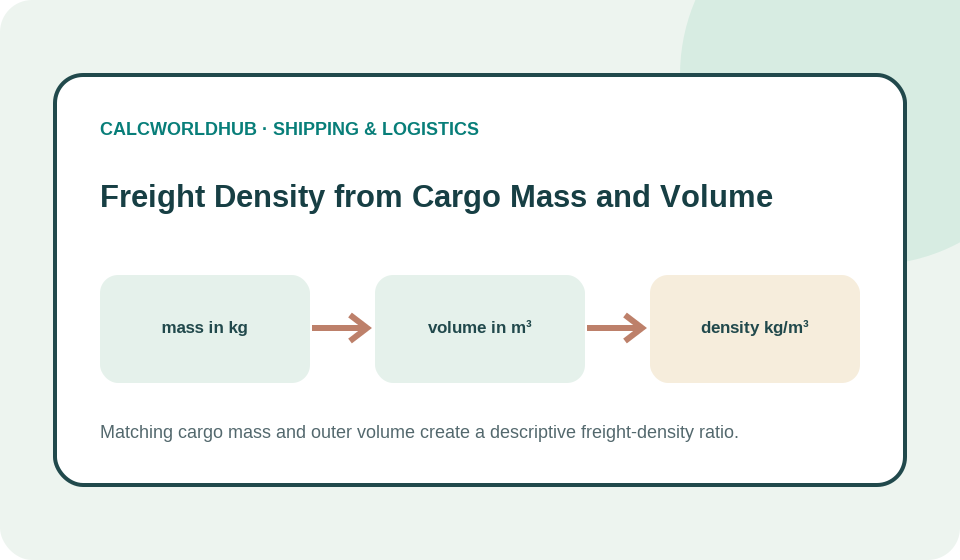
Density = mass ÷ volume. With mass in kilograms and volume in cubic metres, the quotient is kg/m³. Keep the mass and volume measurements tied to the same cargo boundary: the same items, packaging state, and shipment unit. If the entered mass is for a palletized load, the volume should describe that same load as prepared for transport.
The calculator displays the quotient to at most four decimal places. It does not convert pounds, cubic feet, litres, or centimetres automatically. Convert first, using a consistent SI basis. For example, cubic centimetres must be divided by 1,000,000 to become cubic metres; mixing cubic feet with kilograms would not produce the displayed unit meaningfully.
Measure the shipment envelope consistently
For a rectangular carton, volume is length × width × height using compatible length units, then expressed in cubic metres. For an irregular shipment, the volume convention may use the outer bounding dimensions or another documented measurement method. The calculator takes a volume directly; it does not infer shape, stackability, voids, or the dimensions of a pallet or container.
State whether your mass includes packaging, pallet tare, dunnage, and accessories. A density intended to describe cargo alone should not combine cargo mass with an unrelated empty-pallet volume. Conversely, if a carrier evaluates the prepared handling unit, use the shipment boundary required by that carrier’s published rules. Consistent boundaries make comparisons meaningful.
Read the ratio without assuming a tariff
A larger kg/m³ value means more mass per measured cubic metre under the selected boundary. Two shipments with the same density may still differ in handling risk, fragility, hazardous classification, loadability, or dimensional pricing. The calculator has no carrier, route, service, minimum charge, or dimensional-weight divisor fields, so it cannot return a freight quote.
Use the ratio as descriptive data or as an input to a separate policy. Carriers can use different dimensional factors and thresholds, and the chargeable weight may be compared with actual weight according to their own tariff. Confirm the applicable service rules instead of applying a universal cutoff from this density result.
Interpret low and high values carefully
An unusually low density can flag freight that consumes space relative to its mass, while a high value can describe compact, heavy cargo. Those are planning observations, not automatic classifications. The ratio alone does not reveal whether a package can be stacked, whether its contents are distributed evenly, or whether the floor, rack, pallet, or vehicle can support the load.
The measurement uncertainty in dimensions can compound when a three-dimensional envelope is formed. A small error in each side changes the product volume, while a rounded or estimated cargo mass changes the numerator. Preserve the original measurements, units, and method rather than reporting only a quotient with four decimal places.
Know the input validation boundary
The visible fields are mass in kilograms and volume in cubic metres. The calculator checks that division returns a finite number, but it does not require nonnegative cargo mass or positive volume. For practical freight density, use a nonnegative mass and a strictly positive volume; a negative value accepted by the page is not a physically meaningful shipment description.
If the denominator is zero or the values otherwise produce an infinite or non-finite quotient, the tool displays a check-input message. That arithmetic guard is not a full measurement validator. Confirm that volume is greater than zero and that both fields refer to one measured shipment before using the number in an operational record.
Worked examples
Examples use kilograms and cubic metres for the same prepared shipment boundary.
A compact 1.6 m³ shipment
Inputs: Cargo mass = 420 kg; volume = 1.6 m³.
Calculation: Density = 420 ÷ 1.6 = 262.5 kg/m³.
Each cubic metre of the stated cargo envelope corresponds to 262.5 kg at this ratio.
A lighter load using more space
Inputs: Cargo mass = 180 kg; volume = 2.4 m³.
Calculation: Density = 180 ÷ 2.4 = 75 kg/m³.
The second shipment is less mass-dense under the same measurement convention.
