Freight density calculator
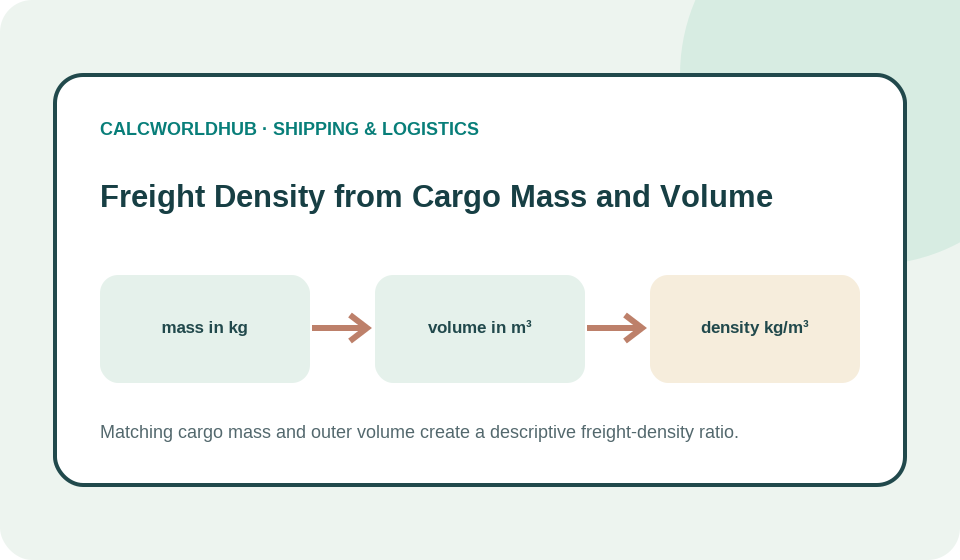
Normalize cargo mass by its measured volume for a mass-per-volume freight density.
Related calculators and articles
Compare methods and explore more free tools in shipping & logistics.
How to use this calculator
Normalize cargo mass by its measured volume for a mass-per-volume freight density.
- Enter Cargo mass (kg), Cargo volume (m³). Match the units shown beside each field and review the result together with the assumptions below.
- Read the worked example below to check the expected input format and result.
- Compare another scenario by changing one input at a time. Use Reset to return to the starting values.
Freight density calculator
Normalize cargo mass by its measured volume for a mass-per-volume freight density.
Inputs and units
- Cargo mass (kg): Shipment mass in kilograms; use measured packed cargo mass for a physical density.
- Cargo volume (m³): Measured loose or compacted gravel volume in cubic metres, matching the selected bulk-density state.
Formula and method
density = mass / volume
Worked example
420 kg occupying 1.6 m³ gives 420/1.6=262.5 kg/m³.
Interpreting the result
Carrier dimensional-weight rules use their own conversion factors and thresholds; this physical density is not itself a shipping charge.
Assumptions and limits
Mass must be nonnegative and volume positive. Measure the packed shipment envelope and use the carrier’s own rules for billable weight.
Frequently asked questions
What does this freight density result tell me?
Carrier dimensional-weight rules use their own conversion factors and thresholds; this physical density is not itself a shipping charge.
What assumptions should I check?
Mass must be nonnegative and volume positive. Measure the packed shipment envelope and use the carrier’s own rules for billable weight.
How do I use the Freight density calculator?
Enter Cargo mass (kg), Cargo volume (m³). Match the units shown beside each field and review the result together with the assumptions below.
What is a worked example of Freight density?
420 kg occupying 1.6 m³ gives 420/1.6=262.5 kg/m³.
What does the Freight density calculator calculate?
Normalize cargo mass by its measured volume for a mass-per-volume freight density.
See the calculation methodology.