How to use this calculator
Estimate a U.S. freight charge from shipment pounds, a quoted rate per 100 pounds, a minimum, and surcharges.
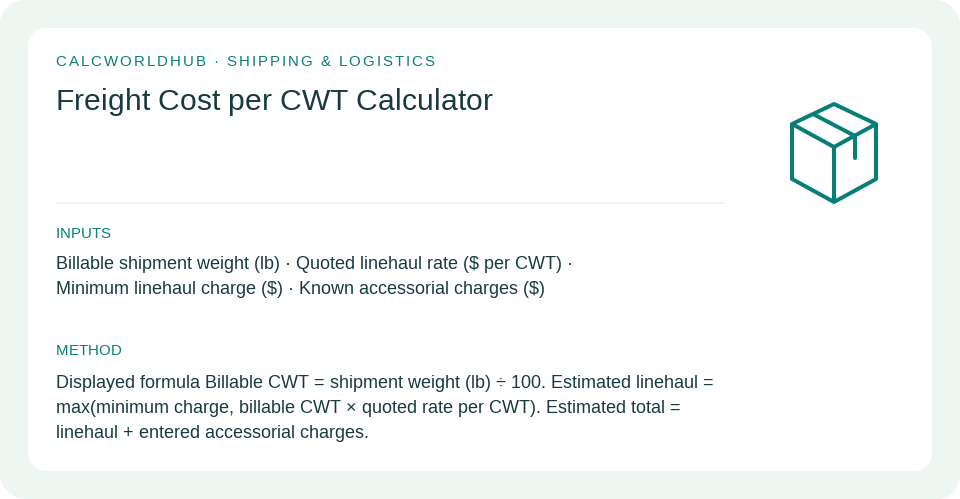
- Enter Billable shipment weight (lb), Quoted linehaul rate ($ per CWT), Minimum linehaul charge ($), Known accessorial charges ($). Match the units shown beside each field and review the result together with the assumptions below.
- Read the worked example below to check the expected input format and result.
- Compare another scenario by changing one input at a time. Use Reset to return to the starting values.
How this calculation works
A hundredweight quote prices a shipment in 100-pound units. This estimator turns a quoted per-CWT rate into a linehaul amount, applies the minimum you enter, then adds accessorial charges. It is useful for a quick quote check when the carrier has already supplied its billable weight and rate.
Inputs and units
weightLb— Billable shipment weight (lb)- Use the chargeable weight from the carrier quote, not an unverified scale weight.
ratePerCwt— Quoted linehaul rate ($ per CWT)- Enter the contracted base rate for each 100 lb.
minimumCharge— Minimum linehaul charge ($)- Use 0 if the quote has no minimum linehaul amount.
accessorials— Known accessorial charges ($)- Add entered extras such as liftgate or appointment fees; do not include them in the CWT rate.
Formula
Billable CWT = shipment weight (lb) ÷ 100. Estimated linehaul = max(minimum charge, billable CWT × quoted rate per CWT). Estimated total = linehaul + entered accessorial charges.
Method
Enter the U.S. short-hundredweight basis used by the quote, the shipment's billable pounds, the quoted rate, any minimum linehaul, and known surcharges. The rate and minimum are applied to linehaul before accessorials are added.
Worked example
A 1,200 lb shipment at $42/CWT is 12 CWT, so the linehaul is $504. With a $75 minimum and $28 in separately entered accessorials, the estimate is $532.
Assumptions and limits
This is a transparent arithmetic estimate, not a carrier tariff lookup. It does not determine freight class, density, zones, billable-weight rounding, weight breaks, discounts, or which accessorials apply. Use the billable weight and rules from the actual carrier quote; U.S. short CWT is 100 lb, while other markets can use different conventions.
Frequently asked questions
What does CWT mean on a U.S. freight quote?
For this estimate, one short hundredweight is 100 lb. Confirm the unit printed on the carrier's quote, especially for shipments priced outside the United States.
Does the calculator find my freight class or carrier rate?
No. It applies a rate and billable weight you already have; class, lane, discount, and weight-break rules must come from the carrier.
When is the minimum charge applied?
The calculator compares the minimum with the computed CWT linehaul and uses whichever is higher, then adds the accessorials you entered.
Should I enter scale weight or billable weight?
Use the carrier's billable weight when you are checking a quote, because its rating rules may use a different chargeable weight.
How do I use the Freight Cost per CWT Calculator?
Enter Billable shipment weight (lb), Quoted linehaul rate ($ per CWT), Minimum linehaul charge ($), Known accessorial charges ($). Match the units shown beside each field and review the result together with the assumptions below.
Reference: UPS Hundredweight Service rate and shipment guidance. See our calculation methodology.