How to use this calculator
Estimate a shipment’s fuel surcharge and total freight charge from its linehaul price and surcharge rate.
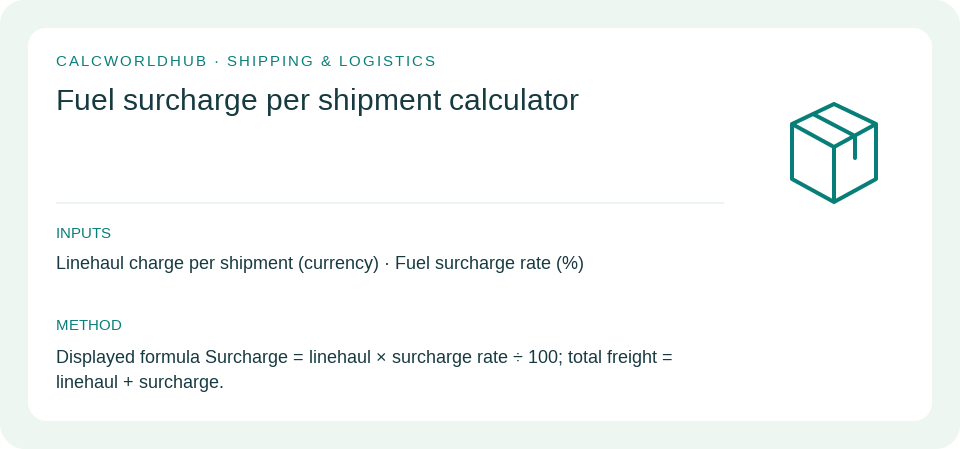
- Enter Linehaul charge per shipment (currency), Fuel surcharge rate (%). Match the units shown beside each field and review the result together with the assumptions below.
- Read the worked example below to check the expected input format and result.
- Compare another scenario by changing one input at a time. Use Reset to return to the starting values.
How this calculation works
Carriers often quote a fuel surcharge separately from base linehaul. Enter the quoted percentage and shipment linehaul amount to separate the extra charge from the total.
Inputs and units
linehaul— Linehaul charge per shipment (currency)- Base transportation charge subject to surcharge.
rate— Fuel surcharge rate (%)- Use the carrier’s quoted surcharge for this shipment.
Formula
Surcharge = linehaul × surcharge rate ÷ 100; total freight = linehaul + surcharge.
Worked example
For a 420 linehaul charge and an 18.5% surcharge, the fuel surcharge is 77.70 and the combined charge is 497.70.
Assumptions and limits
Carrier surcharge tables and eligible charge bases vary. This calculator applies a rate you provide and does not infer a carrier-specific index or contract rule.
Frequently asked questions
Does it look up current carrier rates?
No. Enter the surcharge rate from the carrier’s quote or contract.
Is the percent always applied to linehaul?
No. The applicable base can vary by carrier agreement; confirm the contract definition.
Are accessorial fees included?
No. Add them separately if they are part of the shipment invoice.
How do I use the Fuel surcharge per shipment calculator?
Enter Linehaul charge per shipment (currency), Fuel surcharge rate (%). Match the units shown beside each field and review the result together with the assumptions below.
What is a worked example of Fuel surcharge per shipment?
For a 420 linehaul charge and an 18.5% surcharge, the fuel surcharge is 77.70 and the combined charge is 497.70.
Read our calculation methodology.