How to use this calculator
Compare an air shipment’s gross and volumetric weights, then apply the carrier’s billing increment to estimate chargeable weight.
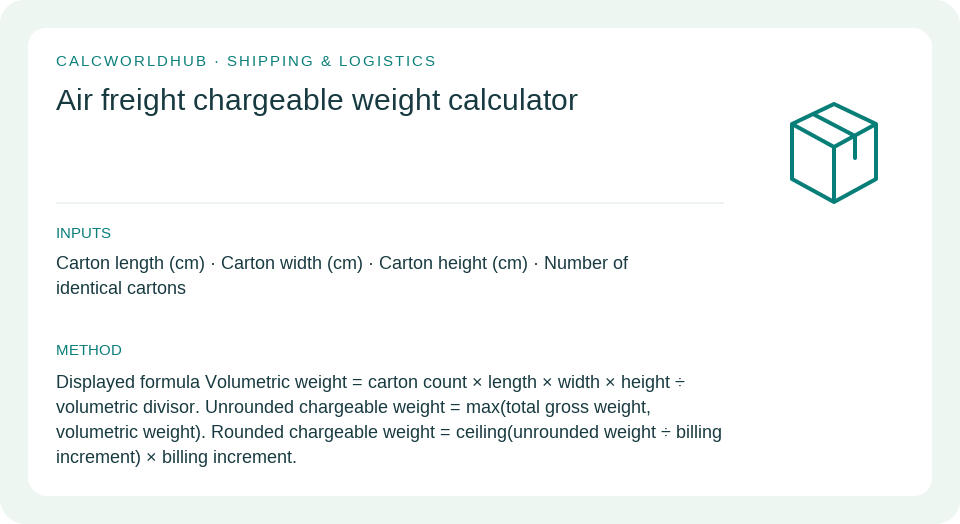
- Enter Carton length (cm), Carton width (cm), Carton height (cm), Number of identical cartons, then complete the remaining labeled fields. Match the units shown beside each field and review the result together with the assumptions below.
- Read the worked example below to check the expected input format and result.
- Compare another scenario by changing one input at a time. Use Reset to return to the starting values.
How this calculation works
Air freight quotes commonly compare the scale weight of a packed shipment with a volume-derived weight. This tool makes that comparison for repeated cartons and lets you enter the volumetric divisor and rounding increment supplied by the carrier or forwarder.
Inputs and units
lengthCm— Carton length (cm)- Outside length of one packed carton, in centimetres.
widthCm— Carton width (cm)- Outside width of one packed carton, in centimetres.
heightCm— Carton height (cm)- Outside height of one packed carton, in centimetres.
cartonCount— Number of identical cartons- Count of cartons with the dimensions entered above.
grossKg— Total packed gross weight (kg)- Scale weight of all cartons together, including packaging.
divisor— Volumetric divisor (cm³/kg)- Use the factor stated by the airline or forwarder; do not assume every service uses the same one.
incrementKg— Billing increment (kg)- Enter the carrier’s upward rounding step; use a small positive increment if the quote bills exact weight.
Formula
Volumetric weight = carton count × length × width × height ÷ volumetric divisor. Unrounded chargeable weight = max(total gross weight, volumetric weight). Rounded chargeable weight = ceiling(unrounded weight ÷ billing increment) × billing increment.
Method
Enter outside carton dimensions in centimetres, the number of identical cartons, and the packed shipment’s total gross mass in kilograms. Use the divisor and billing increment on your quote; 6,000 cm³/kg is a common general air-cargo convention, but services can differ.
Worked example
Two cartons measuring 60 × 40 × 40 cm have 192,000 cm³ total volume. With a 6,000 cm³/kg divisor, volumetric weight is 32 kg. If total gross weight is 28 kg and billing rounds upward in 0.5 kg steps, estimated chargeable weight is 32 kg.
Assumptions and limits
This estimate compares only gross and volume-based weight. It does not calculate a freight price, minimum shipment charge, pallet overhang, irregular-piece rule, or carrier-specific exceptions. Confirm divisor, rounding, and chargeable-weight rules with the carrier for the actual service.
Frequently asked questions
What does chargeable weight mean in air freight?
It is the weight basis used for pricing after comparing packed gross weight with a volume-derived weight under the service’s rules.
Is the volumetric divisor always 6,000?
No. 6,000 cm³/kg is a common air-cargo convention, while express services, routes, and contracts may use different factors.
Should I measure the carton before or after packing?
Use its outside packed dimensions, including bulges or protective packaging that affect the space it occupies.
How do I use the Air freight chargeable weight calculator?
Enter Carton length (cm), Carton width (cm), Carton height (cm), Number of identical cartons, then complete the remaining labeled fields. Match the units shown beside each field and review the result together with the assumptions below.
What is a worked example of Air freight chargeable weight?
Two cartons measuring 60 × 40 × 40 cm have 192,000 cm³ total volume. With a 6,000 cm³/kg divisor, volumetric weight is 32 kg. If total gross weight is 28 kg and billing rounds upward in 0.5 kg steps, estimated chargeable weight is 32 kg.
Reference: technical reference. See our calculation methodology.