International shipping estimate calculator
Add carrier charges and an optional duty estimate to compare shipping scenarios.
inputs.
Calculator
How to use this calculator
Estimate shipping and handling charges plus a duty amount based on the percentage you enter; no tariff lookup is performed.
- Enter Postage quote / base ($), Weight (lb), Additional per lb ($), Insurance + handling ($), then complete the remaining labeled fields. Match the units shown beside each field and review the result together with the assumptions below.
- Read the worked example below to check the expected input format and result.
- Compare another scenario by changing one input at a time. Use Reset to return to the starting values.
Build a shipping estimate from the charges you enter
Combine a base postage quote, weight-based charge, insurance or handling, and an optional duty estimate. The result separates transport and handling from the duty amount you supplied.
Inputs and units
- Postage quote / base ($): The carrier’s base charge for the shipment.
- Weight (lb): The billable weight used with the entered per-pound rate; dimensional-weight rules are not calculated here.
- Additional per lb ($): The extra charge per pound from the quote.
- Insurance + handling ($): One combined amount for the insurance and handling charges you want included.
- Customs value ($): The declared goods value used only for the entered duty estimate.
- Entered duty estimate (%): A percentage you supply; the calculator does not look up an official tariff rate.
Formula and method
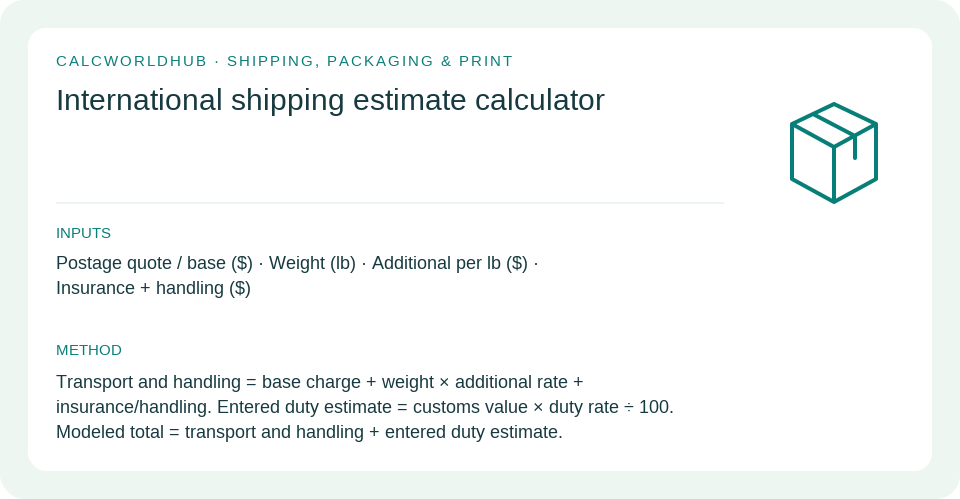
Transport and handling = base charge + weight × additional rate + insurance/handling. Entered duty estimate = customs value × duty rate ÷ 100. Modeled total = transport and handling + entered duty estimate.
Worked example
With a $25 base charge, 2 lb at $3/lb, and $4 insurance/handling, modeled transport and handling is $25 + 2 × $3 + $4 = $35. A $40 customs value with a 10% entered duty estimate adds $4, for a modeled total of $39.
Interpreting the result
The $39 total is the sum of the charges entered in this example. It is useful for comparing scenarios with the same assumptions, but it is not a carrier quote or a customs determination.
Assumptions and limits
Actual import duty can depend on tariff classification, country of origin, valuation rules, trade programs, and other charges. This tool does not retrieve current rates, sales taxes, brokerage fees, dimensional weight, or carrier surcharges. Verify each amount with the carrier and relevant customs authority.
Method references
Frequently asked questions
Does this calculate the official import duty?
No. It multiplies the customs value by the percentage you enter. Official rates depend on the product classification and origin, and the calculator does not identify either one.
How do I use the International shipping estimate calculator?
Enter Postage quote / base ($), Weight (lb), Additional per lb ($), Insurance + handling ($), then complete the remaining labeled fields. Match the units shown beside each field and review the result together with the assumptions below.
What is a worked example of International shipping estimate?
With a $25 base charge, 2 lb at $3/lb, and $4 insurance/handling, modeled transport and handling is $25 + 2 × $3 + $4 = $35. A $40 customs value with a 10% entered duty estimate adds $4, for a modeled total of $39.
What does the International shipping estimate calculator calculate?
Estimate shipping and handling charges plus a duty amount based on the percentage you enter; no tariff lookup is performed.
What assumptions apply to International shipping estimate?
Actual import duty can depend on tariff classification, country of origin, valuation rules, trade programs, and other charges. This tool does not retrieve current rates, sales taxes, brokerage fees, dimensional weight, or carrier surcharges. Verify each amount with the carrier and relevant customs authority.
Good calculators show their work.
CalcWorldHub is built around clear inputs and visible assumptions. Results are estimates for planning; check official sources or your provider’s terms when exact figures matter.