Container load estimator
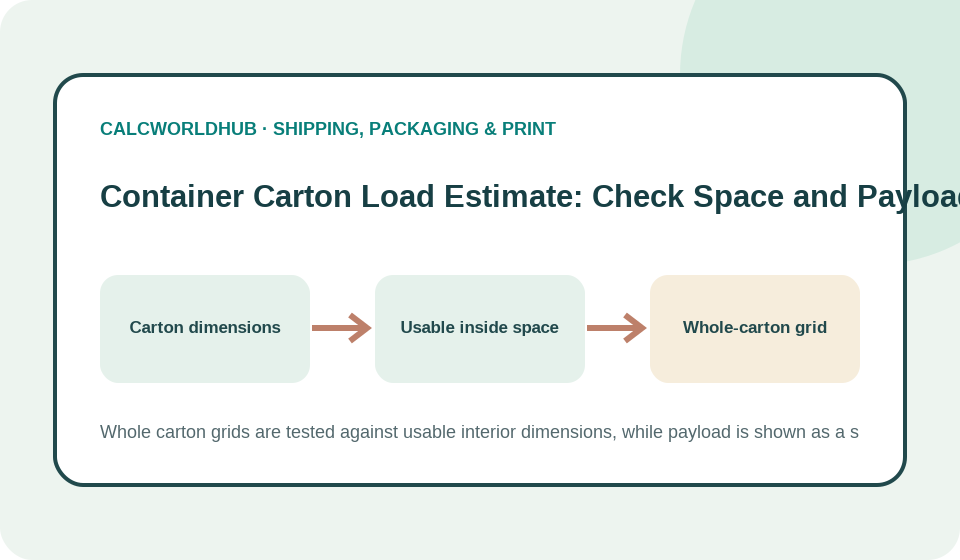
Estimate a rectangular carton count using the best axis-aligned orientation among the six box rotations.
Calculator

How to use this calculator
Estimate a rectangular carton count using the best axis-aligned orientation among the six box rotations.
- Enter Carton length (in), Carton width (in), Carton height (in), Usable container length (in), then complete the remaining labeled fields. Match the units shown beside each field and review the result together with the assumptions below.
- Read the worked example below to check the expected input format and result.
- Compare another scenario by changing one input at a time. Use Reset to return to the starting values.
Container load estimator
Estimate a rectangular carton count using the best axis-aligned orientation among the six box rotations.
What it measures
The estimator multiplies whole cartons that fit along each container dimension for each orientation and chooses the largest count.
Inputs and units
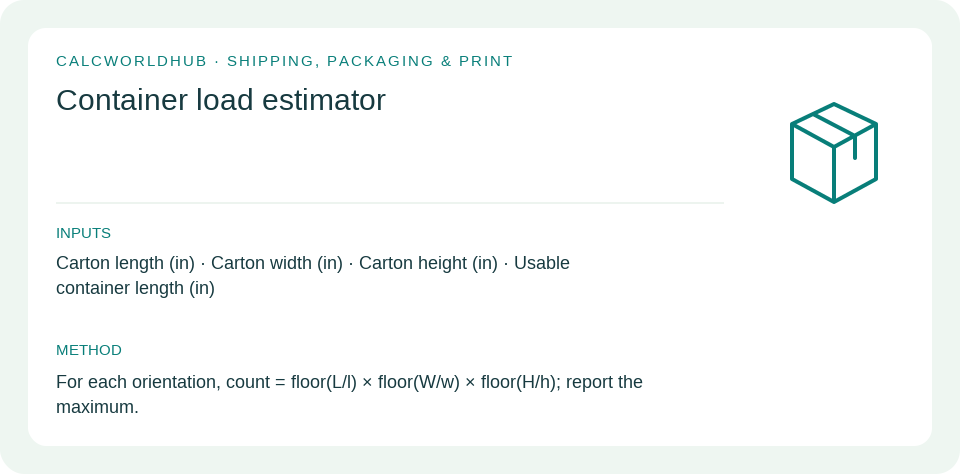
- Carton length (in): Carton outside length in inches.
- Carton width (in): Carton outside width in inches.
- Carton height (in): Carton outside height in inches.
- Usable container length (in): Usable inside container length, not nominal exterior length.
- Usable container width (in): Usable inside container width.
- Usable container height (in): Usable inside container height.
Formula and method
For each orientation, count = floor(L/l) × floor(W/w) × floor(H/h); report the maximum.
Worked example
The default dimensions fit 14×7×9 = 882 cartons in one orientation.
Interpreting the result
The result is a geometric grid fit, not a certified shipping load plan.
Assumptions and limits
It omits carton gaps, container door and corner restrictions, weight, stacking strength, dunnage, bracing, and mixed orientations.
Frequently asked questions
Does this allow cartons to interlock?
No. It evaluates simple aligned grids for each whole-carton orientation.
Does the count guarantee a safe load?
No. Weight limits, stability, packaging strength, and loading rules require separate checks.
How do I use the Container load estimator?
Enter Carton length (in), Carton width (in), Carton height (in), Usable container length (in), then complete the remaining labeled fields. Match the units shown beside each field and review the result together with the assumptions below.
What is a worked example of Container load estimator?
The default dimensions fit 14×7×9 = 882 cartons in one orientation.
What does the Container load estimator calculate?
Estimate a rectangular carton count using the best axis-aligned orientation among the six box rotations.
See the calculation methodology.
Good calculators show their work.
CalcWorldHub is built around clear inputs and visible assumptions. Results are estimates for planning; check official sources or your provider’s terms when exact figures matter.