Void fill estimator
Estimate empty volume inside a rectangular box after subtracting product volume.
Calculator
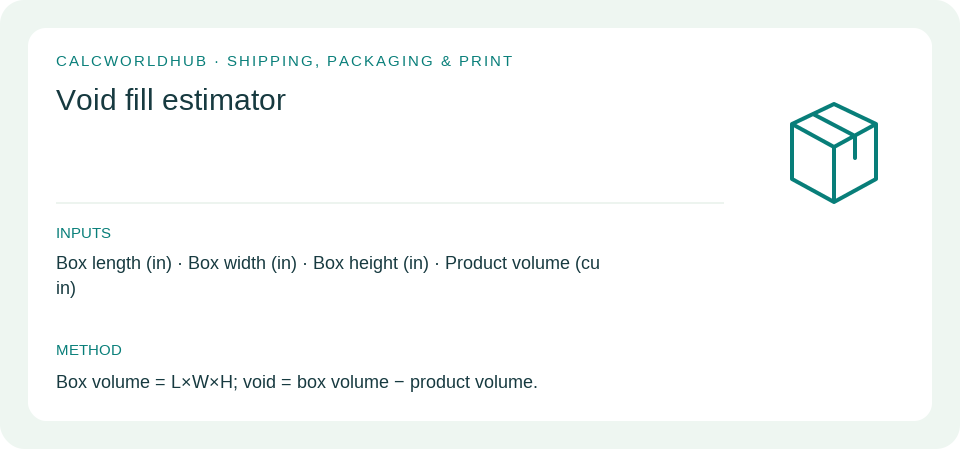
How to use this calculator
Estimate empty volume inside a rectangular box after subtracting product volume.
- Enter Box length (in), Box width (in), Box height (in), Product volume (cu in). Match the units shown beside each field and review the result together with the assumptions below.
- Read the worked example below to check the expected input format and result.
- Compare another scenario by changing one input at a time. Use Reset to return to the starting values.
Void fill estimator
Estimate empty volume inside a rectangular box after subtracting product volume.
What it measures
The tool compares box volume with a single entered product volume and reports the remainder as estimated void.
Inputs and units
- Box length (in): Inside box length in inches.
- Box width (in): Inside box width in inches.
- Box height (in): Inside box height in inches.
- Product volume (cu in): Product volume in cubic inches; keep it at or below the box volume.
Formula and method
Box volume = L×W×H; void = box volume − product volume.
Worked example
12×10×8=960 cu in box; 960−300=660 cu in estimated void, or 68.75%.
Interpreting the result
The percentage is the unoccupied fraction of the rectangular box volume.
Assumptions and limits
A volume-only estimate ignores product shape, orientation, clearances, cushioning, and packing constraints; product volume cannot exceed box volume.
Frequently asked questions
Does this determine how much packing material to buy?
No. It estimates geometric void only; material shape and compression affect actual fill.
What if product volume exceeds the box?
The inputs are rejected because the product cannot fit within the stated box volume.
How do I use the Void fill estimator?
Enter Box length (in), Box width (in), Box height (in), Product volume (cu in). Match the units shown beside each field and review the result together with the assumptions below.
What is a worked example of Void fill estimator?
12×10×8=960 cu in box; 960−300=660 cu in estimated void, or 68.75%.
What does the Void fill estimator calculate?
Estimate empty volume inside a rectangular box after subtracting product volume.
See the calculation methodology.
Good calculators show their work.
CalcWorldHub is built around clear inputs and visible assumptions. Results are estimates for planning; check official sources or your provider’s terms when exact figures matter.