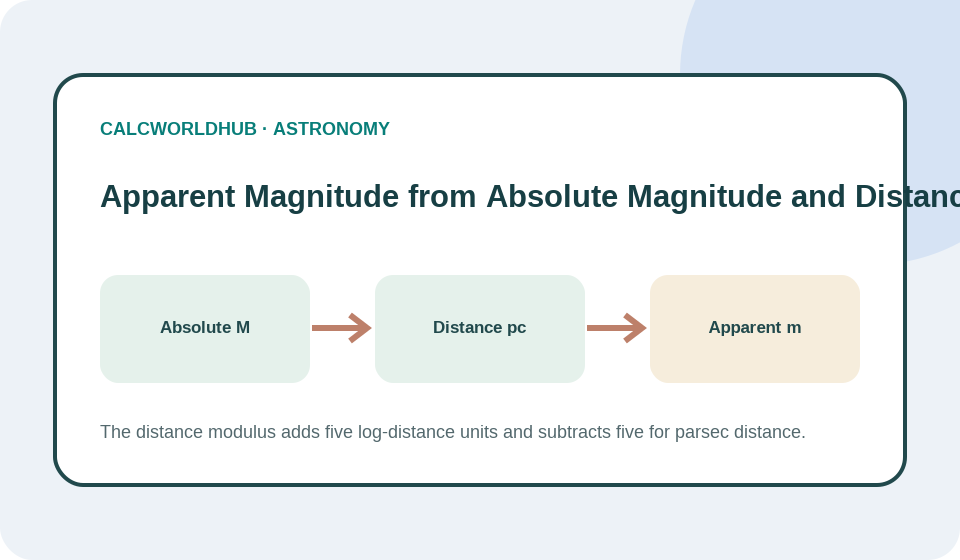

Distance modulus in parsecs
Absolute magnitude M describes an object’s intrinsic brightness on the magnitude scale standardized to a distance of 10 parsecs. For distance d in parsecs, the extinction-free relation is m = M + 5 log₁₀(d) − 5. Equivalently, the distance modulus is m−M = 5 log₁₀(d/10 pc). The calculator uses the first form and displays the resulting apparent magnitude with up to four decimal places.
The absolute-magnitude field may be positive or negative. The distance field must be greater than zero because the logarithm is undefined for a nonpositive value. In astronomical notation, more negative magnitudes are brighter. Moving an object farther away increases its apparent magnitude, making it appear dimmer, even though the magnitude number itself rises.
What is left out of the simple equation
The basic equation omits extinction and reddening between the source and observer. Dust absorbs and scatters light, usually making the object appear dimmer in a given band. If extinction A is known for the same passband, a more complete relation is m = M + 5 log₁₀(d) − 5 + A. The calculator has no extinction field, so its output is the uncorrected distance-modulus estimate.
The input magnitudes must use compatible definitions and passbands. A visual absolute magnitude cannot be combined casually with an apparent magnitude measured in a different filter. K-corrections, source variability, unresolved companions, and calibration conventions can also matter in real observations.
Interpreting the logarithmic change
A tenfold increase in distance adds five magnitude units because log₁₀(10)=1. Doubling distance adds 5 log₁₀(2), about 1.505 magnitudes. These are logarithmic changes, not percentages of brightness. To compare fluxes, a magnitude difference Δm corresponds to a flux ratio of 10^(−0.4Δm), subject to matching wavelength bands and measurement conditions.
The calculator returns magnitude, not flux, luminosity, distance uncertainty, or a spectral classification. It does not estimate distance from measured apparent brightness; it solves the forward relation after distance and absolute magnitude are already supplied.
Use measured magnitudes responsibly
For a real target, use an absolute magnitude appropriate to the object’s type, bandpass, and calibration, and a distance measured independently. If the distance has an uncertainty, the magnitude uncertainty from distance alone is approximately (5/ln 10)(σd/d) for small fractional errors. This propagation is not performed by the calculator, but it helps show why distance uncertainty matters.
A result written to four decimal places should not imply four-decimal observational accuracy. Round according to the precision of M and d, and report whether extinction was excluded or applied elsewhere. If extinction is substantial, an uncorrected estimate can be much fainter than the observed object’s intrinsic distance-only value.
A forward estimate, not a brightness prediction
The distance modulus is a geometric brightness relation. It does not predict how much light a telescope records, because aperture, detector sensitivity, exposure time, atmospheric transmission, and background noise are outside the model. Nor does it infer an object’s absolute magnitude from a spectrum or physical model.
Use this calculator to check the relationship among an assumed absolute magnitude, a parsec distance, and an extinction-free apparent magnitude. If you are comparing published catalogs, align filters, magnitude systems, distance definitions, and corrections first. The arithmetic is simple; matching the conventions is the part that makes the result meaningful.
Worked examples
These examples use the displayed inputs and keep the formula’s units visible so the result can be checked independently.
A solar-like absolute magnitude at 100 parsecs
Inputs: Absolute magnitude M = 4.83; distance d = 100 pc.
Calculation: m = 4.83 + 5 log₁₀(100) − 5 = 4.83 + 10 − 5 = 9.8300 mag.
The extinction-free distance-modulus estimate is 9.8300 mag. Dust attenuation would add a passband-specific term if it were known.
Brighter object at 250 parsecs
Inputs: Absolute magnitude M = −1.2; distance d = 250 pc.
Calculation: m = −1.2 + 5 log₁₀(250) − 5 = 5.789700… mag; displayed 5.7897 mag.
The object appears numerically fainter at 250 pc than at its 10 pc absolute-magnitude reference distance. No extinction correction is included.
