
What the calculator estimates
A belt’s linear speed is the distance traveled along the belt per unit time. If the belt follows a pulley without slip, one revolution advances the belt by the pulley’s pitch circumference, πD. At n revolutions per minute, the ideal speed is πDn/60 when D is in metres, giving metres per second. The calculator returns this ideal magnitude.
Pitch diameter is measured at the belt’s effective pitch line, which may not match the visible outside diameter. The relevant value depends on belt type and pulley geometry. Using the wrong diameter creates a proportional speed error, so consult the drive drawing or manufacturer’s dimensional data rather than assuming a caliper measurement is the pitch diameter.
Choose the matching pulley and speed
Enter pulley diameter in millimetres and rotational speed in rpm. The source handler accepts nonnegative magnitudes for both; a zero value returns zero speed. Use the diameter and rpm for the same driving pulley. Do not combine the driven pulley’s diameter with the driver’s rpm unless that is the pulley actually being modeled.
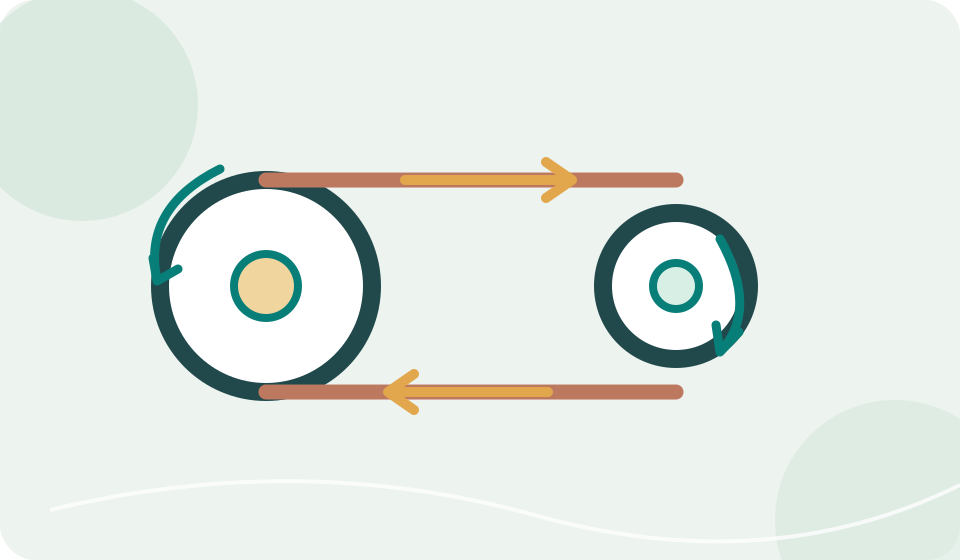
In a simple ideal belt drive without slip, belt speed is the same along both straight spans and the pitch-line speeds of the pulleys match. The driven shaft rpm therefore changes with the pulley diameter ratio. The calculator uses only one diameter and one speed; it does not calculate speed ratio, center distance, wrap angle, tension, belt selection, or allowable power.
Convert the circumference rate
Use v = πDn/60, where v is metres per second, D is pitch diameter in metres, and n is revolutions per minute. The calculator accepts millimetres, so first set Dm = Dmm/1,000. Each revolution covers the pitch circumference πDm metres, and dividing the per-minute travel by 60 converts it to metres per second.
For D = 200 mm = 0.200 m and n = 1,500 rpm, v = π × 0.200 × 1,500/60 = 15.707963… m/s, displayed as 15.70796 m/s. A common error is to use 200 as metres instead of 0.200; that makes the result one thousand times too large. Another is to divide by 60 twice after converting the rpm.
Compare a second pulley condition
For a 160 mm pitch diameter at 750 rpm, v = π × 0.160 × 750/60 = 6.283185… m/s, displayed as 6.28319 m/s. The diameter is 80 percent of the first case and speed is 50 percent, so belt speed is 40 percent of 15.70796 m/s. This checks the formula’s direct proportionality to both inputs.
If the same 200 mm pulley speeds up from 1,500 to 1,800 rpm, ideal belt speed rises by 20 percent, from 15.70796 to 18.84956 m/s. A real drive may deviate because of elastic creep, slip, load, or measurement method. Treat the proportional comparison as a kinematics check, not evidence that the selected belt can safely run at that speed.
Limits and a practical verification
This calculation assumes the effective pitch diameter is known and the belt does not slip. It does not determine belt tension or capacity and does not account for belt stretch, centrifugal effects, groove seating, tooth engagement, wear, or driven-load changes. Different belt constructions use different reference diameters and design procedures; use the applicable manufacturer method for component selection.
To verify an entered case, convert diameter to metres, multiply by π to get pitch circumference, multiply by rpm, and divide by 60. Check that the measured or specified speed is for the same pulley. In a two-pulley ideal model, compare the calculated belt speed on both pulleys using their own pitch diameters and shaft speeds; disagreement can reveal slip, a mismatched diameter definition, or inconsistent data.

Worked examples
200 mm driving pulley
Inputs: Effective pitch diameter = 200 mm; rotational speed = 1,500 rpm.
Calculation: v = π × (200/1,000) × 1,500/60 = 15.707963… m/s.
Ideal no-slip belt speed = 15.70796 m/s.
Smaller, slower pulley
Inputs: Effective pitch diameter = 160 mm; rotational speed = 750 rpm.
Calculation: v = π × (160/1,000) × 750/60 = 6.283185… m/s.
Ideal no-slip belt speed = 6.28319 m/s.