
Translate the threshold into an event
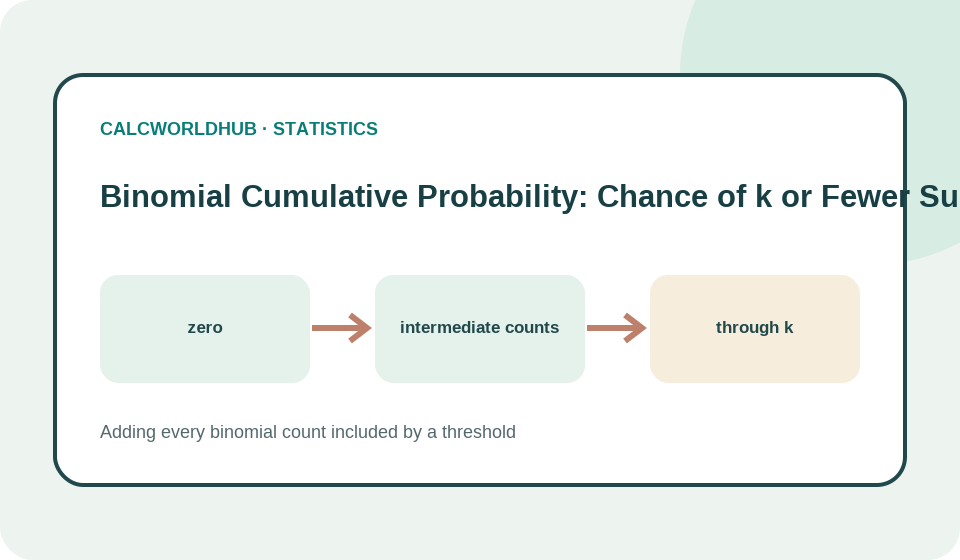
The cumulative event includes several mutually exclusive outcomes. “At most k” means zero, one, two, and every other feasible count through k; it does not mean exactly k. This is useful for setting an upper limit, such as the probability that no more than a specified number of events occur, while a lower-limit question such as “at least k” needs the complementary tail or a separate sum.
Define the count and rate inputs
Enter n, the number of trials; p, the success probability per trial as a decimal; and k, the inclusive upper count. In the mathematical model, n and k are integers, p lies from zero to one, and k is interpreted as a whole-count threshold. The numerical form may permit entries beyond the model’s meaningful range, so verify them before interpreting an output.
Add the point probabilities
The cumulative probability is P(X ≤ k) = Σ from j=0 to k of C(n,j)p^j(1−p)^(n−j). Each term is the probability of exactly j successes, and the sum combines outcomes that satisfy the “no more than” condition. OpenStax distinguishes point probabilities from cumulative events by summing the relevant binomial terms.
Keep the boundary inclusive
A threshold result depends on which side of the boundary is included. If a policy says “fewer than k,” the corresponding event is X ≤ k−1, whereas “k or fewer” includes X = k. If the tool field is labeled k as the maximum count, read the output as inclusive and avoid silently shifting the threshold by one.
Use the lower-tail result carefully
Cumulative probability can support a planning conversation, such as whether a specified count threshold is unusually low under a stated rate. It is not the same as expected successes, and it is not a guarantee that a group will stay within the limit. For a target in the upper tail, use 1−P(X≤k−1) for “at least k,” keeping the off-by-one boundary clear.
A threshold should be chosen from the operational rule or the question being studied, rather than selected after seeing the result. If a service target is a minimum number of successes, a lower-tail cumulative value measures the chance of falling at or below a boundary; for the chance of meeting the target, the boundary and complement must be stated precisely. Keep the inclusive wording beside the number in reports, because dropping the boundary count changes the sum and can change a conclusion near a cutoff.
The total probability over all feasible counts is one, so a lower-tail result can be checked against its complementary upper tail. For an event “more than k,” use 1−P(X≤k); for “at least k,” use 1−P(X≤k−1). These are different complements. The calculator’s lower tail is useful only after the event wording is translated into the correct inclusive cutoff.
Worked examples
Both calculations add the probability of every count from zero up to the inclusive threshold.
No more than two successes in twelve trials
Inputs: Trials n = 12; success probability p = 0.25; inclusive maximum k = 2.
Calculation: P(X ≤ 2) = Σ[j=0..2] C(12,j)(0.25)^j(0.75)^(12−j) = 0.3906750.
There is about a 39.07% chance of two or fewer successes under this model.
At most six successes in twenty trials
Inputs: Trials n = 20; success probability p = 0.40; inclusive maximum k = 6.
Calculation: P(X ≤ 6) = Σ[j=0..6] C(20,j)(0.40)^j(0.60)^(20−j) = 0.2500107.
The cumulative probability through six successes is approximately 25.00%.

Check fit before relying on a tail
The same p must represent every trial. If the success chance differs across attempts, summing the binomial formula with one average p is not generally equivalent to the real model. Record how p was estimated, the population or process it applies to, and whether a trial’s outcome can affect later trials before using the cumulative result in a decision.
The calculator does not estimate p, fit a distribution, or account for dependence between trials. It also does not select a threshold or decide what level of risk is acceptable. A small cumulative value can flag that the threshold is uncommon under the entered model, but operational decisions should also consider costs, sample design, measurement uncertainty, and the consequences of false alarms.