Binomial cumulative probability calculator
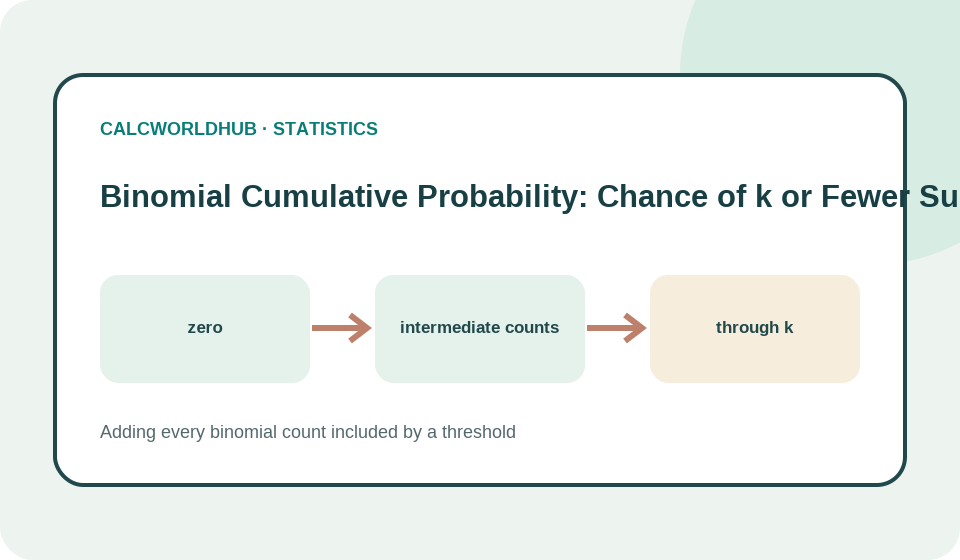
Evaluate the cumulative probability of at most k successes in independent binomial trials, with stable summation for larger counts.
How to use this calculator
Evaluate the cumulative probability of at most k successes in independent binomial trials, with stable summation for larger counts.
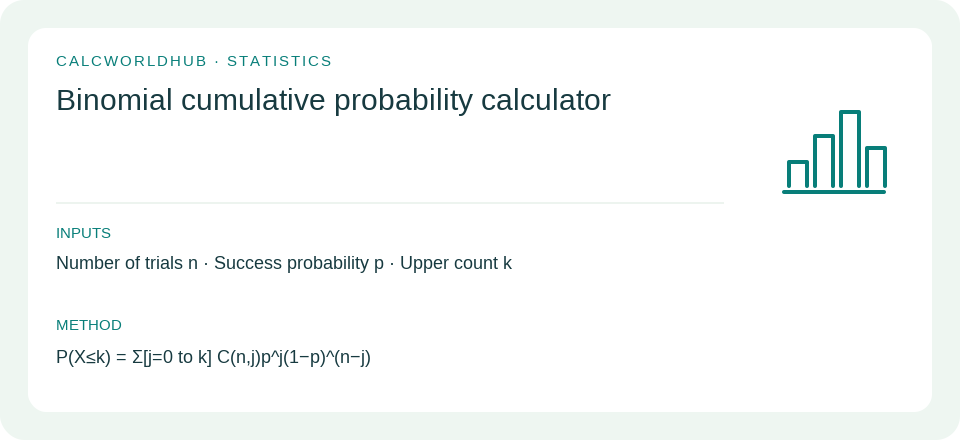
- Enter Number of trials n, Success probability p, Upper count k. Match the units shown beside each field and review the result together with the assumptions below.
- Read the worked example below to check the expected input format and result.
- Compare another scenario by changing one input at a time. Use Reset to return to the starting values.
How the Binomial cumulative probability calculator works
Evaluate the cumulative probability of at most k successes in independent binomial trials, with stable summation for larger counts.
Inputs and units
- Number of trials n: Whole number of independent trials n.
- Success probability p: Decimal success probability p, identical for each trial.
- Upper count k: Whole upper success threshold k; support boundaries are handled explicitly.
Formula and method
P(X≤k) = Σ[j=0 to k] C(n,j)p^j(1−p)^(n−j)
Worked example
For n=5, p=0.5, and k=2, the sum is (1+5+10)/32=0.5. For n=2000, p=0.5, k=1000, it is 0.5089195056.
Interpreting the result
This is the probability of the entire lower tail through k, including k. The complement is the probability of more than k successes.
Assumptions and limits
n and k must be whole numbers; 0≤n≤1,000,000 and 0≤p≤1. Negative k gives zero and k≥n gives one. Assumes identical independent success chances; mode-centered summation avoids underflow from starting at a tiny zero-success term.
Sources and method
- Documents binomial support and CDF; independent numerical checks use scipy.stats.binom.cdf. SciPy: binomial distribution
Frequently asked questions
How do I get P(X>k)?
Subtract this cumulative probability from one.
Does zero trials cause an error?
No. X is then always zero, so the CDF is zero below zero and one at or above zero.
How do I use the Binomial cumulative probability calculator?
Enter Number of trials n, Success probability p, Upper count k. Match the units shown beside each field and review the result together with the assumptions below.
What is a worked example of Binomial cumulative probability?
For n=5, p=0.5, and k=2, the sum is (1+5+10)/32=0.5. For n=2000, p=0.5, k=1000, it is 0.5089195056.
What does the Binomial cumulative probability calculator calculate?
Evaluate the cumulative probability of at most k successes in independent binomial trials, with stable summation for larger counts.
See the calculation methodology.