
Separate capacitance, charge, and energy
Capacitance C measures charge stored per voltage; it is entered in farads. A small component may be marked in microfarads or millifarads, so convert it before entering: 2,200 μF is 0.0022 F. Voltage V is the potential difference across the capacitor. The resulting energy is in joules. These quantities are related, but capacitance alone does not determine the energy without the operating voltage.
Apply the ideal energy equation
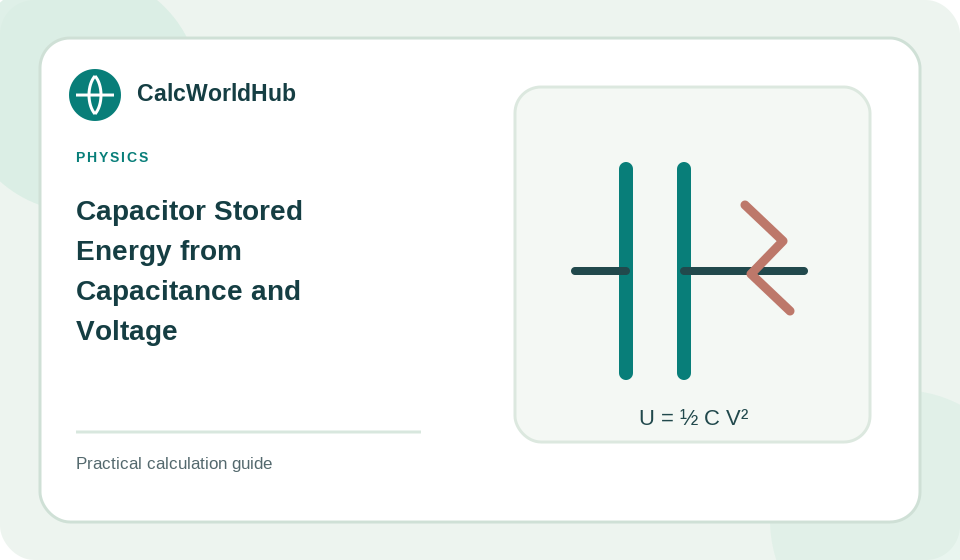
The stored-energy equation is U = ½CV². Its units reduce to joules when C is in farads and V is in volts. The square matters: a capacitor charged to 24 V stores four times as much energy as the same capacitor at 12 V. The calculation assumes an ideal capacitance and does not include leakage, equivalent series resistance, dielectric behavior, or energy lost in a discharge path.
Read a result in joules
Convert capacitance to farads before applying U = ½CV², and remember that energy grows with the square of voltage. The result describes stored energy at the stated voltage; it does not describe discharge time, peak current, usable energy under a load, or circuit losses. Those questions require resistance, switching behavior, voltage limits, and the discharge path.
Use voltage squared carefully
The ideal equation uses V², so reversing polarity without changing voltage magnitude does not change the energy estimate. The component’s voltage rating is a separate safety limit: an equation can produce an energy value for a voltage that exceeds the part’s rating, but that does not make the operating point acceptable. Use the specified maximum voltage, tolerance, temperature rating, and circuit protection when selecting parts.
Know what this calculation cannot answer
The calculator does not model a circuit’s discharge time, peak current, usable energy above a cutoff voltage, or the energy dissipated in a resistor. Those results depend on connected components and their tolerances. Real capacitors also have leakage and dielectric losses. OpenStax presents the ideal field-energy relation; use manufacturer datasheets and electrical safety guidance for component limits and real circuit design.
Treat energy as a service condition, not a handling shortcut
Stored energy depends on the voltage actually present, which can remain after a supply is disconnected. Before service, use the equipment procedure to discharge the capacitor through an appropriate path and verify voltage with a suitable instrument. The energy equation does not tell you what resistor is safe, how hot a discharge component will become, or whether other circuit elements can recharge the capacitor. Those questions require a circuit-specific design and safety review. Use the datasheet to check voltage and temperature limits.
Connect the estimate to a circuit decision
The stored-energy result can help compare component choices or estimate the energy present before service. Before touching a capacitor, follow the equipment’s discharge and verification procedure; stored energy can remain after power is removed. For a circuit design, calculate current and time behavior separately and consider the worst-case capacitance and voltage. The article’s arithmetic is a starting point, not a substitute for safe work practices.
Worked examples
The ideal capacitor model uses U = ½CV². Capacitance is entered in farads and voltage in volts; output is in joules.
Energy in a 2,200 μF capacitor at 24 V
Inputs: Capacitance C = 0.0022 F (2,200 μF); voltage V = 24 V.
Calculation: U = ½CV² = 0.5×0.0022×24² = 0.0011×576 = 0.6336 J.
The ideal stored energy is 0.6336 J. It does not predict discharge current or time through a particular circuit.
Compare a smaller capacitor at 12 V
Inputs: Capacitance C = 470 μF = 0.00047 F; voltage V = 12 V.
Calculation: U = 0.5×0.00047×12² = 0.000235×144 = 0.03384 J.
The ideal energy is 0.03384 J. The lower capacitance and voltage both reduce stored energy, with voltage entering quadratically.
