
Describe one circular-motion case
Choose the speed along the path, not a change in speed per second, and the radius measured from the centre of curvature to the object’s path. A car’s path radius is not necessarily the road’s painted width; an orbit uses the body’s distance from the orbital centre. The calculator treats the entered values as one instant or one representative constant-radius condition.
Keep the inputs in SI units
The fields are tangential speed in m/s and path radius in m. Convert kilometres per hour to m/s by dividing by 3.6, and centimetres to metres by dividing by 100. Because speed is squared, a missed conversion is amplified. For example, entering 72 as though it were m/s when the actual speed is 72 km/h gives a result 12.96 times the correct result for the same radius. The current input rules require a nonnegative speed and a positive radius; zero speed is valid and produces zero acceleration.
Apply the inward-acceleration formula
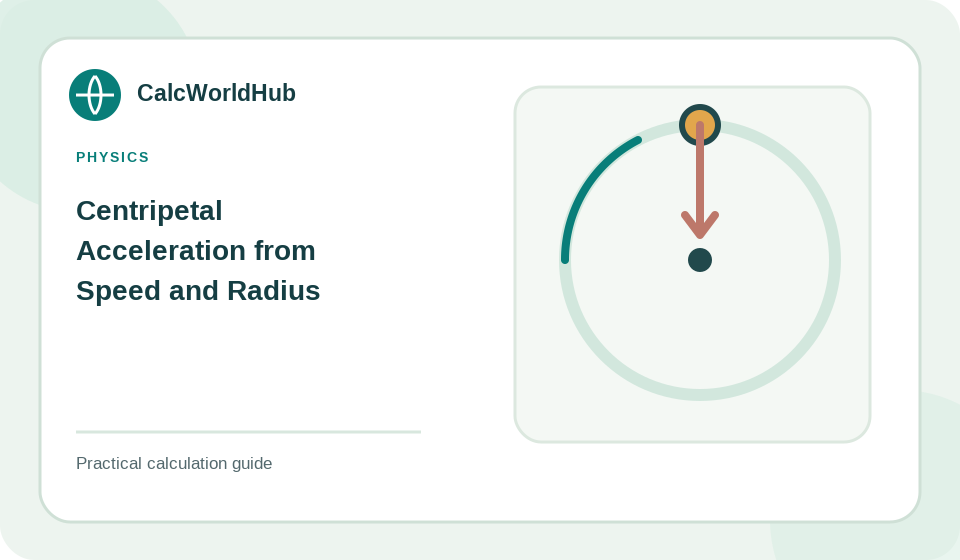
The magnitude is a₍c₎ = v²/r. Squaring speed gives m²/s²; dividing by metres leaves m/s². The direction is toward the centre of curvature, so “centripetal” names a direction as well as a scalar magnitude. The calculator reports the magnitude only. OpenStax derives this relationship for circular motion and distinguishes inward acceleration from tangential changes in speed.
See how radius changes the answer
At a fixed speed, halving the radius doubles the acceleration. At a fixed radius, doubling speed makes acceleration four times as large. This squared dependence is why a modest speed change can matter more than a similar percentage change in radius. Use comparable units and the same definition of the path before interpreting two results as a real difference.
Do not confuse acceleration with force
The result is not a force. To estimate the net inward force on an object of mass m, Newton’s second law would require F = m a₍c₎, but mass is not an input here. Nor does the result specify tire friction, bank angle, engine power, or structural capacity. A vehicle’s safe speed depends on road and weather conditions; the equation alone cannot provide a safe driving recommendation.
State what the model leaves out
The page assumes motion on a circular path with constant radius and returns acceleration magnitude, not a direction vector. A changing radius, speed profile, or three-dimensional trajectory requires a fuller model. Record the speed, radius, unit conversions, and where the path centre was chosen. Use an appropriate mechanics source or engineering analysis when the acceleration is used for design or safety decisions.
Worked examples
The two examples use speed in m/s and radius in m. The reported quantity is inward acceleration magnitude.
A 15 m/s object on a 45 m radius
Inputs: Tangential speed v = 15 m/s; radius r = 45 m.
Calculation: a₍c₎ = v²/r = 15²/45 = 225/45 = 5 m/s².
The required inward acceleration magnitude is 5 m/s². This is acceleration, not force; mass would be needed to calculate net force.
A faster path with a wider radius
Inputs: Tangential speed v = 20 m/s; radius r = 100 m.
Calculation: a₍c₎ = 20²/100 = 400/100 = 4 m/s².
Although the speed is higher, the much wider curve gives a lower acceleration magnitude than Example 1. The comparison depends on both inputs, with speed squared in the numerator.

Compare the magnitude with a familiar scale
For context only, dividing an acceleration by standard gravity gives an approximate multiple of g: 5 m/s² is about 0.51 g, and 4 m/s² is about 0.41 g. This conversion does not change what the calculator reports, and it does not predict how a rider or vehicle will feel. The applied forces and their directions still determine the motion and any safety margin.
Cross-check from angular speed
If angular speed ω is known in radians per second, the same circular-motion model gives v = rω and therefore a₍c₎ = rω². Convert rotations per minute to radians per second by multiplying by 2π/60 before using that relation. It is an alternate calculation, not an additional output from this page, and still assumes the same circular path radius.