
Read the two example results
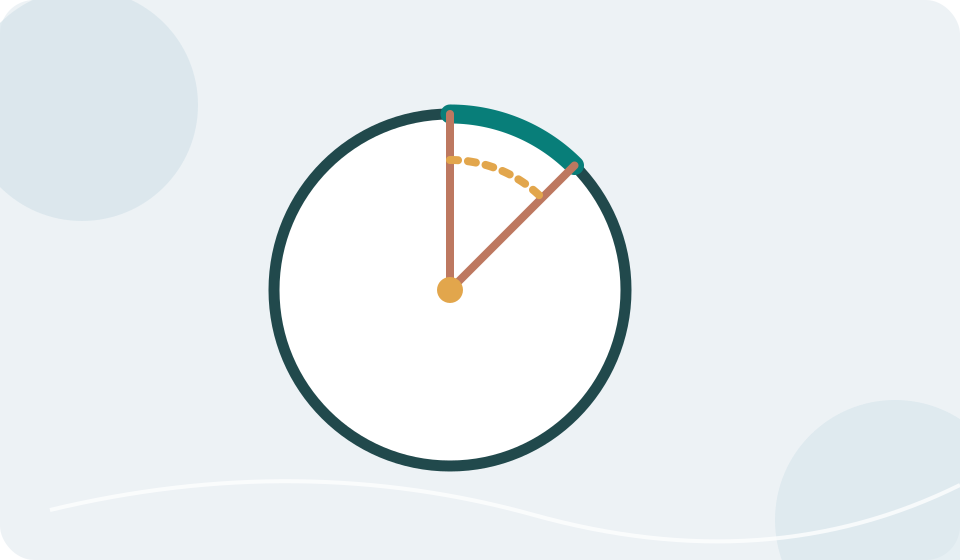
The first example describes a 75° sector of a 5-unit-radius circle. The full circumference would be 31.4159 units, and 75° is 75/360 of one turn. Multiplying those values gives 6.5449847 units, displayed as 6.5450. This is the curved path between the two radii; it is longer than the chord joining the same endpoints.
In the second example, a 90° angle is one quarter of a turn. A circle with radius 10 units has circumference 62.8319 units, so its quarter-circle arc is 15.7079633 units, displayed as 15.7080. Doubling the radius doubles the arc when the angle stays fixed, which provides a quick proportional check.

Formula and degree conversion
The calculator uses s = 2πrθ/360 when θ is entered in degrees. Here r is the circle radius, θ is the central angle, and s is arc length. The factor 2πr is the complete circumference; θ/360 is the fraction of a full revolution. The result therefore has the same units as r.
A radian-based formula is s = rθ, but it requires θ in radians. The calculator’s field is explicitly in degrees, so convert by multiplying degrees by π/180 before using the radian formula. Do not enter 90 as though it were 90 radians: that would describe more than fourteen complete turns and produce a much larger value.
Use the result for a real path
This distance is useful when estimating material that follows a circular edge: trim around a curved opening, a band around part of a wheel, or a cable routed over an arc. The geometry only gives the ideal path length. Add a separate allowance for joints, overlap, fastening, stretch, or installation waste when the job requires it; those allowances are not part of the equation.
Measure the radius from the circle’s center to the curve, not from the center to the edge of a central hole unless that inner boundary is the curve being measured. If a drawing gives diameter, divide it by two first. State the unit beside your inputs because this calculator uses generic length units and carries no automatic conversion between millimeters, inches, or feet.
How angle and radius change the answer
With radius fixed, arc length changes directly with the angle. A 60° arc is one sixth of a circumference, while a 120° arc is one third; doubling the angle doubles the distance. With angle fixed, doubling radius also doubles the result. If both inputs change, multiply the two scale factors to predict how the arc changes before calculating again.
A 360° input returns one whole circumference. The source runtime accepts any finite nonnegative angle, so an angle above 360° represents an accumulated path through more than one full turn. If the intended task is the shorter arc between two points, first identify the minor central angle rather than entering a reflex or multi-turn angle by mistake.
Units, limits, and common input errors
The radius must be positive and the angle cannot be negative. A radius of zero has no meaningful circle for this tool and is rejected by its validation layer. The angle has no upper cap in the shipped runtime, but very large values should be treated as repeated revolutions, not as a conventional single central angle. The output is rounded for display; keep unrounded measurements for downstream work.
The most frequent mistakes are entering diameter as radius, using a perimeter when the question asks for only a portion, and mixing a degree value with a radian formula. Each changes the result in a predictable way: using diameter doubles the calculated arc, while using 90 radians instead of 90° multiplies the sweep by about 57.3. Label the angle unit before entering it.
A repeatable verification
For an independent check, calculate C = 2πr, then multiply by θ/360. For r = 5 and θ = 75°, C = 31.4159265 and the fraction is 0.2083333, giving s = 6.5449847. Alternatively, convert θ to radians and compute rθ; both routes should agree apart from rounding.
Record whether you used a minor arc, a major arc, or more than one revolution. That note makes a result reproducible when two endpoints could define two different paths. The calculator does not infer an angle from endpoints, find a chord, or estimate a curved object from a photograph. Use the right geometric quantity for the design question.
Worked examples
A 75-degree arc on a 5-unit radius
Inputs: Radius r = 5 length units; central angle θ = 75°; same chosen length unit throughout.
Calculation: s = 2π × 5 × 75 / 360 = 6.54498469498 length units.
Arc length = 6.5450 length units.
Quarter-circle arc on a 10-unit radius
Inputs: Radius r = 10 length units; central angle θ = 90°.
Calculation: s = 2π × 10 × 90 / 360 = 15.7079632679 length units.
Arc length = 15.7080 length units.