Math calculator guides
Explore 57 practical guides with worked examples, clear assumptions, and direct links to the calculators they explain.
Showing 1–12 of 57 articles
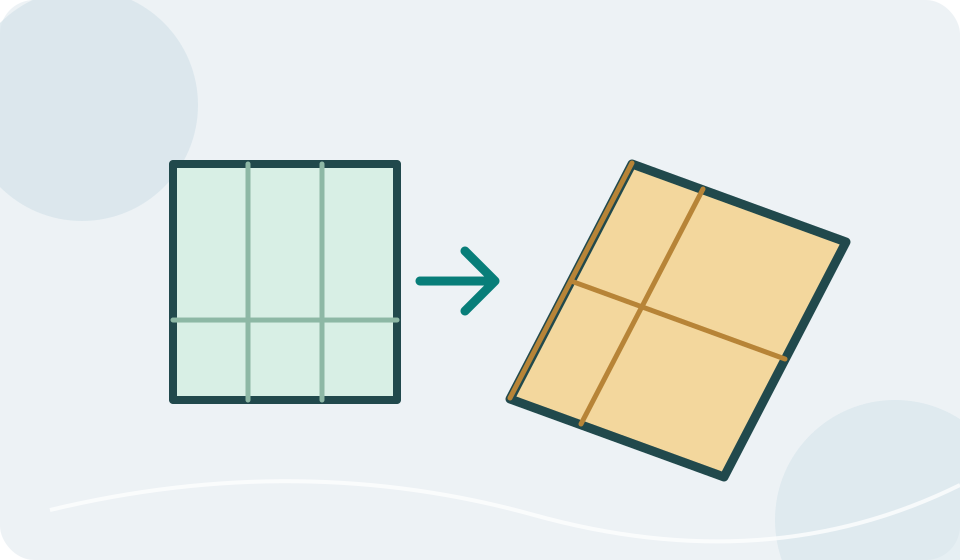
The 2×2 Determinant: Area Scaling and Singularity
Calculate ad − bc for a 2×2 matrix and interpret its sign, magnitude, and zero case.
Read article
How to Invert a 2×2 Matrix and Check the Result
Use the determinant and adjugate formula to invert a nonsingular 2×2 matrix, then verify the product against the identity.
Read article
2×2 Eigenvectors: Directions Preserved by a Transformation
Find a normalized eigenvector for a supplied eigenvalue, and check the defining equation A v = λ v for a real 2×2 matrix.
Read article
How to Multiply 2×2 Matrices: Row-by-Column Steps
Multiply two 2×2 matrices in a fixed order, calculate each row-by-column dot product, and check the resulting transformation.
Read article
2×2 Matrix Rank: Independent Rows, Determinants, and Tolerance
Interpret the rank of a 2×2 matrix and understand the determinant threshold used by this calculator.
Read article
2D Dot Product: Components, Angle, and Interpretation
Calculate the scalar product of two planar vectors and use its sign to reason about their alignment.
Read article
2D Cross Product: Signed Area and Orientation
Calculate the signed z component of two planar vectors and interpret its magnitude as parallelogram area.
Read article
Solve a 3×3 Linear System with Cramer’s Rule
Set up Ax=b, check the determinant, and verify a unique three-variable solution by substitution.
Read article
How to Find the Determinant of a 3×3 Matrix
Calculate a 3×3 determinant by cofactor expansion, interpret its signed volume scale, and check the calculator’s relative singularity tolerance.
Read article
Frobenius Norm of a 3×3 Matrix: Formula and Examples
Calculate the Frobenius norm from all nine entries, interpret its squared value, and distinguish it from other matrix norms.
Read article
How to Calculate the Trace of a 3×3 Matrix
Add the three principal diagonal entries of a 3×3 matrix and learn what trace can summarize—and what it cannot.
Read article
How to Apply a 3×3 Matrix to a Vector
Multiply each row of a 3×3 matrix by a three-component column vector and verify the transformed coordinates.
Read article