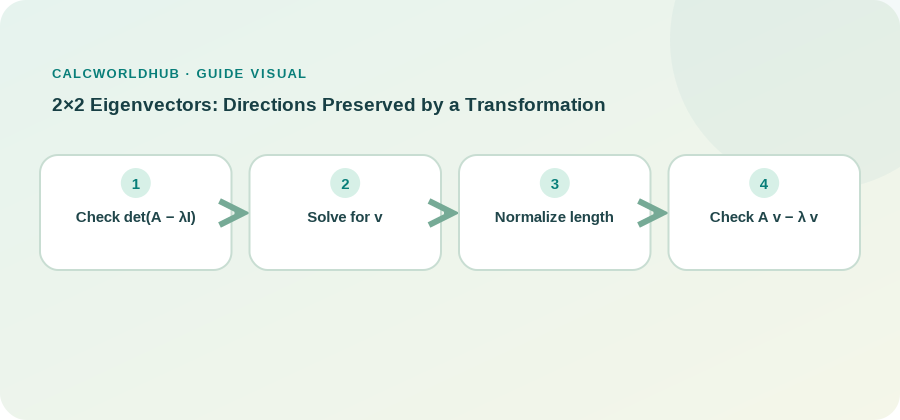
Test the candidate eigenvalue
Move λv to the left: (A − λI)v = 0. A nonzero solution requires A − λI to be singular. For A = [[a,b],[c,d]], check (a − λ)(d − λ) − bc = 0. The tool tests the supplied real λ; it does not find every eigenvalue for you.
If the determinant is nonzero, the only solution is the zero vector, which is not an eigenvector. Small rounding differences in matrix entries can affect the check, so use the precision needed for the calculation you want to reproduce.
Recover and normalize a direction
For a valid λ, solve the dependent rows of (A − λI)v = 0 for a nonzero pair (x,y). The calculator scales that pair to unit length by dividing each component by √(x² + y²). The normalized result is convenient for comparison, but the equation itself does not require unit length.
The vector and its negative describe the same eigenvector line. Other methods may therefore return opposite signs without disagreeing about the direction.
Interpret the eigenvalue
A positive λ keeps the direction and scales its length; a negative λ also reverses its orientation, with magnitude |λ|. At λ = 0, the eigenvector is mapped to the zero vector. These statements apply to vectors on that eigenvector line, not to every vector in the plane.
Repeatedly applying A multiplies an eigenvector by successive powers of λ. In an application, interpret that scale only after confirming what the matrix coordinates and units represent.
Check the result and its limits
Substitute the result back into r = Av − λv. An exact pair has residual (0,0); a rounded display should leave a small residual. The determinant condition is a second check, though its tolerance depends on the scale and precision of the entries.
A repeated eigenvalue may have one eigendirection or a larger eigenspace. This calculator returns one real normalized direction; it does not provide an eigenspace basis, complex eigenpairs, multiplicities, or a stability analysis.
Use a candidate direction carefully
Start with the exact matrix entries and candidate eigenvalue you want to test. The calculator checks that supplied value; it does not solve the characteristic equation to discover all eigenvalues. If an eigenvalue came from rounded software output, the determinant test may leave a residual, so keep the precision and tolerance appropriate to the source.
The nullspace of A − λI contains the eigenvectors for λ together with the zero vector. An eigenvector itself must be nonzero. In two dimensions, dependent rows leave a direction that can be scaled freely; normalization chooses length one for easier comparison, not because the underlying equation requires a unit vector.
An eigendirection is a line through the origin. The returned unit vector and its negative represent that same line. When comparing two outputs, check whether one is the sign-reversed version before treating them as different directions. A sign convention can make displays consistent, but it cannot change which line is preserved.
A repeated eigenvalue does not guarantee two independent eigenvectors. The matrix may have only one eigendirection, or a two-dimensional eigenspace in a special case. This calculator returns one real direction for an accepted real candidate and does not diagnose diagonalizability or provide a full basis.
For an applied matrix, interpret λ only after identifying what the components and units represent. Repeated application scales the eigenvector by powers of λ, but this statement does not describe every initial vector unless the matrix has an appropriate eigenbasis. The result is a linear-algebra check, not a stability conclusion for an unstated model.
Worked examples
Example 1 · symmetric matrix
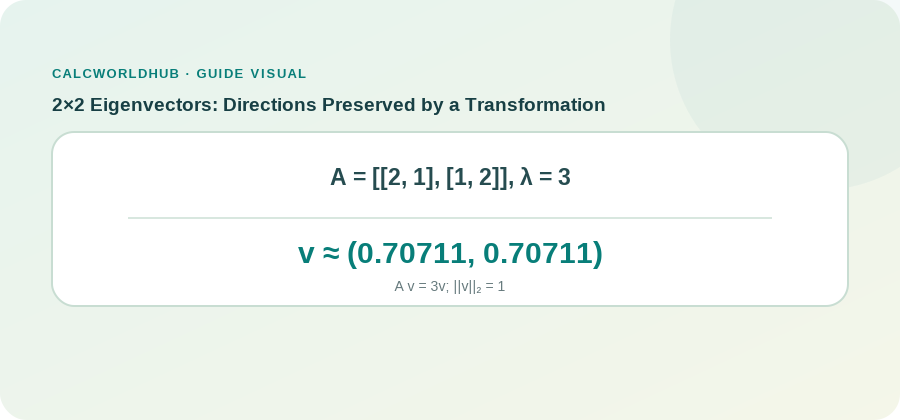
A = [[2, 1], [1, 2]] and λ = 3. Multiplying the matrix by this unit vector returns three times the same vector.
det(A − 3I) = (−1)(−1) − 1 = 0. The direction (1, 1) satisfies A v = 3v; its length is √2, so the unit vector is (1/√2, 1/√2) ≈ (0.70711, 0.70711).
Example 2 · a direction with opposite signs
A = [[4, 1], [2, 3]] and λ = 2. The negative second component is part of the direction; reversing both signs would describe the same eigenvector line.
det(A − 2I) = 2 × 1 − 1 × 2 = 0. The vector (1, −2) satisfies A v = (2, −4) = 2v. Its norm is √5, giving the unit vector (1/√5, −2/√5) ≈ (0.44721, −0.89443).
Sources