Computer science calculator guides
Explore 11 practical guides with worked examples, clear assumptions, and direct links to the calculators they explain.
Showing 1–11 of 11 articles

Addressable Memory Capacity: Convert Address Bits to Bytes
Estimate the byte-addressable address space represented by an address width, then distinguish theoretical capacity from installed memory.
Read article
Algorithm Input Growth Ratio: Compare Work Across Input Sizes
Compare two input sizes under a selected polynomial exponent while separating the growth model from measured execution time.
Read article
Amdahl’s Law: Estimate Parallel Speedup from a Serial Fraction
Estimate ideal speedup from a parallelizable workload fraction and processor count, then interpret the serial-work ceiling.
Read article
Average Memory Access Time: Combine Cache Hits and Misses
Estimate one-level cache average access time from hit time, miss rate, and the incremental miss penalty.
Read article
Bandwidth-Delay Product: Estimate Data in Flight
Multiply link bandwidth by round-trip time to estimate the data volume associated with a network path’s delay.
Read article
Print Size from Pixel Dimensions and DPI
Convert an image's pixel dimensions to nominal print size at a chosen pixels-per-inch setting and understand what resolution does not guarantee.
Read article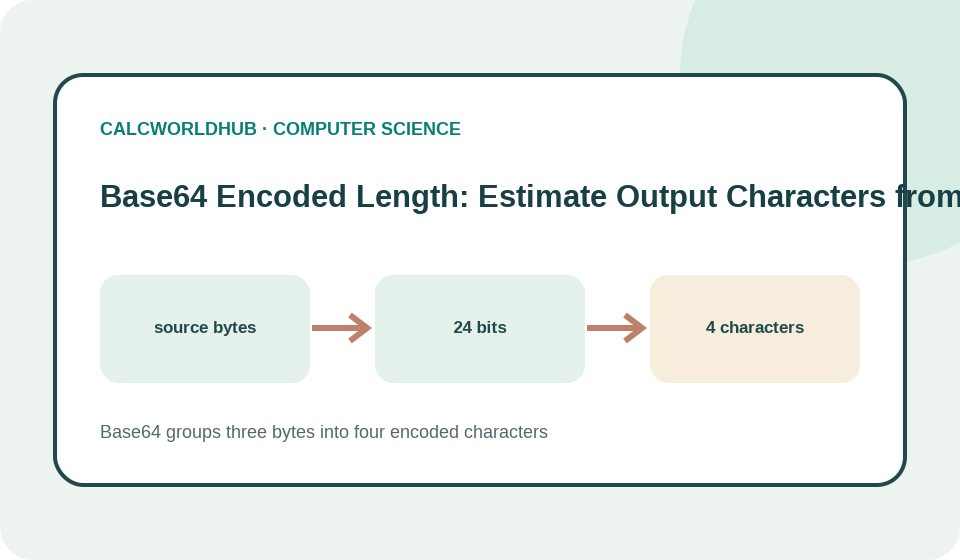
Base64 Encoded Length: Estimate Output Characters from Bytes
Estimate the padded Base64 character count for a known input size in bytes using RFC 4648 grouping.
Read article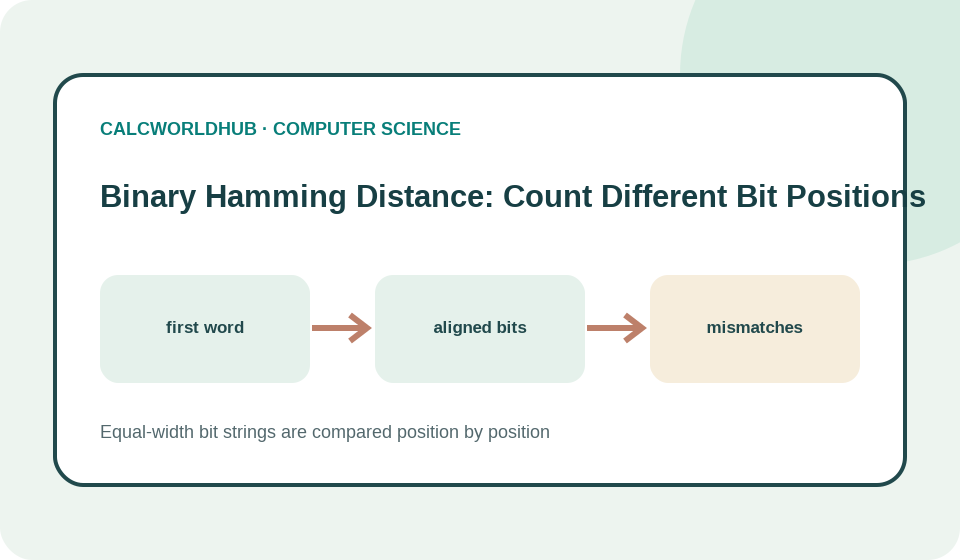
Binary Hamming Distance: Count Different Bit Positions
Count the bit positions that differ between two equal-length binary strings using Hamming distance.
Read article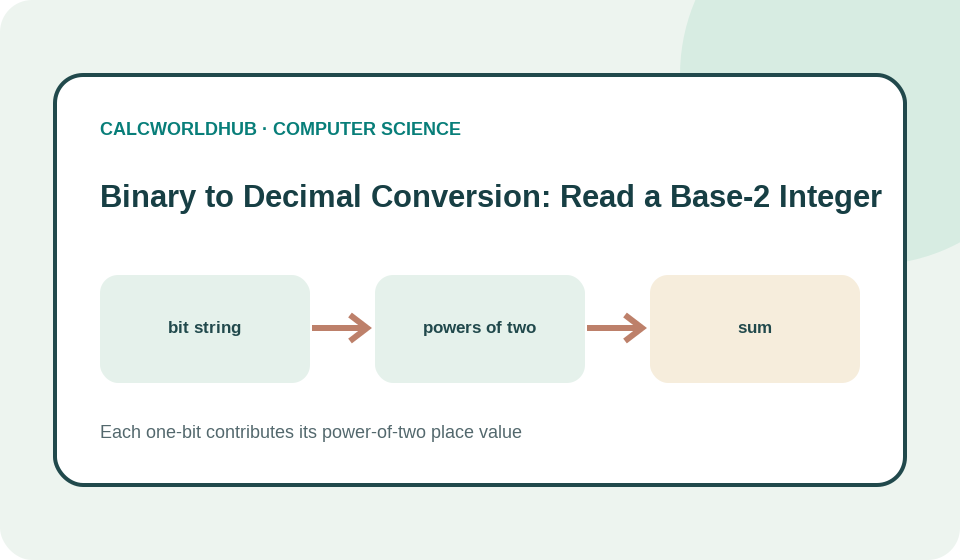
Binary to Decimal Conversion: Read a Base-2 Integer
Convert an unsigned binary digit string into its base-ten integer value using positional powers of two.
Read article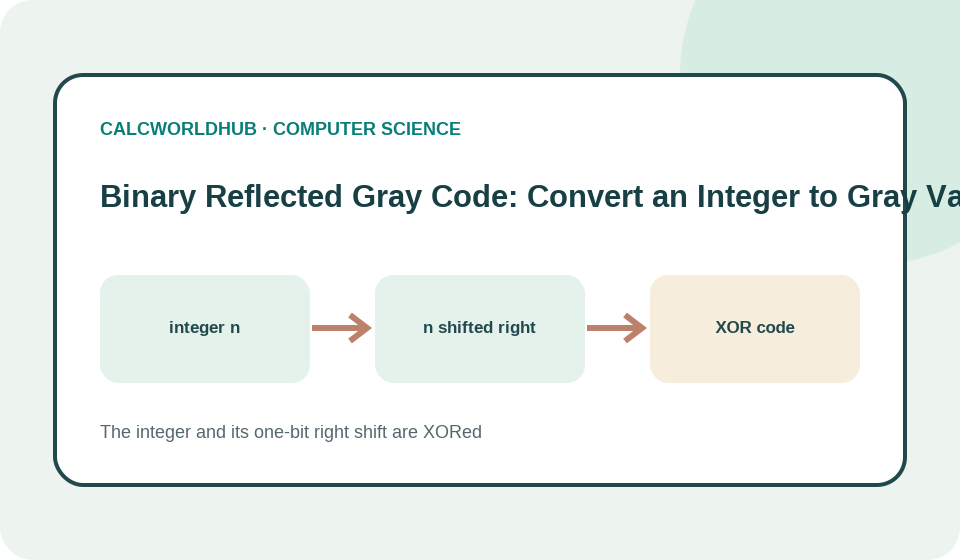
Binary Reflected Gray Code: Convert an Integer to Gray Value
Encode a nonnegative integer as binary-reflected Gray code using n XOR (n shifted right by one bit).
Read article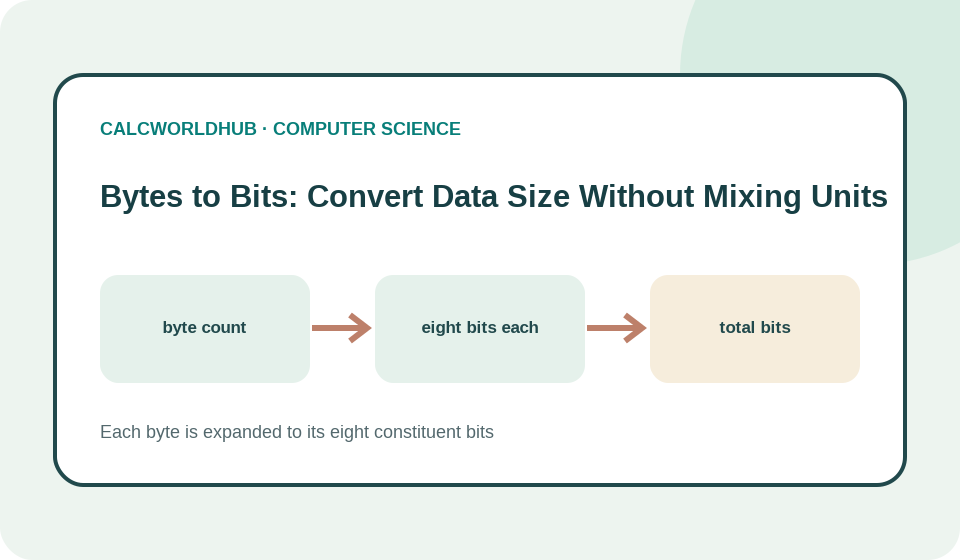
Bytes to Bits: Convert Data Size Without Mixing Units
Convert a byte count to bits using the NIST definition of one byte as eight bits.
Read article