Chemistry calculator guides
Explore 12 practical guides with worked examples, clear assumptions, and direct links to the calculators they explain.
Showing 1–12 of 12 articles

Molarity: Convert Solute Amount to Solution Volume
Calculate amount concentration as moles of solute divided by the final volume of the solution in litres.
Read article
Ideal-Gas Molar Volume: Pressure and Temperature Matter
Estimate ideal-gas volume per mole from absolute pressure and kelvin temperature, while stating the selected conditions.
Read article
Molar Mass from a Formula: Add Atomic Contributions
Estimate molar mass by multiplying each of two entered atomic masses by its atom count and adding the contributions.
Read article
Absorbance and Transmittance: How to Convert Light Measurements
Convert a decadic absorbance reading into percent transmittance, check the inverse logarithmic relationship, and understand what the measurement does not reveal.
Read article
Acid Dissociation Constant from pKa: Calculate Ka
Convert pKa to Ka with the base-10 relation, read the scale correctly, and distinguish a numerical conversion from a full equilibrium calculation.
Read article
Activation Energy from Two Rate Constants: Apply the Arrhenius Relation
Estimate an apparent Arrhenius activation energy from two rate constants measured at distinct absolute temperatures, with units and assumptions made explicit.
Read article
Antoine Equation: Estimate a Pure-Component Vapor Pressure
Use a matched Antoine coefficient set and temperature range to estimate saturation vapor pressure without mixing unit conventions or extrapolating blindly.
Read article
Arrhenius Rate Constant: Compare Reaction Rates by Temperature
Evaluate an Arrhenius rate constant from its pre-exponential factor, activation energy, and absolute temperature, while keeping units and reaction context consistent.
Read article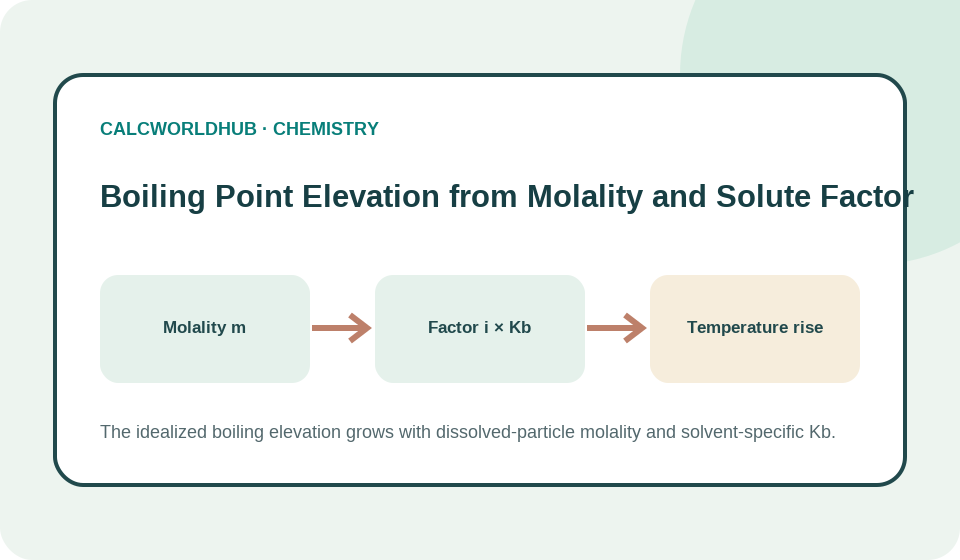
Boiling Point Elevation from Molality and Solute Factor
Estimate the boiling-temperature increase from molality, solvent ebullioscopic constant, and an effective particle factor.
Read article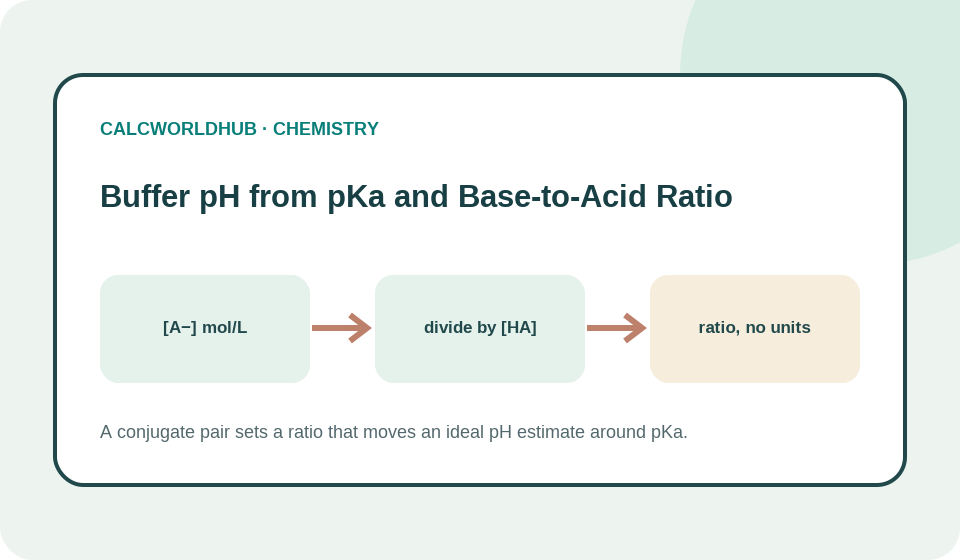
Buffer pH from pKa and Base-to-Acid Ratio
Estimate buffer pH from the acid pKa and the conjugate-base to weak-acid concentration ratio, with the equation, assumptions, and limits explained.
Read article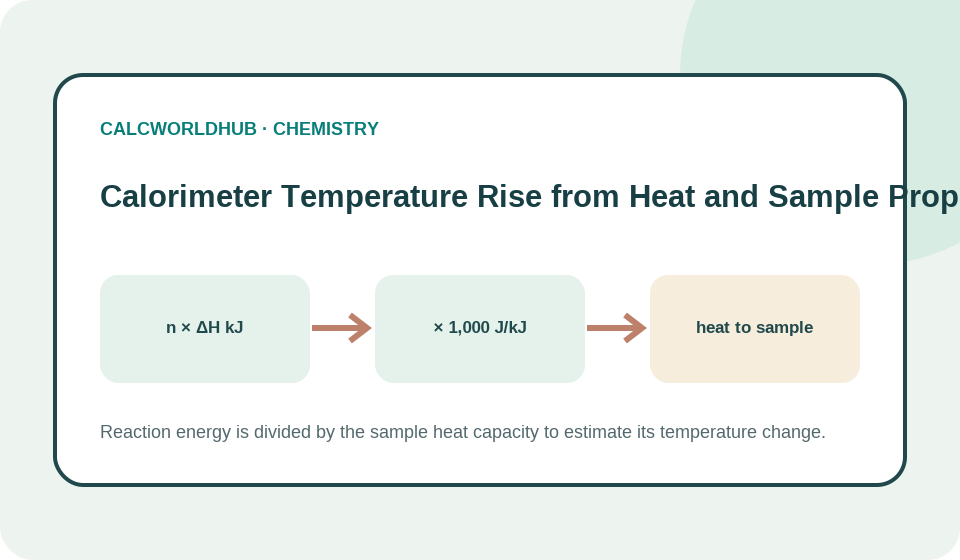
Calorimeter Temperature Rise from Heat and Sample Properties
Estimate the ideal temperature change from reaction amount, molar enthalpy, sample mass, and specific heat, with the sign convention and heat-loss limits made clear.
Read article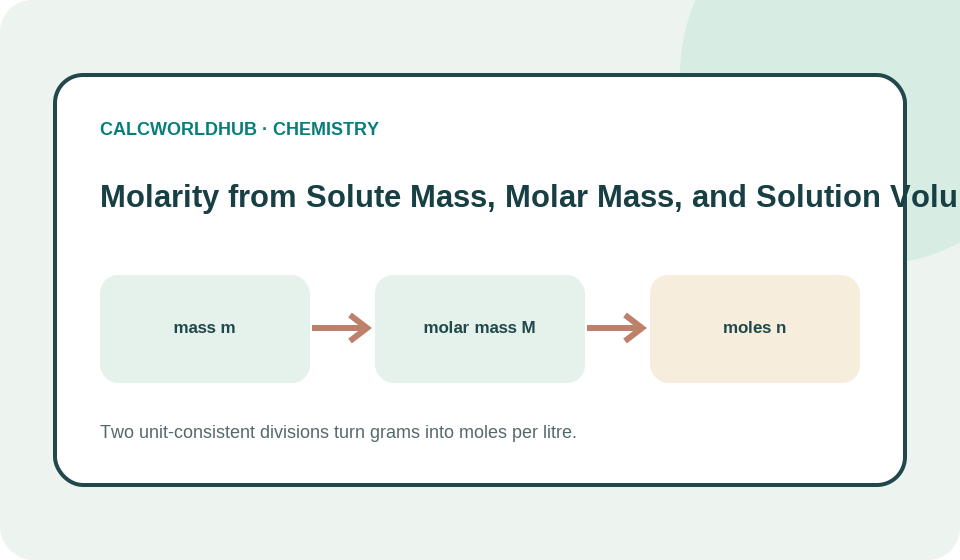
Molarity from Solute Mass, Molar Mass, and Volume
Estimate amount concentration from solute mass, molar mass, and the final volume of the prepared solution.
Read article