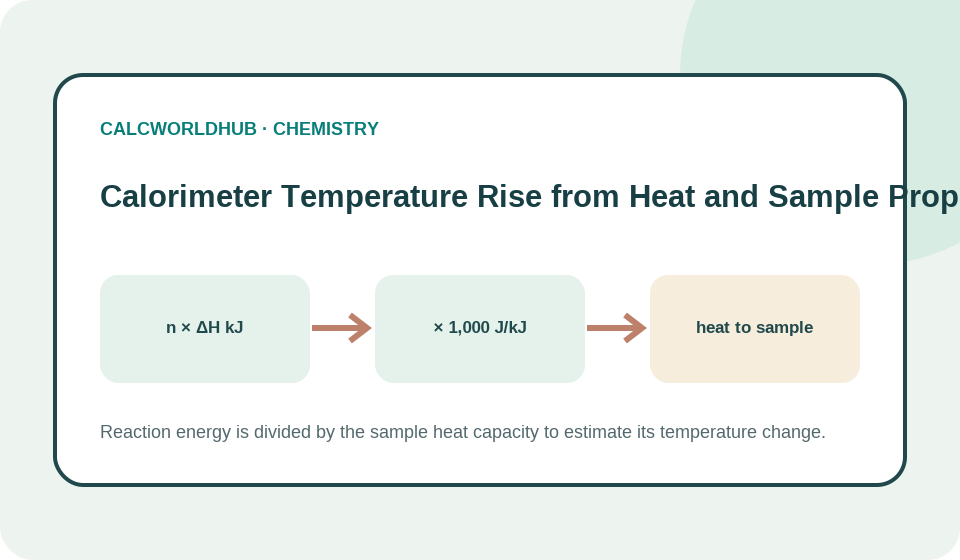

Start with the reaction heat
The input n is the amount of reaction in moles, and ΔH is the molar enthalpy change in kilojoules per mole. Multiplying them gives reaction energy in kilojoules. The calculator converts that product to joules before dividing by the sample mass and specific heat, because the entered heat capacity is in joules per gram per kelvin. Keeping track of units prevents a thousand-fold error.
The minus sign expresses energy transfer from reaction to sample. A negative ΔH describes an exothermic reaction under the entered convention, so the sample’s calculated change is positive. A positive ΔH represents an endothermic reaction and gives a negative sample change. The result is a change, not an absolute final temperature; add it to a justified initial temperature only when that starting state is known.
Understand mass and specific heat
The mass field is the sample mass in grams. The specific-heat field is the sample’s heat capacity per gram per kelvin, in J/(g·K). Their product is the sample heat capacity in J/K. A larger mass or larger specific heat spreads the same transferred energy over more thermal capacity and therefore reduces the magnitude of the temperature change.
Choose a specific heat for the material and phase actually represented by the sample. A water-like liquid may be approximated with a value near 4.18 J/(g·K), but a concentrated solution, solid, gas, or changing phase can have a different value. If the system contains multiple materials, a single entered mass and specific heat cannot represent all of their separate heat capacities unless you first combine them appropriately.
Keep the energy balance dimensionally consistent
The model is ΔT = −nΔH × 1000 ÷ (m c), where the factor 1000 changes kilojoules to joules. The units reduce as (mol × kJ/mol × 1000 J/kJ) ÷ (g × J/(g·K)) = K. For temperature differences, one kelvin has the same magnitude as one degree Celsius, although the calculator labels its output in kelvins.
Check the reaction basis when entering n. If ΔH is reported per mole of reaction as written, n must represent moles of reaction events on that same equation basis, not automatically moles of one reactant when stoichiometric coefficients differ. A mismatched reaction basis changes the energy before any calorimeter calculation takes place.
Read the sign and displayed precision
The calculator displays four decimal places in kelvins, so a small result may show several digits even when the physical inputs are approximate. Treat the digits as arithmetic output, not experimental accuracy. If mass, enthalpy, or specific heat has limited precision, round the final interpretation to match the least certain measurement and report any assumptions alongside it.
A negative result is not an error by itself: it means a modeled temperature decrease for the sample under the selected sign convention. A positive result means a modeled increase. The calculation does not output the reaction’s final equilibrium temperature, rate, or duration; it only estimates a temperature difference from the supplied energy and heat capacity.
Limits of the ideal temperature change
The formula assumes all reaction heat represented by nΔH is transferred to the entered sample. A real calorimeter can absorb energy, lose heat to its surroundings, or contain a thermometer, lid, vessel, stirrer, and other materials with their own heat capacities. OpenStax’s calorimetry treatment explicitly distinguishes heat absorbed by a solution from heat exchanged with a calorimeter and surroundings; this compact calculator does not model those extra terms.
The result also assumes the reaction amount and enthalpy are appropriate for the actual conversion, with no unmodeled phase change or temperature-dependent heat capacity. If the experimental goal requires a reliable temperature, use a calibrated setup, account for the calorimeter constant and losses, and compare the prediction with measured data. Do not use a simple estimate as a substitute for process safety limits.
Worked examples
The examples convert kJ to J before dividing by the sample heat capacity, and preserve the sign of the temperature change.
Exothermic reaction warming the sample
Inputs: Reaction amount = 0.0200 mol; ΔH = −40.0 kJ/mol; sample mass = 100 g; specific heat = 4.18 J/(g·K).
Calculation: ΔT = −(0.0200 × −40.0 × 1000) ÷ (100 × 4.18) = 800 ÷ 418 = 1.9139 K.
The sample’s idealized temperature change is +1.9139 K.
Endothermic reaction cooling a smaller sample
Inputs: Reaction amount = 0.0100 mol; ΔH = +25.0 kJ/mol; sample mass = 75 g; specific heat = 0.90 J/(g·K).
Calculation: ΔT = −(0.0100 × 25.0 × 1000) ÷ (75 × 0.90) = −250 ÷ 67.5 = −3.7037 K.
The idealized sample temperature change is −3.7037 K, a decrease of about 3.70 °C.
