Calorimeter temperature change calculator
The reaction releases or absorbs heat while the calorimeter changes temperature. This version reports a signed change: positive means warming and negative means cooling.
Calculator


How to use this calculator
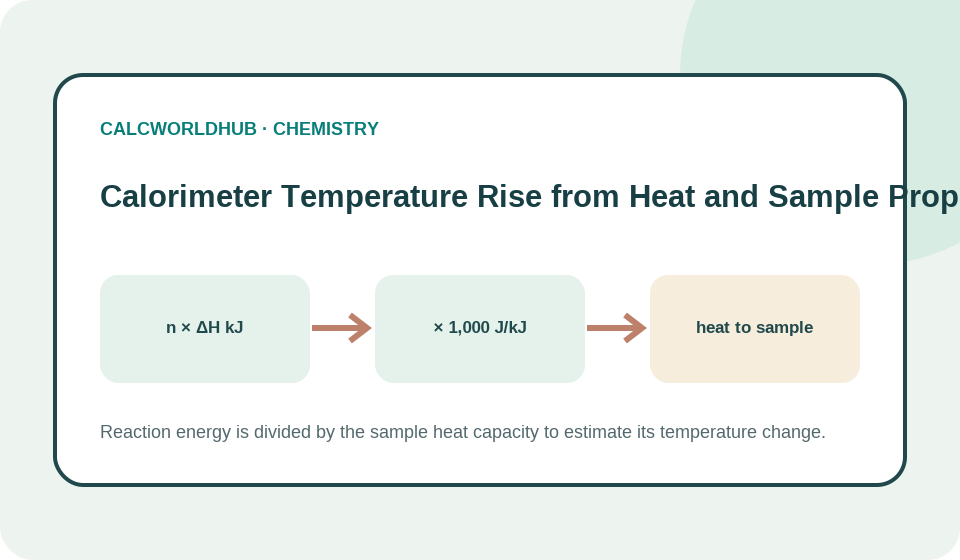
Estimate a calorimeter’s signed temperature change from reaction amount, molar enthalpy, calorimeter mass, and specific heat.
- Reaction amount n (mol) Molar enthalpy ΔH (kJ/mol) Calorimeter mass (g) Specific heat (J/g·K)
- Read the worked example below to check the expected input format and result.
- Compare another scenario by changing one input at a time. Use Reset to return to the starting values.
Calorimeter temperature change calculator
The reaction releases or absorbs heat while the calorimeter changes temperature. This version reports a signed change: positive means warming and negative means cooling.
Inputs and units
- Reaction amount n (mol)
- Molar enthalpy ΔH (kJ/mol)
- Calorimeter mass (g)
- Specific heat (J/g·K)
Formula and method
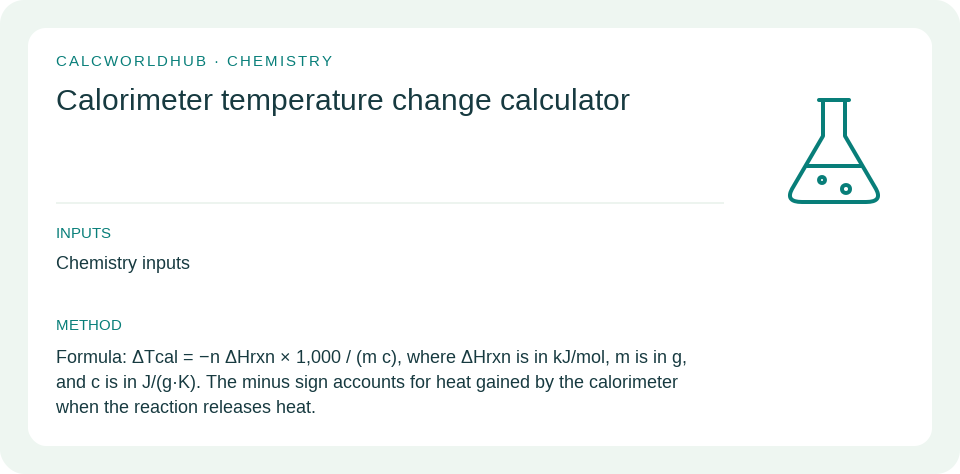
Formula: ΔTcal = −n ΔHrxn × 1,000 / (m c), where ΔHrxn is in kJ/mol, m is in g, and c is in J/(g·K). The minus sign accounts for heat gained by the calorimeter when the reaction releases heat.
Worked example
For n = 0.02 mol, ΔHrxn = −40 kJ/mol, m = 100 g, and c = 4.18 J/(g·K), ΔTcal = 800 J / 418 J/K = +1.9139 K.
Interpreting the result
A positive result is a rise; a negative result is a drop. A temperature difference of 1 K has the same numerical size as a difference of 1 °C.
Assumptions and limits
This estimate assumes the listed calorimeter mass and heat capacity capture all relevant heat storage. It omits heat loss, the solution’s heat capacity, thermometer lag, and any mixing or phase-change effects not entered.
Sources and method notes
- The heat-capacity relation q = mcΔT and reaction enthalpy sign convention support the signed temperature change model. OpenStax Chemistry 2e: thermochemistry equations
Frequently asked questions
Why is the temperature change signed?
An exothermic reaction has negative ΔH and warms the calorimeter; an endothermic reaction has positive ΔH and cools it.
Why was measured ΔT removed?
The calculation predicts ΔT from reaction heat and calorimeter heat capacity; an observed ΔT is not an input to that prediction.
How do I use the Calorimeter temperature change calculator?
Reaction amount n (mol) Molar enthalpy ΔH (kJ/mol) Calorimeter mass (g) Specific heat (J/g·K)
What is a worked example of Calorimeter temperature change?
For n = 0.02 mol, ΔHrxn = −40 kJ/mol, m = 100 g, and c = 4.18 J/(g·K), ΔTcal = 800 J / 418 J/K = +1.9139 K.
What does the Calorimeter temperature change calculator calculate?
Estimate a calorimeter’s signed temperature change from reaction amount, molar enthalpy, calorimeter mass, and specific heat.
See the calculation methodology.
Good calculators show their work.
CalcWorldHub is built around clear inputs and visible assumptions. Results are estimates for planning; check official sources or your provider’s terms when exact figures matter.