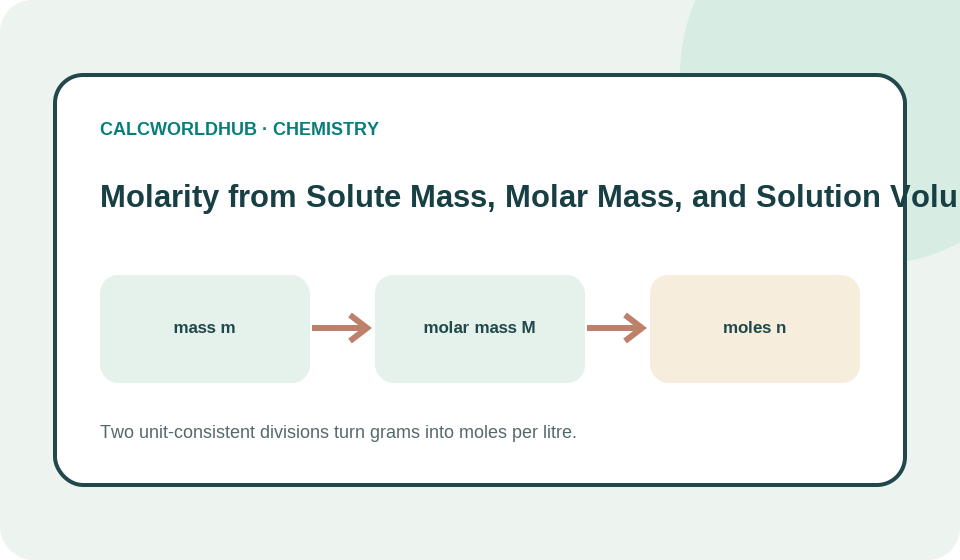

Identify mass, molar mass, and final volume
Enter solute mass in grams, molar mass in grams per mole, and final solution volume in litres. The molar mass depends on the substance’s specified chemical formula and, where relevant, its hydrate or ionic form. Use compatible values from a reliable chemical reference or label.
The volume must be the total prepared solution volume. It is not automatically the amount of water or solvent initially poured into a flask. Dissolving a solute can change the volume, so prepare the solution to the required final volume before using this calculation.
Convert mass to moles, then concentration
Moles of solute n = mass m ÷ molar mass M. Amount concentration c = n ÷ solution volume V, so c = m ÷ (M × V). With grams and grams per mole, the mass-to-molar-mass division yields moles; dividing by litres gives mol/L.
IUPAC defines amount concentration as amount of a constituent divided by the volume of the mixture. NIST’s SI guidance describes the mole and molar mass, which support the two calculation steps. The familiar term molarity is widely used, while amount concentration is the more explicit quantity name.
Check formula units and substance identity
Dimensional analysis is a useful check: g ÷ (g/mol) = mol, then mol ÷ L = mol/L. If molar mass is entered in kg/mol while mass is in grams, convert one of them before calculation. A unit mismatch can introduce a factor of one thousand without changing the calculator’s arithmetic.
Use the molar mass for the exact form weighed. An anhydrous salt and its hydrate have different molar masses per mole of formula units. The calculator does not identify the substance, verify purity, or determine how many ions or reactive particles form in solution.
Amount concentration is based on solution volume, whereas molality uses solvent mass as its denominator. These measures can differ, especially as temperature changes volume or when solutions are concentrated. Do not substitute grams of solvent for litres of final solution in this calculator; they are different quantities with different units.
Understand what the result represents
The output is a mass-derived concentration under the entered mass, molar mass, and final volume. It assumes the weighed mass corresponds to the stated solute and that the volume is measured at the relevant preparation condition. Temperature, evaporation, incomplete dissolution, contamination, and volumetric technique can affect an actual laboratory preparation.
This calculation does not report activity, osmolarity, ionic strength, pH, reaction yield, or concentration after a chemical reaction. Those quantities need additional data and models. Do not interpret a concentration value as a safety instruction or a substitute for a validated laboratory procedure.
Round only after the calculation
Keep the mass-to-moles result unrounded until after dividing by volume. Rounding the mole amount too early can shift the displayed concentration, particularly for a small mass or high molar mass. Match the number of reported digits to the precision of the balance, volumetric glassware, and molar-mass source.
Record the chemical formula, mass, molar mass, final volume, temperature if relevant, and units with the result. This makes a preparation reproducible and reveals whether the comparison uses the same solute form and measurement basis.
Worked examples
Preparing a 0.200 mol/L glucose solution
Inputs: Glucose mass = 18.0156 g; molar mass = 180.156 g/mol; final solution volume = 0.500 L.
Calculation: Moles = 18.0156 ÷ 180.156 = 0.100 mol. Concentration = 0.100 ÷ 0.500 = 0.200 mol/L.
The calculated amount concentration is 0.200 mol/L using the stated mass and final volume.
A smaller sodium chloride solution
Inputs: Sodium chloride mass = 5.844 g; molar mass = 58.44 g/mol; final solution volume = 0.250 L.
Calculation: Moles = 5.844 ÷ 58.44 = 0.100 mol. Concentration = 0.100 ÷ 0.250 = 0.400 mol/L.
The calculated amount concentration is 0.400 mol/L; it is based on final solution volume, not starting water volume.
