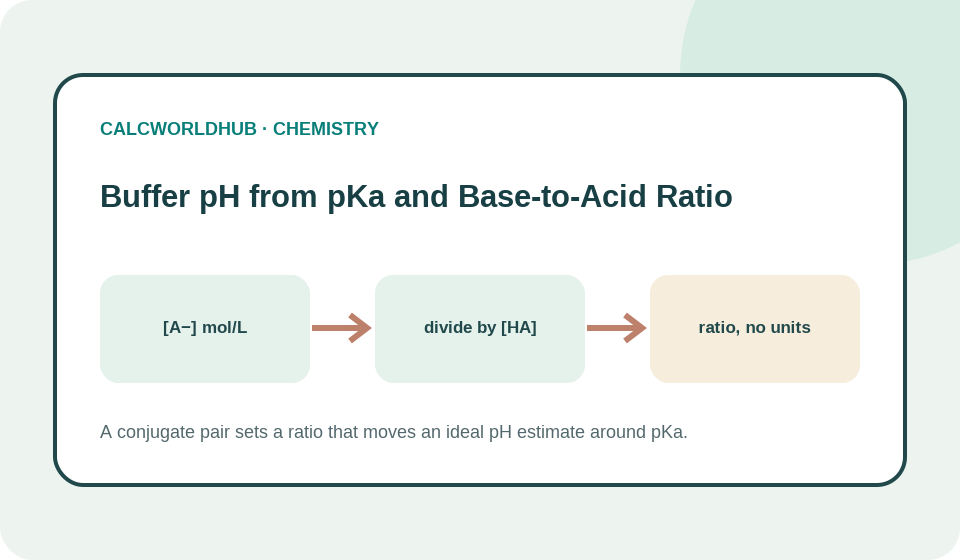

How pKa and the ratio set the estimate
The calculator uses pH = pKa + log10([A−]/[HA]). Here, HA is the weak acid and A− is its conjugate base. The logarithm is base ten, so equal concentrations make the ratio one and the logarithmic term zero; in that ideal case the estimated pH equals pKa. It is an estimate, not a measurement.
A ratio above one means more conjugate base than weak acid in the entered concentrations, which raises the estimate above pKa. A ratio below one lowers it. Because the logarithm responds to multiplicative changes, changing the ratio by a factor of ten changes the ideal estimate by one pH unit.
Enter matching concentration units
The pKa field is dimensionless, while both concentration fields are mol/L. The two concentrations must refer to the conjugate acid-base pair in the same solution and use the same concentration basis. Since they are divided, matching units cancel and the ratio has no units. A value in mmol/L must be converted consistently or paired with another value in mmol/L; mixing mmol/L and mol/L changes the ratio by a factor of one thousand.
The base entry is [A−], not a pH value, salt mass, or percent of the total mixture. The acid entry is [HA], not the total analytical concentration of every species. If you start from masses, dilution volumes, or a recipe, convert those inputs to concentrations for the relevant species first. The calculator does not perform stoichiometric neutralization, dilution, speciation, or volume corrections for you.
Use a pKa for the actual acid system
A pKa belongs to a particular acid dissociation and depends on the conditions under which it is reported. Select the value for the correct acid, solvent, and temperature, and make sure the entered base is the conjugate partner of that acid. A nearby pKa from a different compound or a different dissociation step can produce a neat-looking number that does not describe the intended buffer.
For polyprotic acids, each dissociation has its own pKa and conjugate pair. The simple two-component equation is not a full speciation model for every mixture. If several equilibria overlap, concentrations are very dilute, or ionic strength is high, activity effects can matter. A more complete equilibrium calculation or measurement is needed when those conditions control the decision.
What the displayed pH does and does not say
The result is displayed to four decimal places and has no unit suffix because pH is a logarithmic quantity. Extra displayed digits do not make the input data more accurate. If the pKa is known only to two decimal places or concentrations are approximate, report the estimate with precision that reflects those inputs rather than treating the final digit as a measurement.
A calculated pH does not show buffer capacity. Two mixtures can have the same base-to-acid ratio and therefore the same ideal estimate while containing very different total amounts of buffer species. Their resistance to an added dose can differ greatly. The tool also does not include temperature-dependent pKa selection, activity coefficients, contaminants, electrode calibration, or the volume change caused by additions.
Use the estimate within its chemical limits
For the equation to represent a physical buffer, concentrations must be chemically meaningful: the conjugate-base concentration should be positive and the weak-acid concentration must be positive. A zero denominator is undefined, and negative concentrations have no physical interpretation even if a pair of negative numbers happens to produce a positive quotient. Check the chemistry as well as the displayed arithmetic before using a result.
The current calculation is a compact equation, not a laboratory protocol or safety assessment. It cannot tell you whether a chosen acid or salt is compatible with a process, whether the mixture is safe to handle, or whether the final measured pH will match the estimate. Prepare solutions using a suitable procedure, observe relevant safety documentation, and measure pH with an instrument when the application requires a verified value.
Worked examples
The examples keep both concentrations in mol/L and use the calculator’s four-decimal display precision.
Equal pKa with a two-to-one base ratio
Inputs: pKa = 4.76; conjugate base [A−] = 0.200 mol/L; weak acid [HA] = 0.100 mol/L.
Calculation: pH = 4.76 + log10(0.200 ÷ 0.100) = 4.76 + log10(2) = 5.0610; displayed estimate = 5.061.
The calculator estimates pH 5.061, about 0.301 pH unit above the entered pKa.
A lower conjugate-base share
Inputs: pKa = 6.35; [A−] = 0.025 mol/L; [HA] = 0.100 mol/L.
Calculation: pH = 6.35 + log10(0.025 ÷ 0.100) = 6.35 + log10(0.25) = 5.7479.
The displayed estimate is pH 5.7479, below pKa because the conjugate-base concentration is one quarter of the weak-acid concentration.
