Buffer pH calculator (Henderson–Hasselbalch)
Use pKa and a same-unit conjugate-base/acid ratio.
Calculator


How to use this calculator
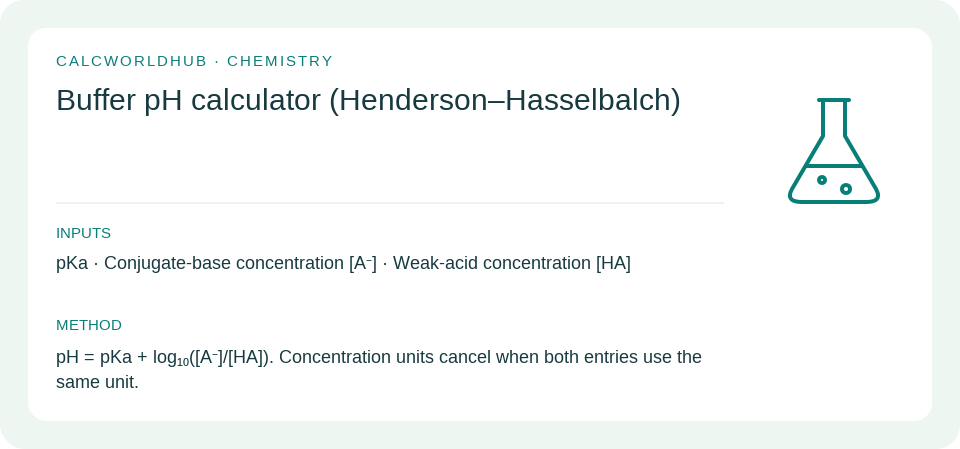
Estimate buffer pH from pKa and the conjugate-base to weak-acid concentration ratio.
- Enter pKa, Conjugate-base concentration [A⁻], Weak-acid concentration [HA]. Match the units shown beside each field and review the result together with the assumptions below.
- Read the worked example below to check the expected input format and result.
- Compare another scenario by changing one input at a time. Use Reset to return to the starting values.
Estimate buffer pH from pKa and conjugate ratio
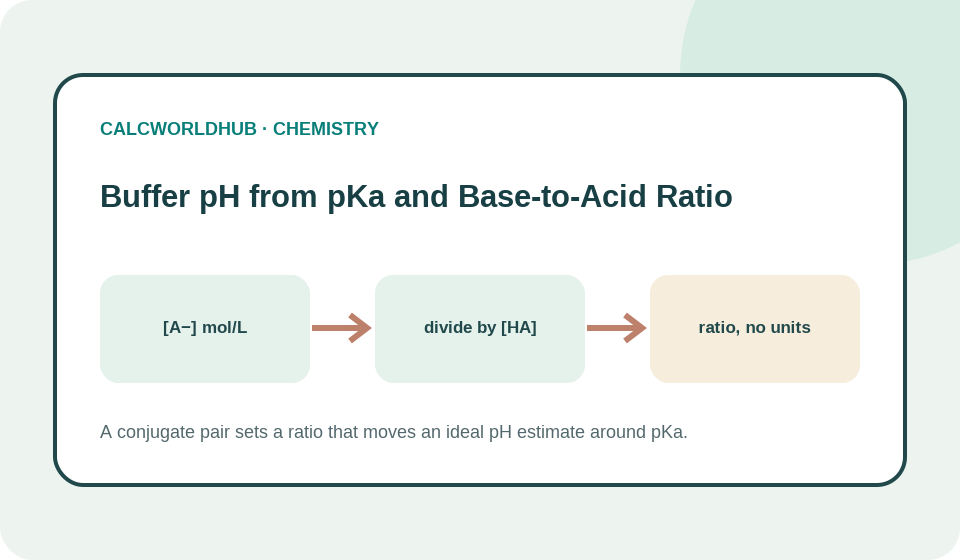
The Henderson–Hasselbalch equation relates a buffer’s pH to pKa and the ratio of conjugate base to acid.
Inputs and units
- pKa: Use the acid’s pKa at the relevant temperature and conditions.
- Conjugate-base concentration [A⁻]: Enter a positive concentration.
- Weak-acid concentration [HA]: Enter a positive concentration in the same unit as [A⁻].
Formula and method
pH = pKa + log₁₀([A⁻]/[HA]). Concentration units cancel when both entries use the same unit.
Worked example
For pKa = 4.76, [A⁻] = 0.20 M, and [HA] = 0.10 M, pH = 4.76 + log₁₀(2) ≈ 5.061.
Interpreting the result
Equal base and acid concentrations give pH = pKa. A base-to-acid ratio above one shifts the estimate upward by the logarithm of that ratio.
Assumptions and limits
The equation is an approximation for a buffer pair under specified conditions. Temperature, ionic strength, activity, additional equilibria, and exhausted buffer capacity can change the measured pH.
Method references
Frequently asked questions
Why must the two concentrations use the same unit?
The equation uses their ratio; using different units would multiply that ratio by a unit-conversion factor.
Does the result say how much acid the buffer can absorb?
No. Buffer capacity depends on total concentrations and added acid or base, which this ratio alone does not describe.
How do I use the Buffer pH calculator (Henderson–Hasselbalch)?
Enter pKa, Conjugate-base concentration [A⁻], Weak-acid concentration [HA]. Match the units shown beside each field and review the result together with the assumptions below.
What is a worked example of Buffer pH calculator (Henderson–Hasselbalch)?
For pKa = 4.76, [A⁻] = 0.20 M, and [HA] = 0.10 M, pH = 4.76 + log₁₀(2) ≈ 5.061.
What does the Buffer pH calculator (Henderson–Hasselbalch) calculate?
Estimate buffer pH from pKa and the conjugate-base to weak-acid concentration ratio.
Good calculators show their work.
CalcWorldHub is built around clear inputs and visible assumptions. Results are estimates for planning; check official sources or your provider’s terms when exact figures matter.