pOH calculator
Convert hydroxide-ion concentration into pOH using a base-10 logarithm.
Calculator
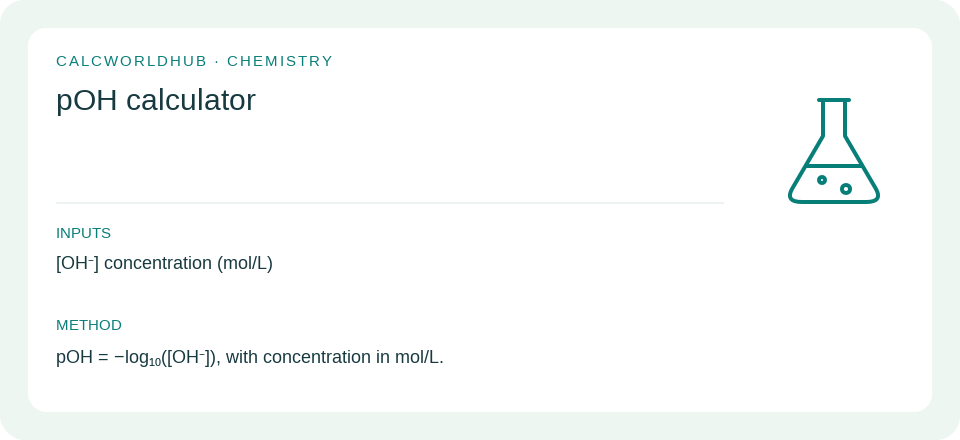
How to use this calculator
Convert hydroxide-ion concentration into pOH using a base-10 logarithm.
- Enter [OH⁻] concentration (mol/L). Match the units shown beside each field and review the result together with the assumptions below.
- Read the worked example below to check the expected input format and result.
- Compare another scenario by changing one input at a time. Use Reset to return to the starting values.
pOH calculator
Convert hydroxide-ion concentration into pOH using a base-10 logarithm.
What it measures
pOH expresses hydroxide concentration on a logarithmic scale; a tenfold concentration change shifts pOH by one unit.
Inputs and units
- [OH⁻] concentration (mol/L): Hydroxide concentration in mol/L; it must be greater than zero.
Formula and method
pOH = −log₁₀([OH⁻]), with concentration in mol/L.
Worked example
[OH⁻]=0.0001 mol/L gives pOH=−log₁₀(10⁻⁴)=4.
Interpreting the result
Lower pOH corresponds to higher hydroxide concentration.
Assumptions and limits
Concentration must be positive. Converting pOH to pH also depends on temperature through the ion product of water; this calculator does not infer pH.
Sources and method
- Relates hydroxide concentration to pOH on a logarithmic scale. OpenStax Chemistry: pH and pOH
Frequently asked questions
Can concentration be zero?
No. The logarithm of zero is undefined.
Is pH always 14 minus pOH?
That relation is temperature-dependent through pKw and is not assumed here.
How do I use the pOH calculator?
Enter [OH⁻] concentration (mol/L). Match the units shown beside each field and review the result together with the assumptions below.
What is a worked example of pOH?
[OH⁻]=0.0001 mol/L gives pOH=−log₁₀(10⁻⁴)=4.
What does the pOH calculator calculate?
Convert hydroxide-ion concentration into pOH using a base-10 logarithm.
See the calculation methodology.
Good calculators show their work.
CalcWorldHub is built around clear inputs and visible assumptions. Results are estimates for planning; check official sources or your provider’s terms when exact figures matter.