
Molality is based on solvent mass
Molality is moles of dissolved solute per kilogram of solvent, not per kilogram of the final solution. This distinction matters when a mixture contains substantial solute mass. The ebullioscopic constant Kb belongs to the solvent and carries temperature times kilograms per mole as its unit, such as °C·kg/mol.
The van’t Hoff factor i is dimensionless and represents the effective number of dissolved particles per formula unit in the idealized treatment. A non-electrolyte is often approximated with i near one; an electrolyte can produce a larger value when it dissociates. Real solutions may depart from the ideal count because ions interact and dissociation is not perfectly represented by a single integer.
Use the boiling-elevation equation
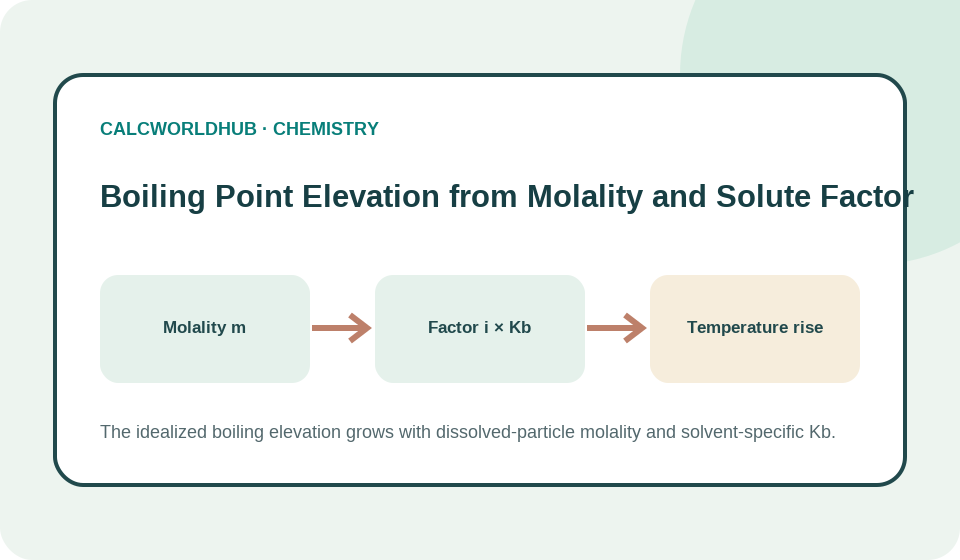
The relation is ΔTb = i × Kb × m. Multiplying dimensionless i by °C·kg/mol and mol/kg leaves degrees Celsius as the temperature elevation. The result is the increase above the pure-solvent value, not an absolute boiling temperature.
The tool asks for i, molality, and Kb. It reports the numerical elevation only, without appending a temperature unit in the result label, so interpret the number in the same temperature scale used for Kb. The calculation does not add the solvent’s baseline boiling point. At ordinary pressure the elevation may be added to a reference value for an estimate, but pressure and composition must be defined for that comparison.
Worked examples
Both examples show ΔTb. A final solution boiling temperature would also require the pure solvent’s reference boiling point under the same pressure.
A dilute aqueous solution with factor two
Inputs: Van’t Hoff factor i = 2.0; molality = 0.50 mol/kg; Kb = 0.512 °C·kg/mol.
Calculation: ΔTb = 2.0 × 0.512 × 0.50 = 0.512 °C.
The idealized boiling-temperature increase is 0.512 °C; the final boiling temperature is not calculated.
A different solvent constant and effective factor
Inputs: Van’t Hoff factor i = 1.8; molality = 0.20 mol/kg; Kb = 1.86 °C·kg/mol.
Calculation: ΔTb = 1.8 × 1.86 × 0.20 = 0.6696 °C.
Under the entered effective-factor model, the predicted elevation is 0.6696 °C above the pure-solvent reference.

Understand the assumptions behind the estimate
The elementary equation is a dilute-solution model for a nonvolatile solute. It treats the solvent property as fixed and uses an effective particle factor. At higher concentrations, activity effects, ion pairing, multiple solutes, or concentration-dependent properties can make the simple product less accurate. Use experimental data or a more complete thermodynamic model when precision matters.
For a real electrolyte, the effective i can differ from the number of ions suggested by the formula because particles do not behave independently at every concentration. The simple calculator does not infer dissociation, ion association, solvent identity, concentration range, or pressure. Enter an appropriate effective factor and Kb from a source that matches the chemical system, and state whether they are ideal or measured values.
Keep concentration units aligned
Use molality in mol/kg solvent and Kb in a compatible temperature unit per molality unit. If Kb is supplied in K·kg/mol, the numeric temperature interval is the same size as one degree Celsius, but absolute temperatures in kelvin and Celsius are not interchangeable. Do not insert molarity in mol/L without converting using solution density and composition; the equation calls for mass-based molality.
The fields permit decimal values, but physically meaningful use calls for nonnegative solute amount, positive solvent constant, and a factor appropriate to the substance. A zero molality produces zero elevation in the current arithmetic. Negative entries can produce a signed result mathematically but do not describe the ordinary boiling-elevation case. Check that each input belongs to the same prepared solution.
Interpret the rise, not an entire boiling curve
A temperature increase is one result at one composition under the chosen assumptions. It does not describe how the boiling temperature changes as solvent evaporates and the solution becomes more concentrated. It also does not predict heat required, evaporation rate, or safety. A solution’s composition can change during heating, so an initial molality may cease to describe the liquid.
Use the result to understand or compare a basic colligative calculation. For laboratory or process design, confirm the solvent constant, concentration basis, pressure, and relevant nonideal behavior from an appropriate chemistry reference or measurement. The calculator is a quick multiplication after those choices have been made, not a substitute for identifying the actual solution.