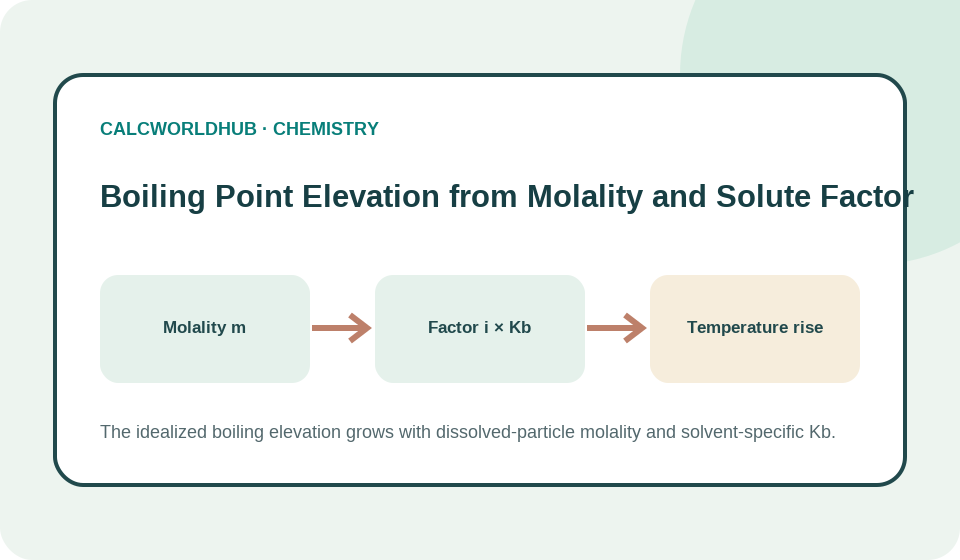
Boiling point elevation calculator
Estimate the increase in a solvent’s boiling point from dissolved solute molality. Enter your values below to see the result and method.
inputs.
Related calculators
How to use this calculator
Estimate the increase in a solvent’s boiling point from dissolved solute molality.
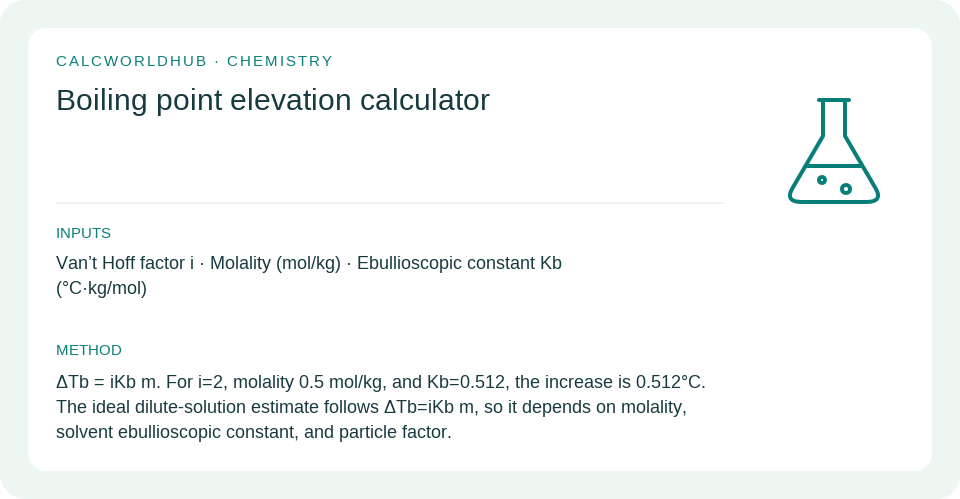
- Enter Van’t Hoff factor i, Molality (mol/kg), Ebullioscopic constant Kb (°C·kg/mol). Match the units shown beside each field and review the result together with the assumptions below.
- Read the worked example below to check the expected input format and result.
- Compare another scenario by changing one input at a time. Use Reset to return to the starting values.
Set the chemical conditions and units
Estimate the increase in a solvent’s boiling point from dissolved solute molality.
Inputs and units
- Van’t Hoff factor i:Effective number of solute particles per formula unit for the solution model.
- Molality (mol/kg):Moles of solute per kilogram of solvent.
- Ebullioscopic constant Kb (°C·kg/mol):Boiling-point elevation constant for the solvent, in °C·kg/mol.
Equation and worked example
ΔTb = iKb m.
For i=2, molality 0.5 mol/kg, and Kb=0.512, the increase is 0.512°C.
The ideal dilute-solution estimate follows ΔTb=iKb m, so it depends on molality, solvent ebullioscopic constant, and particle factor.
Using the result
This is a dilute-solution estimate using the entered van’t Hoff factor and solvent constant; nonideal behavior or ion pairing can change the measured elevation.
Assumptions and limitations
Returns the temperature increase, not the final boiling temperature; assumes dilute-solution behavior.
Source and method
The reference derives boiling-point elevation from solute molality, the solvent constant, and particle factor. OpenStax Chemistry 2e — Colligative Properties.
Frequently asked questions
What inputs determine boiling-point elevation?
The rise is ΔT_b=iK_bm: van't Hoff factor times solvent-specific ebullioscopic constant times solute molality.
Does this estimate include non-ideal behavior?
Only to the extent stated here. Returns the temperature increase, not the final boiling temperature; assumes dilute-solution behavior.
When is a molality calculation more useful?
Use molality when you know solute amount and solvent mass and need m. This page uses molality and the solvent's K_b to estimate the temperature rise.
How do I use the Boiling point elevation calculator?
Enter Van’t Hoff factor i, Molality (mol/kg), Ebullioscopic constant Kb (°C·kg/mol). Match the units shown beside each field and review the result together with the assumptions below.
What is a worked example of Boiling point elevation?
ΔTb = iKb m. For i=2, molality 0.5 mol/kg, and Kb=0.512, the increase is 0.512°C. The ideal dilute-solution estimate follows ΔTb=iKb m, so it depends on molality, solvent ebullioscopic constant, and particle factor.
Read the calculation methodology and privacy policy.