Freezing point depression calculator
Calculate how much a dissolved solute lowers a solvent’s freezing point. Enter your values below to see the result and method.
inputs.
Related calculators
Molality and boiling-point elevation use related solution properties; osmotic pressure is another colligative effect.
How to use this calculator
Free Freezing point depression calculator. Calculate how much a dissolved solute lowers a solvent’s freezing point. Formula, example, and assumptions explained.
- Enter Van’t Hoff factor i, Molality (mol/kg), Cryoscopic constant Kf (°C·kg/mol). Match the units shown beside each field and review the result together with the assumptions below.
- Read the worked example below to check the expected input format and result.
- Compare another scenario by changing one input at a time. Use Reset to return to the starting values.
Set the chemical conditions and units
Calculate how much a dissolved solute lowers a solvent’s freezing point.
Inputs and units
Enter effective van’t Hoff factor i, molality in mol/kg, and solvent cryoscopic constant Kf in °C·kg/mol.
- Van’t Hoff factor i: Effective number of dissolved particles per solute formula unit under the ideal dilute approximation.
- Molality (mol/kg): Moles of solute per kilogram of solvent, not per kilogram of solution.
- Cryoscopic constant Kf (°C·kg/mol): Solvent-specific freezing-point constant in °C·kg/mol.
Equation and worked example
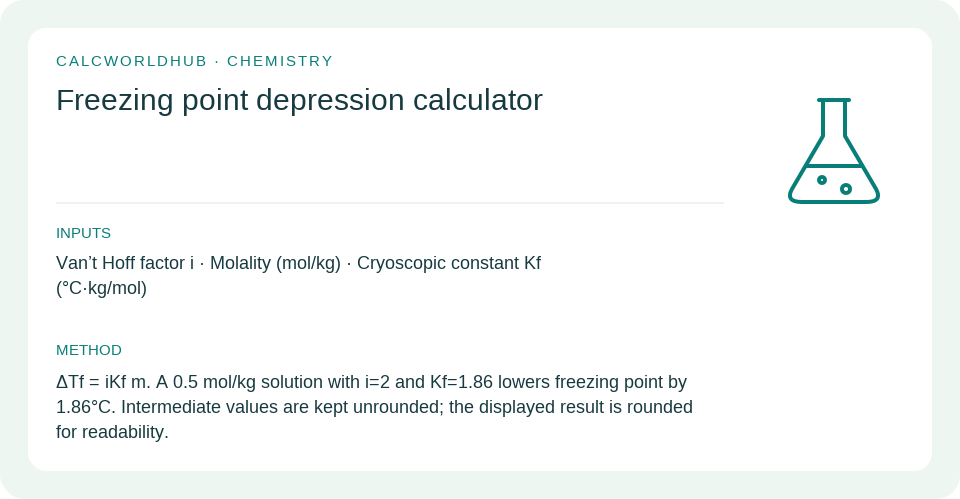
ΔTf = iKf m.
A 0.5 mol/kg solution with i=2 and Kf=1.86 lowers freezing point by 1.86°C.
Intermediate values are kept unrounded; the displayed result is rounded for readability.
Using the result
The result is the magnitude of the temperature decrease. Subtract it from the pure solvent’s freezing point to estimate the solution value.
Assumptions and limitations
Returns the magnitude of the decrease; assumes a dilute solution and a suitable constant Kf for the solvent.
Frequently asked questions
How is freezing-point depression calculated?
For a dilute solution, ΔTf=iKf m, where i is the effective van’t Hoff factor, Kf is the solvent constant, and m is molality.
What does the van’t Hoff factor represent?
It accounts for the effective number of dissolved particles per formula unit; real solutions may depart from the ideal value because of incomplete dissociation and interactions.
Is the answer a new freezing temperature?
The output is the magnitude of the decrease. Subtract it from the pure solvent’s freezing point to estimate the solution’s freezing temperature.
How do I use the Freezing point depression calculator?
Enter Van’t Hoff factor i, Molality (mol/kg), Cryoscopic constant Kf (°C·kg/mol). Match the units shown beside each field and review the result together with the assumptions below.
What is a worked example of Freezing point depression?
ΔTf = iKf m. A 0.5 mol/kg solution with i=2 and Kf=1.86 lowers freezing point by 1.86°C. Intermediate values are kept unrounded; the displayed result is rounded for readability.
Read the calculation methodology and privacy policy.