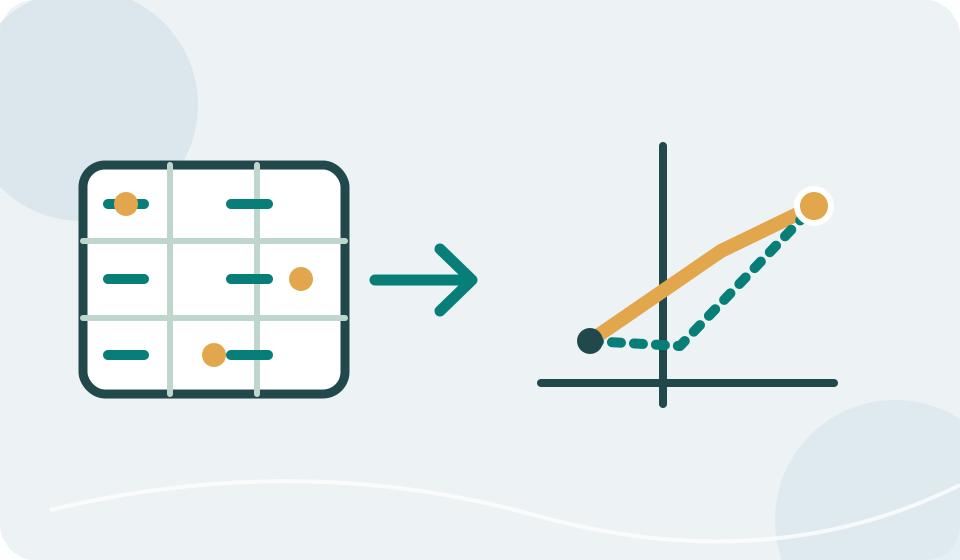

Use the row-by-column rule
For A=[[a,b,c],[d,e,f],[g,h,i]] and x=[x₁,x₂,x₃]ᵀ, the product is Ax=[ax₁+bx₂+cx₃, dx₁+ex₂+fx₃, gx₁+hx₂+ix₃]ᵀ. Each output component comes from one row of A paired with the complete input vector. A 3×3 matrix and a three-entry vector produce a three-entry vector.
The inputs follow a clear order: nine matrix entries row by row, then vector x₁, x₂, and x₃. The calculator’s labels use A₁₁ through A₃₃ and Vector x₁ through x₃. It applies A to x exactly as entered; it does not transpose the matrix or infer whether the application expects row vectors.
Work the first transformation
With A=[[1,2,0],[0,1,−1],[2,0,1]] and x=(3,1,2), the first component is 1×3+2×1+0×2=5. The second is 0×3+1×1+(−1)×2=−1. The third is 2×3+0×1+1×2=8, so Ax=(5,−1,8).
A useful check is to calculate each row separately and keep the three subtotals in order. The negative second component comes from the minus sign in A₂₃, not from a negative input vector. The tool displays components to five decimal places, so small decimal inputs may produce output whose visible precision is lower than the internal calculation.
Worked examples
Example 1 · mixed rows
Inputs: A=[[1,2,0],[0,1,−1],[2,0,1]], x=(3,1,2).
Calculation: Ax=(1×3+2×1+0×2, 0×3+1×1−1×2, 2×3+0×1+1×2).
Ax=(5.00000, −1.00000, 8.00000).
Example 2 · diagonal scaling
Inputs: A=diag(2,0.5,−1), x=(4,6,3).
Calculation: Ax=(2×4, 0.5×6, −1×3).
Ax=(8.00000, 3.00000, −3.00000).

Interpret a second example and the matrix
For A=diag(2,0.5,−1) and x=(4,6,3), the output is (8,3,−3). The x₁ component doubles, x₂ is halved, and x₃ changes sign. This diagonal example makes each coordinate action visible, but a matrix with off-diagonal entries can mix coordinates as well as scale them.
When the entries represent a rotation, scale, projection, or another linear map, the output is the transformed vector in the same chosen coordinate convention. A general matrix need not preserve length or angles. To test length preservation for one vector, compare its input and output Euclidean lengths; one test vector cannot prove that every vector is preserved.
Keep coordinates and units consistent
If x stores a position in meters and A is dimensionless, Ax is also in meters. If matrix entries carry units, each product term within one output row must have compatible units before the terms are added. The calculator does not include unit selectors or unit conversion, so it cannot detect a row that mixes incompatible quantities.
Coordinate convention also matters. A matrix intended for column vectors may be transposed in a source that uses row vectors. Before comparing results across software or notes, confirm whether the transformation is written x′=Ax or x′=xA, how coordinates are ordered, and whether vectors are local or world coordinates. The calculator follows x′=Ax.
What this multiplication does not solve
The operation is a forward transform: give A and x, receive Ax. It does not solve Ax=b for an unknown x, invert A, determine whether the mapping is reversible, or decompose the transformation into rotation and scale. Those questions require additional calculations and may need determinant or factorization checks.
If you expect to recover x from Ax, first determine whether A is invertible and whether numerical conditioning is acceptable. A singular matrix can map different input vectors to the same output. Even an invertible matrix can amplify measurement or rounding error if it is poorly conditioned; the six output values alone do not diagnose that sensitivity.
Check each output component
A practical verification table has one row per output: write the corresponding three coefficients, multiply each by x₁, x₂, x₃, and add. Check row 1 produces y₁, row 2 produces y₂, and row 3 produces y₃. This catches the common errors of pairing a column with the vector, skipping a zero term, or copying a matrix entry into the wrong row.
For a quick identity check, use the identity matrix: Ix=x. For a diagonal matrix, each output should be the matching diagonal factor times its coordinate. If a result looks surprising, compare unrounded subtotals before blaming the calculator. Inputs must be finite numbers; values that create non-finite intermediate outputs are rejected by the runtime.