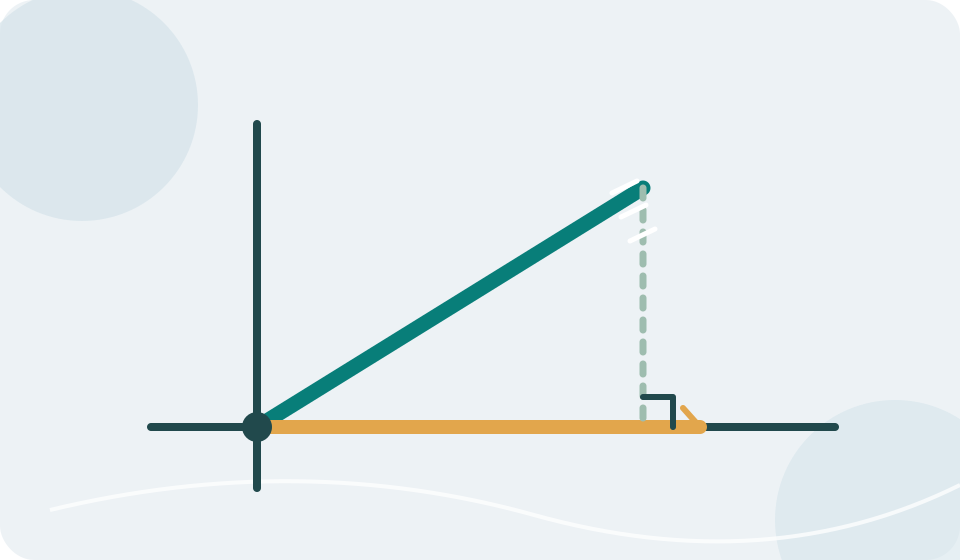

Multiply matching components
For u=(uₓ,uᵧ) and v=(vₓ,vᵧ), u·v=uₓvₓ+uᵧvᵧ. The calculator asks for the x and y components of u followed by the x and y components of v. It calculates the scalar sum and displays the result rounded to four decimal places.
The component formula is often the safest route when the vectors are already written in coordinates. Keep x paired with x and y paired with y. Multiplying crosswise, such as uₓvᵧ+uᵧvₓ, is a different expression and does not produce the standard dot product.
Worked examples
Example 1 · positive alignment
Inputs: u=(3,4), v=(5,7).
Calculation: u·v=3×5+4×7=15+28=43.
The positive scalar is consistent with an acute angle between these nonzero vectors.
Example 2 · perpendicular components
Inputs: u=(2,−1), v=(1,2).
Calculation: u·v=2×1+(−1)×2=2−2=0.
Both vectors are nonzero, so the zero dot product indicates perpendicular directions.

Connect the scalar to the angle
When both vectors are nonzero, u·v=|u||v|cosθ, where θ is the angle between them. A positive dot product corresponds to an acute angle, zero to perpendicular vectors, and a negative value to an obtuse angle. The angle itself is not an output of this calculator; the result supplies one ingredient for an angle calculation.
The dot product also equals the length of one vector multiplied by the signed scalar projection of the other onto it. If v is fixed, u·v measures the part of u along v, scaled by |v|. It does not report the full projection vector unless you divide by the appropriate squared magnitude and multiply by the direction vector.
Work an aligned and a perpendicular example
For u=(3,4) and v=(5,7), the component products are 15 and 28, so the result is 43. Both components generally point in the same directions, giving a positive scalar. For u=(2,−1) and v=(1,2), the products are 2 and −2, so the sum is zero; the vectors are perpendicular because neither is the zero vector.
A zero result needs context. If u=(0,0), then its dot product with every vector is zero, but the zero vector has no defined direction or angle. Therefore, only infer perpendicularity from a zero dot product after confirming both vectors have nonzero length.
Keep coordinate systems and units consistent
The four inputs should describe components in one shared coordinate basis. If a vector is recorded in a rotated or differently scaled frame, convert it before comparing components. In physical applications, choose x and y directions explicitly; changing an axis sign can change the component values and therefore the result.
The tool has no unit selectors. If both vectors are positions, their dot product has squared-length units; if one is force and one is displacement, the product has energy units and can represent work under the appropriate assumptions. Do not attach a unit to the scalar until the meaning and units of both vectors are known.
Check the arithmetic and the sign
Recompute the two component products separately, then add them. For a quick sign check, compare the result with the angle or projection you expect: similar directions tend to produce a positive value, opposite directions a negative one, and an exact right angle produces zero. A magnitude check can use |u·v|≤|u||v| for nonzero vectors.
The bound is a useful error detector, not an extra output. For the first example, |u|=5 and |v|=√74, so the product magnitude 43 is below 5√74. If your manual value violates that bound, revisit the component pairing or arithmetic.
Distinguish the dot product from nearby operations
The dot product returns one number. Vector addition returns a vector, and a two-dimensional cross product is represented by a signed scalar determinant with different component pairing. The two scalar operations answer different questions: dot product describes alignment; the 2D cross component describes oriented area and order.
This calculator does not infer vector lengths, an angle in degrees, or a projection vector. It accepts finite numeric components, including negative and zero values. When a vector is zero, the arithmetic remains valid, but geometric interpretations that require a direction should be omitted.