2D vector dot product calculator
Multiply matching vector components and add their products.
inputs.
Calculator
How to use this calculator
Calculate a two-dimensional dot product from the x and y components of two vectors.
- Enter Vector u x, Vector u y, Vector v x, Vector v y. Match the units shown beside each field and review the result together with the assumptions below.
- Read the worked example below to check the expected input format and result.
- Compare another scenario by changing one input at a time. Use Reset to return to the starting values.
Combine matching components with a two-dimensional dot product
The dot product multiplies corresponding components of two 2D vectors and adds the products. It is a scalar that relates vector alignment to their magnitudes.
Inputs and units
- Vector u x: Horizontal component of the first vector.
- Vector u y: Vertical component of the first vector.
- Vector v x: Horizontal component of the second vector.
- Vector v y: Vertical component of the second vector.
Formula and method
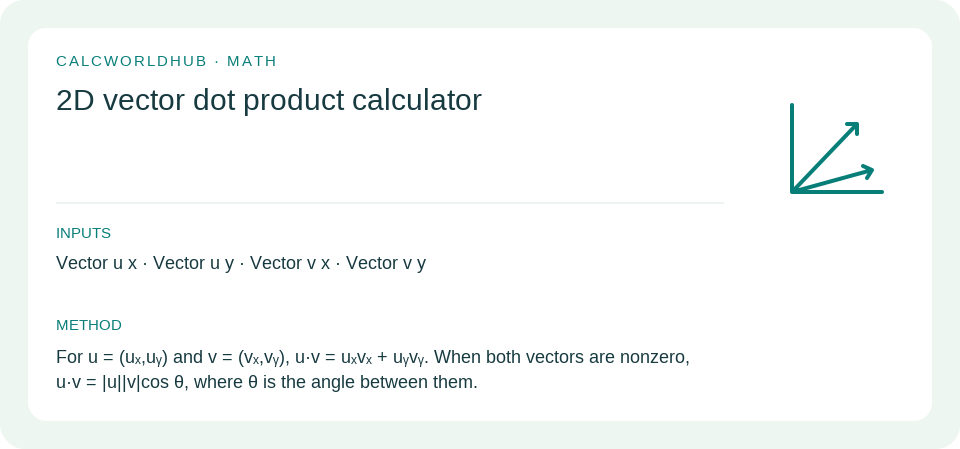
For u = (uₓ,uᵧ) and v = (vₓ,vᵧ), u·v = uₓvₓ + uᵧvᵧ. When both vectors are nonzero, u·v = |u||v|cos θ, where θ is the angle between them.
Worked example
For u = (3,4) and v = (5,7), u·v = 3×5 + 4×7 = 15 + 28 = 43.
Interpreting the result
The positive result indicates the two vectors have a positive projection relationship. A zero dot product means perpendicular vectors when both have nonzero magnitude; a negative value indicates an obtuse angle.
Assumptions and limits
Component order and units must match. If vector entries represent physical quantities, the dot product carries the product of their units; the sign depends on the chosen coordinate directions.
Method references
Frequently asked questions
Does the dot product return a vector?
No. It returns one scalar. The 2D cross product uses a different operation and produces an oriented scalar in two dimensions.
How do I use the 2D vector dot product calculator?
Enter Vector u x, Vector u y, Vector v x, Vector v y. Match the units shown beside each field and review the result together with the assumptions below.
What is a worked example of 2D vector dot product?
For u = (3,4) and v = (5,7), u·v = 3×5 + 4×7 = 15 + 28 = 43.
What does the 2D vector dot product calculator calculate?
Calculate a two-dimensional dot product from the x and y components of two vectors.
What assumptions apply to 2D vector dot product?
Component order and units must match. If vector entries represent physical quantities, the dot product carries the product of their units; the sign depends on the chosen coordinate directions.
Good calculators show their work.
CalcWorldHub is built around clear inputs and visible assumptions. Results are estimates for planning; check official sources or your provider’s terms when exact figures matter.