Angle between 3D vectors calculator
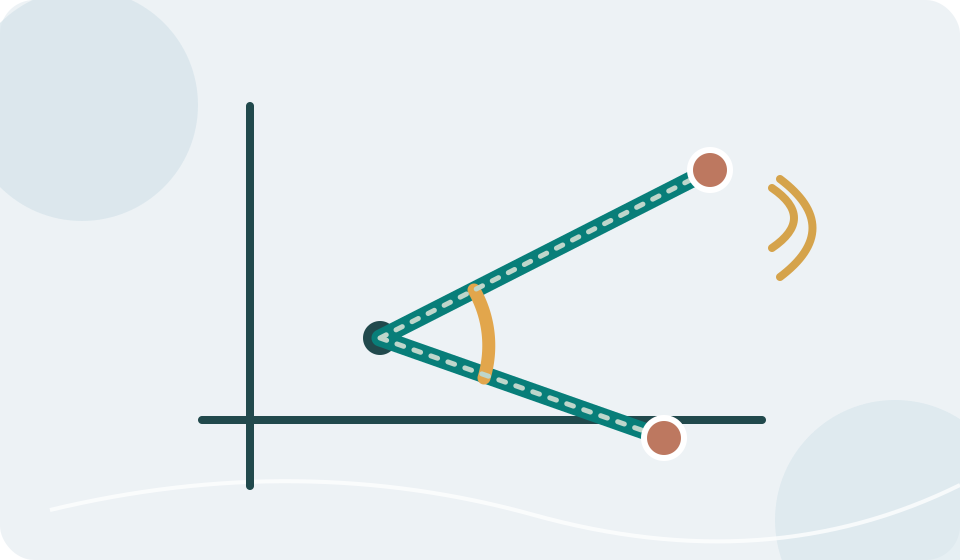
Find the smaller included angle between two nonzero 3D vectors.
How to use this calculator
Find the smaller included angle between two nonzero 3D vectors.
- Enter uₓ, uᵧ, u_z, vₓ, then complete the remaining labeled fields. Match the units shown beside each field and review the result together with the assumptions below.
- Read the worked example below to check the expected input format and result.
- Compare another scenario by changing one input at a time. Use Reset to return to the starting values.
How the Angle between 3D vectors calculator works
Find the smaller included angle between two nonzero 3D vectors.
Inputs and units
- uₓ: uₓ is a signed coordinate component; use the same coordinate units throughout the vectors.
- uᵧ: uᵧ is a signed coordinate component; use the same coordinate units throughout the vectors.
- u_z: u_z is a signed coordinate component; use the same coordinate units throughout the vectors.
- vₓ: vₓ is a signed coordinate component; use the same coordinate units throughout the vectors.
- vᵧ: vᵧ is a signed coordinate component; use the same coordinate units throughout the vectors.
- v_z: v_z is a signed coordinate component; use the same coordinate units throughout the vectors.
Formula and method
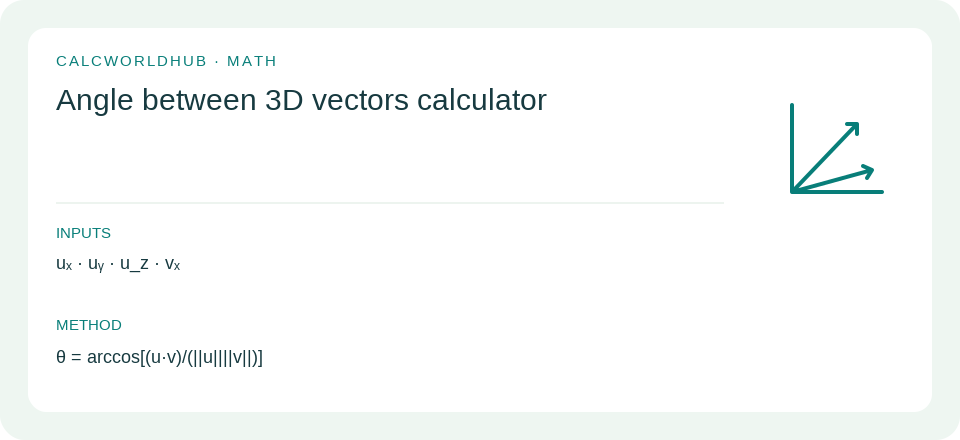
θ = arccos[(u·v)/(||u||||v||)]
Worked example
u=(1,0,0) and v=(0,1,0) have dot product 0, so θ=90°.
Interpreting the result
The result ranges from 0° to 180°. It describes direction, not the angle of a specific 3D rotation axis.
Assumptions and limits
Both vectors must be nonzero and share a coordinate frame. Small floating-point roundoff is clamped to the valid cosine range.
Frequently asked questions
What is the angle between opposite directions?
It is 180°.
Does multiplying one vector by a positive number change the angle?
No. Positive scaling changes length but not direction.
How do I use the Angle between 3D vectors calculator?
Enter uₓ, uᵧ, u_z, vₓ, then complete the remaining labeled fields. Match the units shown beside each field and review the result together with the assumptions below.
What is a worked example of Angle between 3D vectors?
u=(1,0,0) and v=(0,1,0) have dot product 0, so θ=90°.
What does the Angle between 3D vectors calculator calculate?
Find the smaller included angle between two nonzero 3D vectors.
See the calculation methodology.