3D cross product magnitude calculator
Measure the area scale of two 3D vectors without retaining the cross product’s direction.
How to use this calculator
Measure the area scale of two 3D vectors without retaining the cross product’s direction.
- Enter uₓ, uᵧ, u_z, vₓ, then complete the remaining labeled fields. Match the units shown beside each field and review the result together with the assumptions below.
- Read the worked example below to check the expected input format and result.
- Compare another scenario by changing one input at a time. Use Reset to return to the starting values.
How the 3D cross product magnitude calculator works
Measure the area scale of two 3D vectors without retaining the cross product’s direction.
Inputs and units
- uₓ: uₓ is a signed coordinate component; use the same coordinate units throughout the vectors.
- uᵧ: uᵧ is a signed coordinate component; use the same coordinate units throughout the vectors.
- u_z: u_z is a signed coordinate component; use the same coordinate units throughout the vectors.
- vₓ: vₓ is a signed coordinate component; use the same coordinate units throughout the vectors.
- vᵧ: vᵧ is a signed coordinate component; use the same coordinate units throughout the vectors.
- v_z: v_z is a signed coordinate component; use the same coordinate units throughout the vectors.
Formula and method
|u×v| = √[(uᵧv_z−u_zvᵧ)²+(u_zvₓ−uₓv_z)²+(uₓvᵧ−uᵧvₓ)²]
Worked example
For u = (1,0,0) and v = (0,3,0), u×v = (0,0,3), so its magnitude is 3.
Interpreting the result
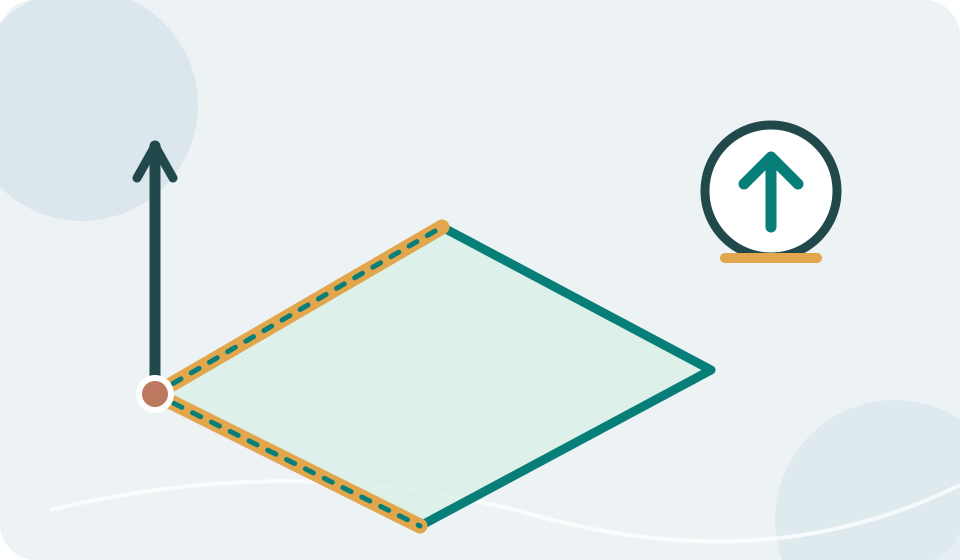
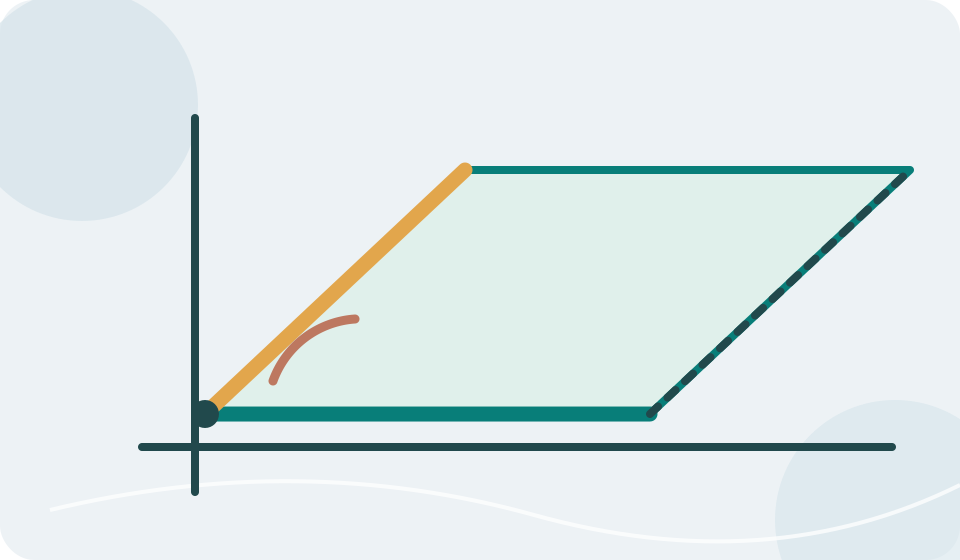
The magnitude is the area of the parallelogram spanned by the vectors. It is zero when the vectors are parallel or either vector is zero.
Assumptions and limits
All coordinates must use the same coordinate system and units. The magnitude is nonnegative and has squared coordinate units.
Frequently asked questions
When is the magnitude zero?
For parallel or antiparallel vectors, or if either vector is zero.
Does the magnitude include the right-hand-rule direction?
No. It is only an area magnitude; use the vector cross-product calculator for orientation.
How do I use the 3D cross product magnitude calculator?
Enter uₓ, uᵧ, u_z, vₓ, then complete the remaining labeled fields. Match the units shown beside each field and review the result together with the assumptions below.
What is a worked example of 3D cross product magnitude?
For u = (1,0,0) and v = (0,3,0), u×v = (0,0,3), so its magnitude is 3.
What does the 3D cross product magnitude calculator calculate?
Measure the area scale of two 3D vectors without retaining the cross product’s direction.
See the calculation methodology.